Table of Contents
Context: Amid geopolitical vulnerabilities in West Asia, the Indian government is set to notify draft regulations for Ethanol 85 (E85), a high-blend alternative fuel expected to roll out within the next two years.
About Ethanol 85 (E85) Fuel
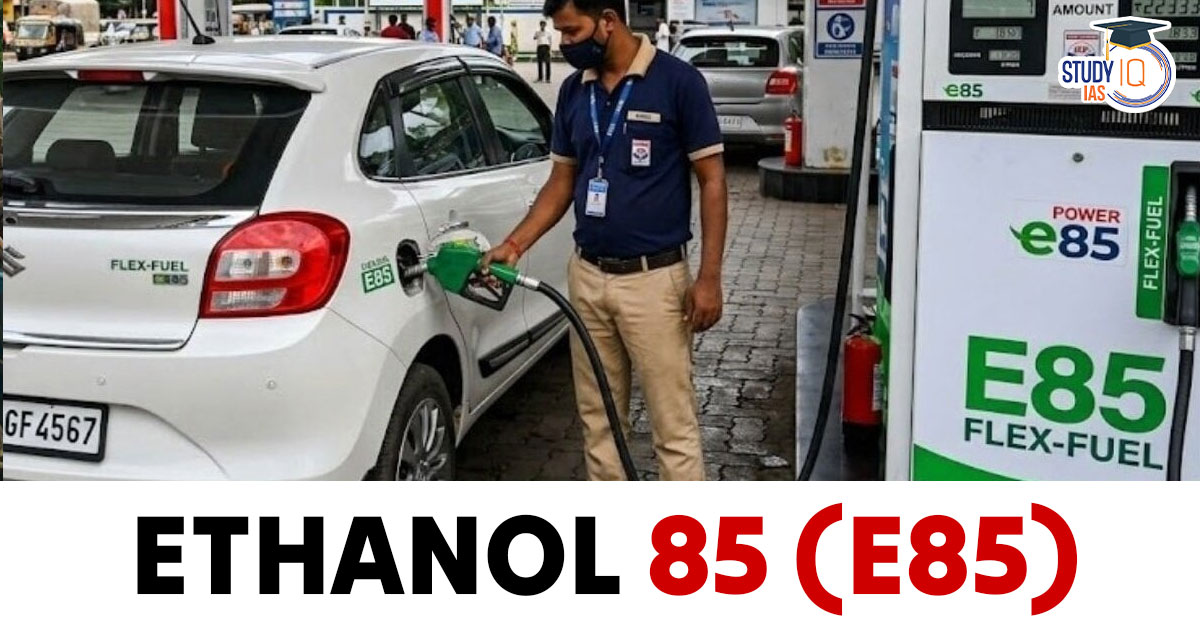
Ethanol 85 (E85) is a high-concentration ethanol-gasoline blend designed to significantly reduce dependence on fossil fuel imports.
- Composition: A mixture consisting of up to 85% ethanol and 15% petrol (gasoline).
- 85% Ethanol (bio-based alcohol fuel)
- 15% Petrol (for engine compatibility and ignition support)
- Distinct Grade: Unlike the current E20 target (20% ethanol), E85 will be introduced as a separate fuel grade.
- Engine Versatility: Vehicles designed for E85 are often referred to as Flex-Fuel Vehicles (FFVs). These engines are capable of running on E85 as well as lower blends like E50 or E60.
| What is Ethanol? |
|
Ethanol is a type of biofuel produced from renewable sources such as:
In countries like India, ethanol is mainly derived from sugarcane molasses, making it a key component of the government’s biofuel strategy. |
Check Here: Ethanol Blending Programmes (EBP)
Significance
- Energy Security: High-level blending acts as a buffer against volatile oil prices and supply chain disruptions caused by global conflicts (e.g., the West Asia crisis).
- Emission Reduction: Ethanol is a cleaner-burning fuel; higher blends lead to a substantial decrease in tailpipe emissions, particularly carbon monoxide and particulate matter.
- Agricultural Support: Increased demand for ethanol benefits farmers by providing a stable market for sugarcane, maize, and damaged food grains used in ethanol production.
Also Check: Ethanol Blending in India
How E85 Works
E85 is designed for use in flex-fuel vehicles, which can run on:
- Pure petrol
- Ethanol blends (E20, E85, etc.)
- Any combination of the two
These vehicles have specially designed engines and fuel systems that can automatically adjust to different ethanol levels.
Implementation Challenges
- Dedicated Hardware: Standard internal combustion engines (ICE) cannot run on E85 due to ethanol’s corrosive nature and different combustion properties. Manufacturers must produce engines with compatible fuel lines, seals, and engine mapping.
- Dual Infrastructure: Fuel stations will need dedicated storage tanks and separate dispensing units for E85, distinct from existing E20 or unblended petrol pumps.
- Cost Implications: While ethanol is typically cheaper than petrol, the specialised engine technology and infrastructure upgrades may involve initial capital costs.
E85 in India: Current Status
The government of India is actively promoting ethanol blending under its biofuel policy. While E20 (20% ethanol blending) is currently being expanded nationwide, E85 is still in the early stages and mainly limited to pilot projects and select flex-fuel vehicles. Automobile companies are gradually introducing flex-fuel compatible engines, which may accelerate E85 adoption in the future.
Global Scenario
Countries like:
- Brazil
- United States
have already adopted E85 widely, supported by strong infrastructure and government incentives.
Future Prospects
E85 fuel is expected to play a significant role in:
- Reducing carbon emissions
- Enhancing energy security
- Promoting sustainable mobility
With increasing focus on clean energy, E85 could become a major alternative fuel, especially in countries with strong agricultural sectors.
Conclusion
Ethanol 85 (E85) represents a promising step toward cleaner and more sustainable transportation. While challenges such as infrastructure and efficiency remain, continued policy support and technological advancements can help unlock its full potential. For countries like India, E85 offers a dual benefit of environmental protection and economic growth.

 Ramsar Sites in India 2026 List: Names, ...
 Skyroot Vikram-1 Mission Aagaman: India'...
 Oor Pare Prehistoric Site: Location, Roc...














 WhatsApp