
Table of Contents
Context
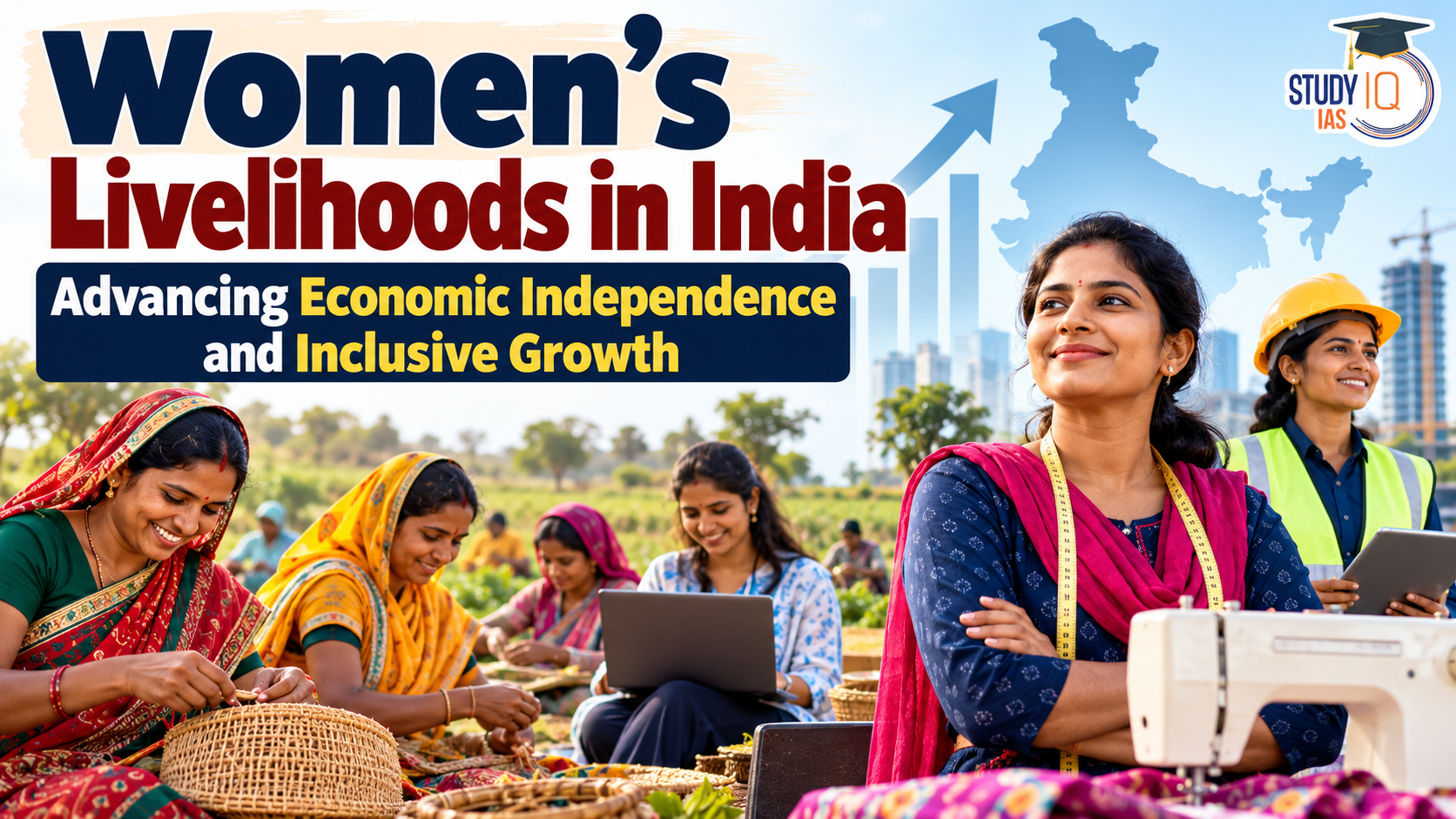
Women’s livelihoods are vital for economic empowerment, gender equality and inclusive growth. The reported lapse of the Deendayal Antyodaya Yojana–National Urban Livelihoods Mission (DAY-NULM) without a successor has raised concerns about continuity of institutional support for women’s economic and social empowerment. India therefore needs a comprehensive approach to create sustainable and dignified livelihood opportunities for women.
Why are women’s livelihoods important for India?
- Economic empowerment: Livelihood opportunities provide women with independent incomes, reduce dependence on family members and strengthen their control over income and assets.
- Demographic dividend: Higher Female Labour Force Participation (FLFP) can unlock the productive potential, skills and entrepreneurial capacity of nearly half of India’s population.
- Gender equality: Equal access to employment, income and productive resources reduces economic disparities between men and women.
- Inclusive growth: Women’s participation expands the productive workforce and helps ensure that the gains of economic growth reach a wider section of society.
- Human-capital development: Higher female income is associated with better child nutrition, health outcomes, school enrolment and lower dropout rates. The supplied material notes that women may invest up to 90% of their earnings in families and communities, compared with an estimated 30–40% for men.
- Sustainable development: Women’s livelihoods support SDG 5: Gender Equality and SDG 8: Decent Work and Economic Growth.
What challenges do women face in securing livelihoods?
- Patriarchal mindset: Traditional norms often treat men as primary earners and women as caregivers, limiting women’s employment choices, mobility and economic independence.
- Low labour-force participation: Social norms, household responsibilities and limited work opportunities restrict women’s participation in the labour market.
- Unpaid care work: Women bear a disproportionate burden of household work, childcare and eldercare, reducing their time for paid employment and enterprise.
- Gender wage gap: Occupational segregation, discrimination and unequal access to better-paying jobs often result in lower wages for women.
- Limited access to resources: Women may face barriers in accessing land ownership, institutional credit, modern technology and productive assets.
- Lack of market-oriented skills: Limited vocational training, digital literacy and technical skills reduce women’s employability and access to better-paying livelihoods.
- Safety and mobility constraints: Concerns regarding sexual harassment, unsafe public transport, workplace security and social restrictions limit access to work opportunities.
- Regional and social inequalities: Women from disadvantaged castes, tribal communities and economically weaker households face multiple barriers in education, skills, credit and employment. Regional gaps in infrastructure and jobs further restrict their prospects.
How do government initiatives support women’s livelihoods?
- Deendayal Antyodaya Yojana–National Rural Livelihoods Mission (DAY-NRLM): Organises rural women into Self-Help Groups (SHGs) and supports access to credit, skill development and self-employment.
- Deendayal Antyodaya Yojana–National Urban Livelihoods Mission (DAY-NULM): Supports urban poor women through SHGs, skill development, credit access and self-employment opportunities.
- Pradhan Mantri MUDRA Yojana (PMMY): Facilitates collateral-free institutional loans to eligible micro-enterprises, including women-led businesses.
- Stand-Up India Scheme: Facilitates bank loans for eligible greenfield enterprises promoted by women and SC/ST entrepreneurs.
- Lakhpati Didi Initiative: Seeks to enable women in SHGs to earn sustainable annual household livelihoods of at least ₹1 lakh through diversified economic activities.
- Namo Drone Didi Scheme: Trains women SHG members in drone piloting and maintenance for agricultural uses such as crop monitoring and fertiliser spraying.
- Swavalambini Scheme: Supports young women through enterprise ideation, financial access and 21 weeks of dedicated business mentorship.
How has civil society strengthened women’s livelihoods?
- Self-Employed Women’s Association (SEWA): Organises women in the informal economy and supports skill development, microfinance, social security and market linkages.
- Kudumbashree Mission, Kerala: Promotes women’s neighbourhood groups, micro-enterprises, collective farming and producer companies.
- PRADAN: Strengthens rural women’s livelihoods through sustainable agriculture, livestock rearing and natural-resource management.
- Mann Deshi Foundation: Operates a microfinance bank managed by and for rural women, along with business schools for women entrepreneurs.
- Sheroes and digital platforms: Help urban and semi-urban women access remote-work opportunities, peer-support networks and career coaching.
- Barefoot College, Tilonia: Trains rural and non-literate women as solar engineers, or “Solar Mamas”, creating clean-energy livelihoods in off-grid areas.
Way Forward: How can India ensure dignified livelihoods for women?
- Provide market-oriented skills: Expand vocational training, digital literacy and technical skills aligned with industry requirements.
- Improve access to credit: Strengthen affordable institutional credit, microfinance and financial-literacy programmes for women entrepreneurs and SHGs.
- Ensure equal wages: Enforce equal pay for equal work through effective implementation of the Code on Wages, 2019, along with wage audits and grievance-redressal systems.
- Promote women’s entrepreneurship: Provide women entrepreneurs with affordable credit, skills, modern technology and better market access.
- Strengthen SHGs: Improve SHGs’ access to credit, digital literacy, skill development and market linkages through programmes such as DAY-NRLM and Lakhpati Didi.
- Improve access to productive resources: Ensure women’s ownership of land, property and other productive assets, along with access to institutional credit, technology, irrigation and agricultural training.
- Address patriarchal norms: Promote gender-sensitive education, community awareness and equal sharing of domestic responsibilities to support women’s economic independence.

 Strategic Disinvestment in India: IDBI B...
 Daily Current Affairs PDF 2026: Download...
 Daily Mains Articles 2026 – Updated Da...













 WhatsApp






