
Table of Contents
Context: ISRO has released the second Announcement of Opportunity (AO) inviting proposals from the Indian solar physics community for observation time on the Aditya L1 mission.
More in News
- Images captured by Aditya-L1 reveal the Sun’s dynamic activities, including a solar storm that occurred in May.
- Notable solar flares of X-class and M-class erupted in the region AR13664 on the Sun.
- These flares were associated with coronal mass ejections (CMEs).
- Two instruments, the Solar Ultraviolet Imaging Telescope (SUIT) and Visible Emission Line Coronagraph (VELC), were active during this period.
Aditya L1 Mission
Aditya L1 mission is India’s first dedicated space-based solar mission. The mission has been making continuous observations of the sun from the Sun-Earth L1 point.
Objectives of ISRO Aditya L1 Mission
Broadly, the study of solar activities and their effect on space weather.
- Study of coronal heating
- Study of solar wind acceleration
- Study of Coronal Mass Ejections (CME)
- Dynamics of solar atmosphere and temperature anisotropy.
You can also check here for details on the Lunar Polar Exploration Mission (LUPEX), also known as the Chandrayaan 4 Mission.
Timeline of Aditya L1 Mission
| Date | Event |
| September 02, 2023 | India’s first solar observatory embarks on its journey to the Sun-Earth L1 point. |
| September 03, 2023 | The next manoeuvre is scheduled for September 5, 2023, around 03:00 Hrs. IST. |
| September 05, 2023 | The second Earth-bound manoeuvre was successfully performed, achieving a new orbit of 282 km x 40225 km. |
| September 10, 2023 | The third Earth-bound manoeuvre was successfully executed, resulting in a new orbit of 296 km x 71767 km. |
| September 15, 2023 | Fourth Earth-bound manoeuvre completed, establishing a new orbit of 256 km x 121973 km. |
| September 18, 2023 | Aditya-L1 initiates the collection of scientific data. |
| September 19, 2023 | The spacecraft is currently en route to the Sun-Earth L1 point. |
| January 6, 2024 | Aditya-L1 reaches the L1 point, approximately 1.5 million kilometres from Earth. |
Aditya-L1 Enters Sun’s Final Orbit
ISRO achieved another milestone on January 6, 2024, by successfully executing the last manoeuvre to position the Aditya-L1 spacecraft into its designated orbit, marking India’s accomplishment in deploying its inaugural solar observatory. This observatory, designed to study the Sun, has now reached its final destination approximately 1.5 million kilometres away from Earth. India celebrates the successful establishment of Aditya-L1, reinforcing its capabilities in space exploration.
Aditya L1 Mission Launch Date and Time
For further information about the Aditya L1 Solar Mission Details, see the Points below. You should be aware that this is ISRO’s first solar mission, and that it will be launched on September 2, 2023. Check the details on ISRO Aditya L1 Mission Launch Date below in the table:
| ISRO Aditya L1 Mission | |
| Particulars | Details |
| Mission Name | Aditya L1 |
| Authority | Indian Space & Research Organisation |
| Type of Mission | Solar Mission |
| ISRO Aditya L1 Mission Launch Date | 2nd September 2023 |
| ISRO Aditya L1 Mission Budget | Rs 400 Crore |
| Objective of Aditya L1 | To Study the Gas Pattern, Coronal Heating & Solar Wind Acceleration |
| Aditya L1 Launch Vehicle | PSLV-XL |
| Landing Site | Lagrange Points |
| Total Aditya L1 Payload | Check Below |
| ISRO Website | isro.gov.in |
| About L1 |
Related Information:
|
Launch Vehicle of Aditya L1 Mission
The Aditya L1 Solar Mission was launched by the Indian Space & Research Organisation on September 2, 2023. The spacecraft is transported by PSLV-XL, the Aditya L1 Launch Vehicle. Aditya L1 will split from the spacecraft after the launch vehicle has sent it into orbit. After the launch of Chandrayaan 3, ISRO’s Aditya L-1 mission is the organisation’s second straight mission.
Payloads of Aditya L1 Mission
- Visible Emission Line Coronagraph (VELC): VELC is the prime payload designed as a reflective coronagraph with a multi-slit spectrograph.
- Solar Low Energy X-ray Spectrometer (SoLEXS): SoLEXS is a soft X-ray spectrometer designed to measure the solar soft X-ray flux to study solar flares.
- Plasma Analyser Package for Aditya (PAPA): PAPA is designed to understand solar winds and their composition and perform mass analysis of solar wind ions.
- High Energy L1 Orbiting X-Ray Spectrometer (HEL1OS): HEL1OS is a hard X-Ray spectrometer designed to study solar flares in the high-energy X-rays.
- Solar Ultra-violet Imaging Telescope (SUIT): SUIT is a UV telescope to image the solar disk in the near UV wavelength range.
- Aditya Solar wind Particle EXperiment (ASPEX): ASPEX payload comprises 2 sub-systems: SWIS & STEPS.
- Solar Wind Ion Spectrometer (SWIS) is a low-energy spectrometer designed to measure the proton and alpha particles of the solar wind.
- Supra-Thermal & Energetic Particle Spectrometer (STEPS) is a high-energy spectrometer designed to measure high-energy ions of the solar wind.
- Magnetometer: MAG will measure the low-intensity interplanetary magnetic field in space. It has two steps of Magnetic sensors.
Complete Details of Aditya-L1 Mission
Aditya L1 Mission is the first space-based observatory-class Indian solar mission to study the Sun. The spacecraft is planned to be placed in a halo orbit around the Lagrange Point 1 (L1) of the Sun-Earth system, which is about 1.5 million km from the Earth. A satellite placed in the halo orbit around the L1 point has the major advantage of continuously viewing the Sun without any occultation/eclipse.
This will provide a greater advantage in observing solar activities continuously. The spacecraft carries seven payloads to observe the photosphere, chromosphere, and the outermost layers of the Sun (the corona) using electromagnetic and particle detectors. Using the special vantage point of L1, four payloads directly view the Sun, and the remaining three payloads carry out in-situ studies of particles and fields at the Lagrange point L1.
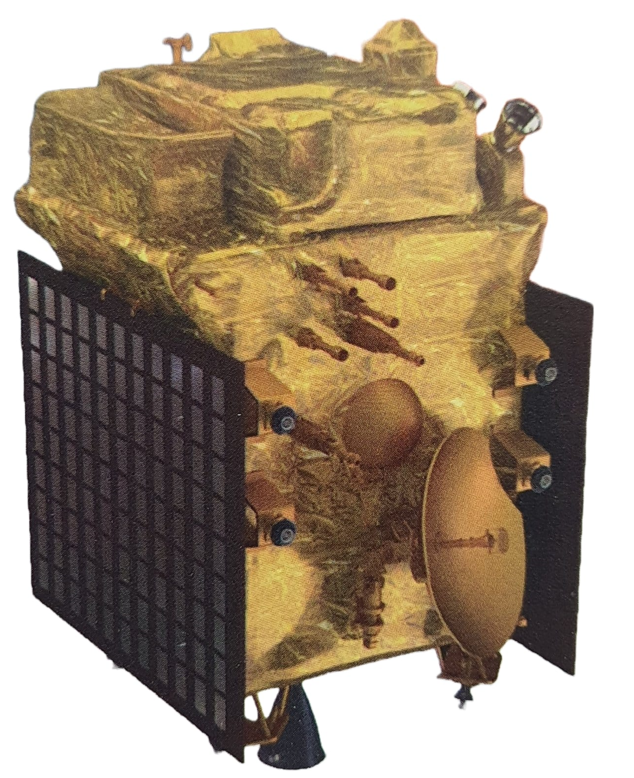
The suite of Aditya L1 Mission payloads is expected to provide the most crucial information to understand the problems of coronal heating, Coronal Mass Ejection, pre-flare and flare activities, and their characteristics, dynamics of space weather, study of the propagation of particles, and fields in the interplanetary medium, etc.
Aditya L1 Solar Mission Uniqueness
- First time spatially resolved solar disk in the near UV band.
- CME dynamics close to the solar disk (~ from 1.05 solar radius), thereby providing information on the acceleration regime of CME, which is not observed consistently.
- On-board intelligence to detect CMEs and solar flares for optimised observations and data volume.
- Directional and energy anisotropy of solar wind using multi-directional observations.
Details of Aditya L1 Mission Payloads
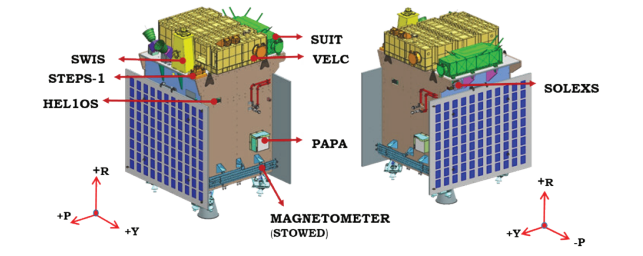
The Aditya-L1 mission carries a suite of seven scientific payloads to carry out a systematic study of the Sun. All the payloads are developed with the close collaboration of various centres of the Indian Space Research Organization (ISRO). All seven Aditya L1 Mission Payloads have been discussed below:
Visible Emission Line Coronagraph (VELC)
The Visible Emission Line Coronagraph (VELC) studies the solar corona and dynamics of Coronal Mass Ejections. The VELC instrument was developed at the Indian Institute of Astrophysics, Bangalore.
Solar Ultra-violet Imaging Telescope
The Solar Ultra-violet Imaging Telescope (SUIT) payload images the Solar Photosphere and Chromosphere in near Ultra-violet (UV) and also measures the solar irradiance variations in near UV. The SUIT instrument at the Inter-University Centre for Astronomy & Astrophysics, Pune.
Aditya Solar Wind Particle Experiment & Plasma Analyser Package for Aditya
The Aditya Solar Wind Particle Experiment (ASPEX) and Plasma Analyser Package for Aditya (PAPA) payloads study the solar wind
and energetic ions, as well as their energy distribution. The ASPEX instrument at the Physical Research Laboratory, Ahmedabad, the PAPA payload at Space Physics Laboratory, Vikram Sarabhai Space Centre, Thiruvananthapuram
Solar Low Energy X-ray Spectrometer & High Energy L1 Orbiting X-ray Spectrometer
The Solar Energy X-ray Spectrometer (SoLEXS) and The High Energy L1 Orbiting X-ray Spectrometer (HEL1OS) study the X-ray flares from the Sun over a wide X-ray energy range. The SoLEXS and HEL1OS payloads at U R Rao Satellite Centre, Bangalore.
Magnetometer
The Magnetometer payload is capable of measuring interplanetary magnetic fields at the L1 point. The Magnetometer payload at the Laboratory for Electro-Optics Systems, Bangalore.
|
Aditya L1 Mission Payloads |
||
| Type | Payload | Capability |
| Remote Sensing Payloads | Visible Emission Line Coronagraph(VELC) | Corona/Imaging & Spectroscopy |
| Solar Ultraviolet Imaging Telescope (SUIT) | Photosphere and Chromosphere Imaging- Narrow & Broadband | |
| Solar Low Energy X-ray Spectrometer (SoLEXS) | Soft X-ray spectrometer: Sun-as-a-star observation | |
| High Energy L1 Orbiting X-ray Spectrometer(HEL1OS) | Hard X-ray spectrometer: Sun-as-a-star observation | |
| In-situ Payloads | Aditya Solar wind Particle Experiment(ASPEX) | Solar wind/Particle Analyzer Protons and heavier Ions with directions |
| Plasma Analyser Package For Aditya (PAPA) | Solar wind/Particle Analyzer Electrons and heavier Ions with directions | |
| Advanced Tri-axial High Resolution Digital Magnetometers | In-situ magnetic field (Bx, By and Bz). | |
Where will the Aditya L1 be placed?
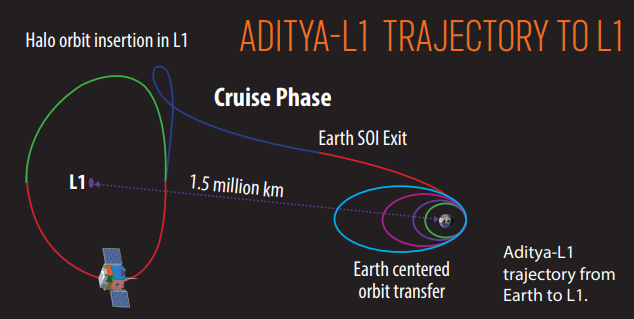
Aditya L1 spacecraft would originally be sent into low-Earth orbit (LEO). With the use of onboard propulsion, the spacecraft’s orbit will then be made more elliptical, and it will be launched towards the Lagrange Point L1 between the Sun and the Earth system.
The spaceship will leave the gravitational Sphere of Influence (SOI) of the Earth as it moves toward L1. The Sun-Earth Lagrange Point L1 will thereafter be the object of Aditya L1’s final orbit, which will be a wide halo orbit. This location in space is 1.5 million kilometres away from Earth. The gravitational pulls of the Sun and Earth are balanced at the L1 point, which is a stable place.
Why is Aditya L1 placed at the L1 point between Sun and Earth?
In layman’s terms, the Aditya L1 spacecraft will be put in the vast halo orbit around the Sun-Earth Lagrange Point L1, which will help to ensure that there are no occultations or eclipses that prevent a continuous view of the Sun. Let’s examine the Lagrange Points to provide a scientific explanation.
Lagrange Points
For a two-body gravitational system, the Lagrange Points are the positions in space where a small object tends to stay if put there. These points in space for a two-body system, such as the Sun and Earth, can be used by spacecraft to remain at these positions with reduced fuel consumption.
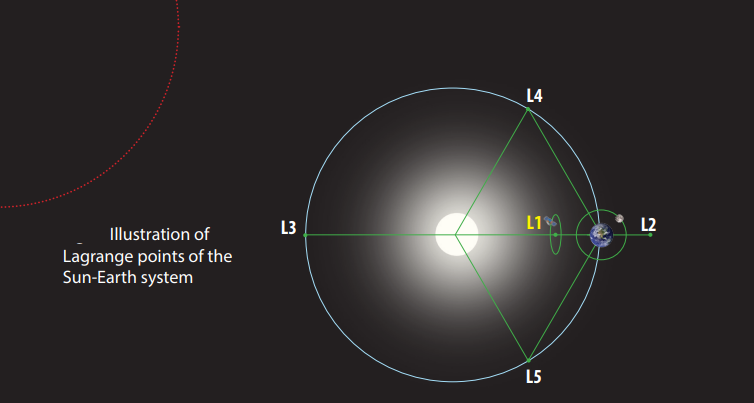
Technically, at the Lagrange point, the gravitational pull of the two large bodies equals the necessary centripetal force required for a small object to move with them. For two-body gravitational systems, there is a total of five Lagrange points denoted as L1, L2, L3, L4 and L5. The Lagrange points for the Sun-Earth system are shown in the figure. The Lagrange point L1 lies between the Sun-Earth line. The distance of L1 from Earth is approximately 1% of the Earth-Sun distance.
Benefits of Aditya L1 Solar Mission
- The spacecraft will have the advantage of continuously observing the Sun without any occultation or eclipse, thanks to its positioning in the unique vantage point of L1.
- This will enable us to comprehend the Sun and how it affects Earth better.
- The information acquired from the mission will help us better understand and predict space weather phenomena like solar flares, CMEs, solar wind, and other phenomena that have an impact on the operation of space technology near or on Earth, as well as other planets.
- When it comes to the Earth, a magnetic disturbance can occur when the Earth’s magnetic field interacts with the field delivered by the CME.
- Space weather events have the potential to significantly affect our satellites, communication networks, and power grids. We can better safeguard ourselves from these occurrences by comprehending the Sun.
Aditya L1 Launch Budget
The orbit of Aditya-L1 will be set in the Sun-Earth system’s L1, where the gravitational pull of both bodies is balanced out. For the Aditya-L1 mission in 2019, the Centre approved funding equivalent to around $46 million. Costs have not received an official update from the ISRO.
Aditya L1, a flagship project of ISRO, has a substantial budget in line with its complexity and significance. The budgeted amount will go toward designing, developing, launching, and operating spacecraft. The budget includes all research, development, and testing phases as well as the high-end equipment and expertise required for investigating the Sun’s corona.
The estimated 400 Crore budget includes funds for post-launch activities, operational costs, and contingencies. With this expenditure, India is demonstrating its dedication to enhancing its space capabilities and boosting global science.
Aditya-L1 Mission to use PSLV-C57 rocket for launch
The mission will launch with a PSLV-C57 rocket. Aditya-L1 is equipped with seven specialised payloads that can observe the photosphere, chromosphere, and corona of the Sun at various wavelengths. Earlier on August 14, ISRO provided an update on the preparations for the launch of mission Aditya-L1, the first Indian observatory to study the Sun from orbit.
Aditya-L1, the first Indian observatory to study the Sun from orbit, is getting ready for launch as part of the PSLV-C57 mission. The U R Rao Satellite Centre (URSC), Bengaluru-built satellite, has arrived at SDSC-SHAR, Sriharikota.
Other Solar Missions
| Mission | Agency | Launch Date | Location / Orbit | Primary Science Focus |
| Parker Solar Probe | NASA (USA) | 2018 | Elliptical (Closest to Sun) | Sampling the solar corona and magnetic fields directly. |
| Solar Orbiter (Solo) | ESA & NASA | 2020 | Inclined Elliptical | High-res imaging and first-ever look at the Solar Poles. |
| Hinode (Solar-B) | JAXA (Japan) | 2006 | Sun-synchronous (Earth) | High-resolution “microscopic” detail of magnetic structures. |
| Proba-3 | ESA | 2024 | High Earth Orbit (Formation) | Studying inner corona via a 150m artificial eclipse created by two flying craft. |
| SWFO-L1 | NOAA (USA) | 2025 | Lagrange Point 1 (L1) | Operational space weather forecasting and early warning (Solar-1). |
| SMILE | ESA & CAS (China) | 2026 (To be launched) | High Earth Orbit | How solar wind “dents” the Earth’s magnetosphere. |
| SOLAR-C (EUVST) | Led by JAXA, collaboration with NASA and European Space Agencies | 2028 | Sun-synchronous Earth orbit (approx. 600 km altitude) for continuous solar viewing. | Observe the entire solar atmosphere simultaneously with unprecedented resolution.
Captures everything from the “cool” chromosphere (5,000 K) to the super-hot flaring corona (20 million K) at the same time. |
 Anthropic's Claude Mythos AI Model: Mean...
 Memristor: Brain-Inspired Computing Devi...
 Stem Cell Therapy for Frailty in Ageing ...













 WhatsApp





