Table of Contents
Context: The leak and testing of Anthropic’s Mythos AI model have triggered global concern, including in India, due to its ability to both detect and exploit vulnerabilities, posing risks to sectors like banking and digital infrastructure.
AI firm Anthropic introduced its advanced model Mythos, capable of detecting deep software vulnerabilities. The emergence of Mythos, an advanced AI model under Project Glasswing, has raised concerns due to its ability to autonomously detect and exploit vulnerabilities (including zero-day bugs) across critical systems.
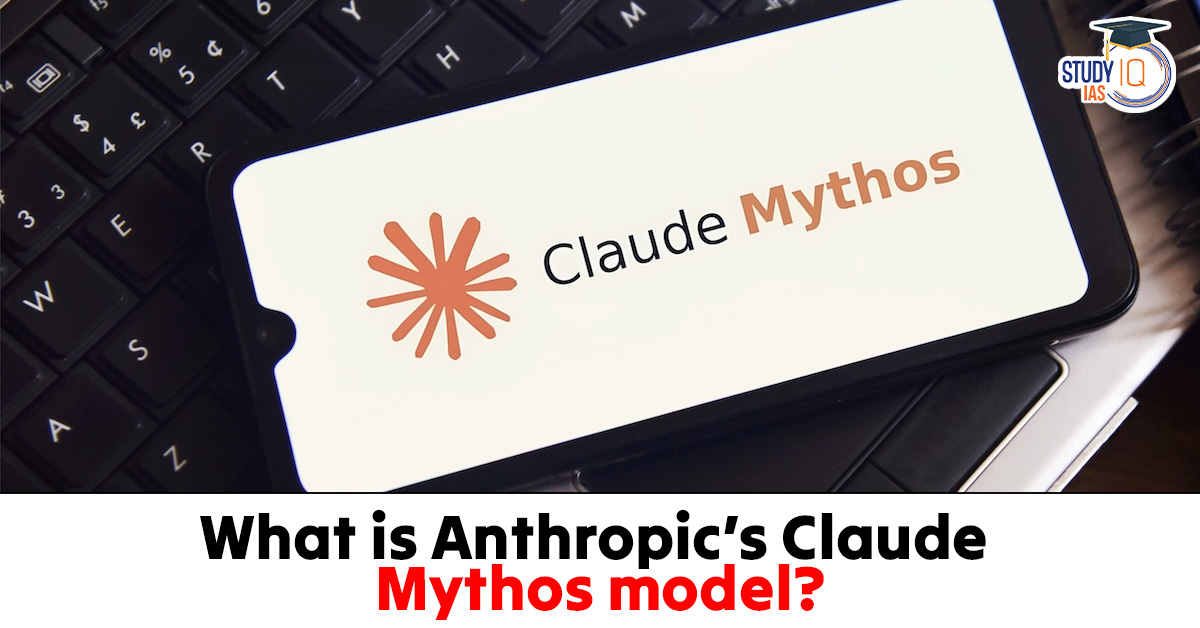
Anthropic’s Claude Mythos AI Model
The Claude Mythos model is the latest innovation from Anthropic, designed to push the boundaries of advanced artificial intelligence. Built as part of the evolving Claude AI family, this model focuses on enhanced reasoning, deeper contextual understanding, and more reliable responses across complex tasks. As Artificial Intelligence competition intensifies globally, Claude Mythos stands out for its emphasis on safety, alignment, and human-like interaction, making it highly relevant for research, content creation, and enterprise applications.
About Mythos
Definition: Mythos is an advanced AI model developed by Anthropic with capabilities in cybersecurity analysis, vulnerability detection and exploit generation.
- Core Capability: It can identify vulnerabilities, generate exploits and execute multi-step cyber operations autonomously, compressing the entire attack lifecycle.
- Restricted Deployment: Due to its risks, it is not publicly released and is shared selectively under Project Glasswing to secure critical infrastructure.
- Advanced Cybersecurity AI: Detects hidden vulnerabilities in legacy and modern systems (found bugs in Linux kernel, OpenBSD, FFmpeg).
- High Code Intelligence: Analyses large codebases and identifies flaws missed by human experts (hundreds of severe vulnerabilities detected).
- Part of Claude Ecosystem: Belongs to Anthropic’s Claude models (similar to earlier launched Haiku, Sonnet, Opus, Mythos has the highest capability).
- Dual-Use Nature: Can be used for defence (patching bugs) or offence (exploiting vulnerabilities).
- Access: Project Glasswing partners will receive access to the Claude Mythos Preview to find and fix vulnerabilities or weaknesses in their foundational systems
- Why not make Public: Public release could enable hackers to exploit vulnerabilities before fixes are applied.
- Autonomous Functioning: A highly self-directed system capable of planning and executing tasks independently.
Current Status
- Restricted and controlled deployment due to the high-risk nature.
- Accompanied by defensive initiatives like Project Glasswing.
About Project Glasswing
- Global Cybersecurity Initiative: A consortium of ~40 companies working to detect and fix vulnerabilities before public release.
- Includes firms like Microsoft, Apple, and Cisco.
- Large-Scale Investment: Backed by ~$100 million programme for scanning global codebases.
- Objective: Secure foundational software systems before attackers gain similar AI tools.
Impact on Indian IT Industry
- Risk to Bespoke Software: Indian IT service firms develop custom enterprise software for global clients, which could be vulnerable to AI-assisted vulnerability discovery.
- SaaS and Product Ecosystem Threat: Indian Software-as-a-Service and deep-tech firms face risks if vulnerabilities are rapidly exposed.
- Shift in Cybersecurity Paradigm: The traditional bug bounty ecosystem may weaken as AI automates vulnerability detection.
- Dependence on Global Software Stack: Indian IT companies rely heavily on global open-source platforms and enterprise software, which Mythos is analysing for vulnerabilities.
- Competitive Pressure: Indian IT companies may need to invest more in cybersecurity tools and AI-driven vulnerability scanning.
Impact on Internal Security
- Critical Infrastructure Risk: Systems like banking, telecom, power grids, SCADA, IoT networks may be exposed (high systemic risk).
- Government Systems Vulnerability: Legacy systems (e.g., Aadhaar, GST platforms) may contain undetected vulnerabilities exploitable by AI.
- State-Sponsored Cyber Threats: Adversarial states could use similar AI tools for cyber espionage and infrastructure attacks.
- Transition Period Risk: Short-term phase may see an increase in cyberattacks before defences stabilise (“cyber tsunami” risk).
How It Creates Security Issues
- Financial System Vulnerability: Banks operate on interconnected legacy and modern IT systems (shared vendors, common platforms), allowing a single vulnerability to trigger system-wide failures (cascading financial disruptions).
- Zero-Day Exploit Expansion: Mythos can discover unknown vulnerabilities (zero-days) at scale, enabling attacks before patches exist, increasing unpredictable cyber threats.
- Lowering Skill Barrier for Attacks: By automating exploit generation, Mythos allows even low-skilled actors to launch sophisticated cyberattacks, expanding the threat landscape.
- Compression of Attack Lifecycle: It reduces time between vulnerability discovery → exploit creation → attack execution, making defence response windows extremely narrow.
- National Security Risks: State and non-state actors can use such AI for cyber warfare, espionage and sabotage (military systems, surveillance networks).
- Shift in Cybersecurity Paradigm: The challenge shifts from finding vulnerabilities to managing and defending against large-scale AI-driven threats, requiring AI-based defence systems.
Expanding Capabilities of Mythos
- Advanced Vulnerability Discovery: Mythos can scan complex systems and identify deep flaws.
- Eg. It reportedly found a vulnerability in widely used software that had remained undetected for nearly 30 years.
- Autonomous Exploit Development: It can convert vulnerabilities into real-world exploits at scale
- Eg. in Mozilla Firefox’s JavaScript engine, it not only identified bugs but created working “shell exploits” that could allow attackers to control a user’s system through a browser.
- Agentic Behaviour (Multi-Step Execution): Performs long attack chains independently.
- Eg. in UK AISI tests, it completed a corporate network attack—from initial entry to full takeover—similar to how real hackers infiltrate systems step by step.
- High-Level Problem Solving: Handles expert-level challenges
- Eg. It showed solving 73% of advanced cybersecurity tasks, which normally require trained professionals.
- Lowering Entry Barriers: A person with basic technical knowledge could use Mythos to generate sophisticated cyberattacks without understanding the underlying systems.
Threats Posed by Mythos
- Risk to Critical Infrastructure: Threatens sectors like banking
- Eg, Indian authorities fear that vulnerabilities in financial systems could be exploited rapidly, leading to financial disruptions.
- Democratisation of Cyber Attacks: Expands access to hacking tools. Now, even novices can launch attacks using AI-generated scripts.
- Weaponisation of AI: Dual-use nature increases risks. A government or rogue actor could deploy Mythos offensively to attack another country’s infrastructure.
- Autonomous Attack Chains: Executes full-scale attacks
- Eg, completing multi-step attacks like corporate network takeover without human intervention.
- Global AI Arms Race: Rapid development by other countries
- Eg, China’s Qihoo 360 reportedly identified nearly 1,000 vulnerabilities, indicating competitive escalation.
- Leak and Misuse Risks: Unauthorised access increases danger
- Eg, Mythos was accessed via a private Discord group despite restricted release, showing difficulty in containment.
- Short-Term Instability: The transition phase is risky
- Eg. before defensive use becomes dominant, attackers may exploit these tools faster than systems can adapt.
Way Forward
- Strengthening Cyber Defence: Use AI for protection (g. Project Glasswing brings companies like Apple and Nvidia to proactively identify and fix vulnerabilities before attackers exploit them).
- Robust Regulation: Develop balanced AI governance (g. India forming an AI Governance and Economic Group to coordinate policy response).
- Global Coordination: Build common standards (e.g. need for international agreements to regulate powerful AI tools across countries).
- Controlled Access: Restrict high-risk models (e.g. limiting Mythos deployment to trusted organisations to prevent misuse).
- Capacity Building: Train institutions (g. banks and government agencies improving cyber preparedness against AI-driven threats).
- Public-Private Collaboration: Joint response (g. governments working with tech companies to strengthen digital infrastructure security).

 QDENGA Dengue Vaccine: India’s First A...
 Skyroot Vikram-1 Mission Aagaman: India'...
 Oor Pare Prehistoric Site: Location, Roc...













 WhatsApp