
Table of Contents
Context: Recently, researchers have developed a new hafnium-based memristor that can significantly reduce AI energy consumption.
About the Memristor
- A memristor (memory + resistor) is a device whose resistance changes based on past current and “remembers” it even after power is removed, enabling storage and computation in a single device.
- Making (Structure): Typically made using a metal–insulator–metal structure:
- A thin layer of titanium dioxide (TiO₂) or other oxides, which is sandwiched between two metal electrodes
- Working Principle
- Electric current changes the internal resistance of the device. After the current is removed, it retains this resistance (memory effect).
- Resistance levels represent synaptic weight (represent data).
Thus, it has in-memory computing (processing + storage in the same location).
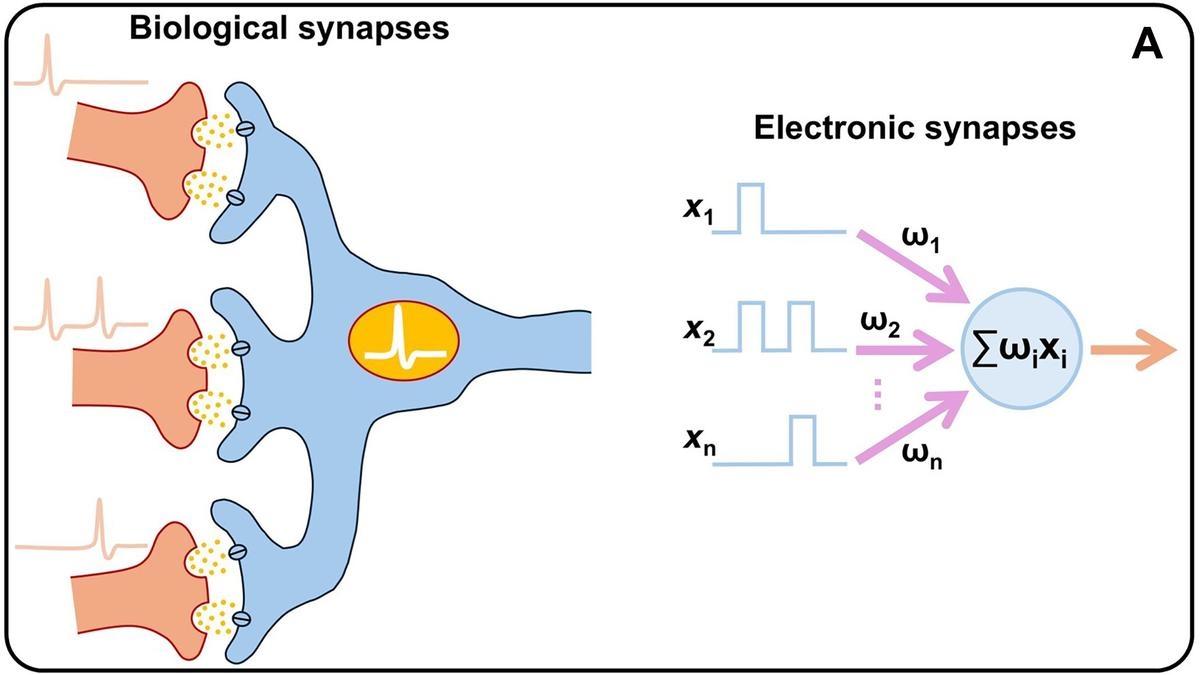
- Efficiency: Eliminates data transfer between memory and processor, thus leading to very low energy consumption
- Eg. brain-like efficiency, i.e. ~10¹⁴ operations/sec at ~20 W energy, whereas AI systems use hundreds to thousands times more energy
Memristor vs Traditional Computing
| Aspect | Memristor-Based Computing | Traditional Computing (Von Neumann) |
| Memory & Processing | Integrated (same device performs storage + computation) | Separate units (CPU + memory → data transfer required) |
| Energy Efficiency | High (minimal data movement → low power consumption) | Lower (high energy spent on data transfer between memory and processor) |
| Speed | Faster for AI tasks (parallel, in-memory processing) | Slower due to memory bottleneck (data transfer delays) |
| Architecture | Neuromorphic (brain-inspired, synapse-like devices) | Von Neumann architecture (sequential processing) |
Issues in Traditional Oxide-Based Memristors
- Filament-Based Instability: Rely on conductive filament formation inside oxide layer (e.g., TiO₂), which is random and difficult to control, leading to unreliable switching.
- Filament formation refers to the creation of a tiny conductive path (filament) inside the memristor’s insulating layer when voltage is applied.
- High Switching Energy: Filament creation requires relatively high voltage/current, increasing overall energy consumption.
- Abrupt Switching Behaviour: Exhibits binary (ON/OFF) switching, limiting fine analogue control needed for neuromorphic computing.
New and Improved Memristor (Hafnium-Based)
- Design Innovation: Uses hafnium oxide + titanium oxynitride, forming a p–n junction (acts as an adjustable electronic gate) instead of an unstable filament mechanism.
- Improved Working: Controls resistance via ion movement (smooth, predictable switching instead of abrupt filament formation).
- Efficiency Gain: Requires ~10⁶ times less current for switching → ~70% reduction in AI energy consumption.
- Industrial Advantage: Hafnium oxide is already used in CMOS chips → easier integration into existing semiconductor manufacturing.
- Limitations: High fabrication temperature (~700°C) and still far from matching full brain complexity.

 QDENGA Dengue Vaccine: India’s First A...
 Skyroot Vikram-1 Mission Aagaman: India'...
 Oor Pare Prehistoric Site: Location, Roc...














 WhatsApp