Table of Contents
His career flourished during the height of the Khilji and Tughlaq dynasties. He represents the shift toward a more professionalized, merit-based military bureaucracy that emerged after the Mamluk period.
Before Ain-ul-Mulk, the Delhi Sultanate’s attempts to hold Central India were mostly “plunder raids” (like Iltutmish’s raid on Bhilsa and Ujjain). Ain-ul-Mulk changed this to permanent annexation. He survived the transition from the ruthless Alauddin Khilji to the orthodox Ghiyasuddin Tughlaq, and finally the volatile Muhammad bin Tughlaq.
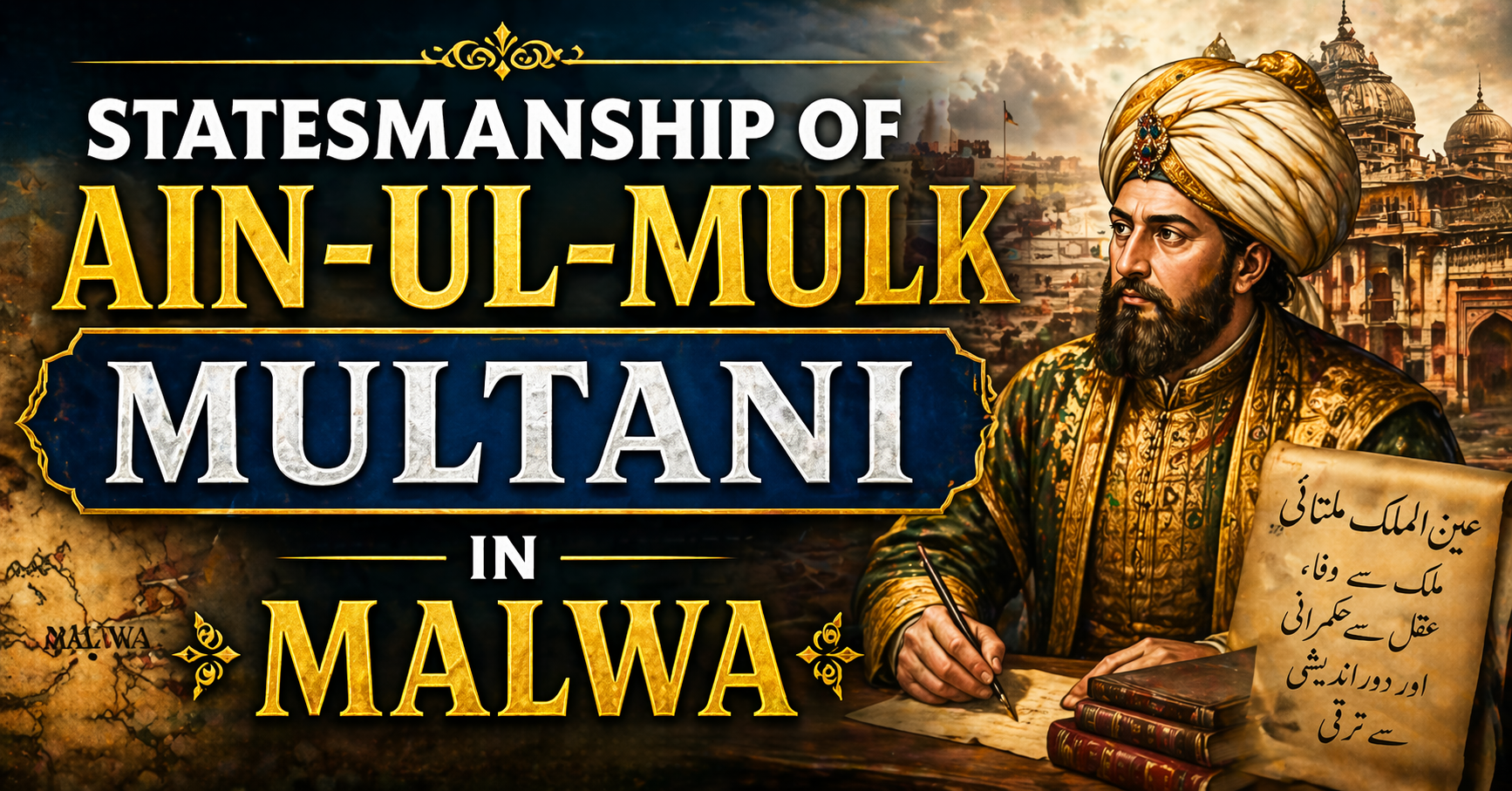
About Ain-ul-Mulk Multani
- Title: Ain-ul-Mulk (The Eye of the State).
- Major Victory: 1305 Conquest of Malwa (Defeat of Mahalakadev).
- Administrative Contribution: Insha-i-Mahru (Literary work providing historical context).
- Unique Fact: Served under the Khiljis and the Tughlaqs; survived a rebellion against Muhammad bin Tughlaq.
Origin of Ain-ul-Mulk Multani
- Origin: Born in Multan (modern-day Punjab, Pakistan), hence the title Multani. He belonged to the Mahru family (Ain-ud-din Abdullah bin Mahru).
- Significance: As an Indian-born Muslim official, he represented the “New Nobility” of the Khilji Revolution. This group displaced the old Turkish monopoly (The Forty) of the Mamluk period, emphasizing professional merit over ethnic lineage.
- Survivalist Statesman: He is a rare example of a high-ranking official who navigated the “Three Dynastic Tempests”: the ruthless expansionism of Alauddin Khilji, the orthodox restoration of Ghiyasuddin Tughlaq, and the volatile experimentation of Muhammad bin Tughlaq.
- Multani lobby in Delhi: Ain-ul-Mulk was the most prominent face of a powerful socio-economic “Multani bloc” that influenced the Delhi court for decades:
- Socio-Political Bloc: Growing up in Multan, he was part of an indigenous or “Indianized” elite that served as a counterweight to the old Turkish nobility. This lobby was essential to Alauddin Khilji’s “Khilji Revolution,” which sought to replace hereditary Turkish privilege with professional merit.
- Sufi Philosophical Roots: Multan was the heart of the Suhrawardiyya Sufi order. Unlike the reclusive Chishtis, the Suhrawardis believed in engaging with the State to guide administration and ensure social order. Ain-ul-Mulk’s pragmatic, orderly, and firm administrative style in Malwa is a direct reflection of this philosophical background.
- Military-Fiscal Connection: The Multani lobby often consisted of wealthy merchants and traditional administrators. Their expertise in finance and logistics was the backbone of the Sultanate’s ability to fund and maintain long-distance standing armies in Central India and the Deccan.
Check Here: Tughlaq Dynasty
Contributions of Ain-ul-Mulk Multani in consolidating Sultanate Rule in Central India
- Battle of Dhar (1305): Leading a force of 30,000–40,000 cavalry, he defeated the last great Parmar king, Mahalakadev, and his brilliant commander Koka Pradhan (also known as Goga).
- Fall of Mandu: He pursued the fleeing Parmar forces to Mandu. Tradition holds that a traitor showed his forces a secret path into the fort, leading to a decisive victory.
- Legacy in Malwa: Following the conquest, Alauddin Khilji appointed him the Governor of Malwa. He was responsible for implementing the Iqta system and stabilizing the region, making Mandu a key administrative hub for the first time in Islamic history.
Also Read: Khilji Dynasty
Contribution of Ain-ul-Mulk Multani under different Sultanate dynasties
- Under Alauddin Khilji: He was the architect of the Malwa Conquest (1305). He defeated the last Parmar ruler, Mahalakadev, and his commander, Goga (Koka Pradhan). Following this victory, Alauddin appointed him as the Governor of Malwa, where he stabilised the administration of Ujjain, Mandu, and Dhar.
- Under Ghiyasuddin Tughlaq: He transitioned smoothly into the Tughlaq service, assisting in the consolidation of the Sultanate after the chaos following Alauddin’s death.
- Under Muhammad bin Tughlaq (MBT): He served as the Governor of Oudh (Awadh). In 1340-41, he led a famous revolt against MBT because he feared a transfer to the Deccan (which he viewed as a demotion and exile). Despite being defeated, Muhammad bin Tughlaq pardoned him—a rare act for the “contradictory” Sultan—because his administrative expertise was deemed irreplaceable.
Administrative Versatility of Ain-ul-Mulk Multani
Unlike many generals of his time who were merely “sword-wielders,” Ain-ul-Mulk was a refined bureaucrat.
- Diplomacy in Devagiri: He was instrumental in managing the administrative transition of the Deccan after the fall of the Yadavas.
- Intellectual Caliber: He was a scholar and a master of Persian prose. His collection of letters, known as the Insha-i-Mahru, is a primary source for understanding the administrative and social history of the Tughlaq period.
- Zonal Command in Malwa: He divided the Malwa plateau into administrative circles that forced local Rajput landed aristocracy (Ranas and Rawats) to integrate into the Sultanate’s revenue web as intermediaries. This “de-feudalization” of Malwa is precisely why the region did not collapse into chaos when the Tughlaq central authority later weakened.
Ain-ul-Mulk’s Contribution in Urbanization of Malwa
- Shift of Administrative Pivot: He transitioned the regional seat of power from the traditional religious and cultural center of Ujjain to the strategic fortified hilltop of Mandu, institutionalizing it as a provincial capital.
- Establishment of ‘Fiscal Urbanism’: By implementing the Iqta system, he diverted the agricultural surplus of the fertile Malwa plateau to support a permanent urban garrison and a settled bureaucratic class at Mandu.
- The ‘Paper Revolution’: He introduced a Persianized administrative structure, replacing local feudal oral traditions with a literate class of Munshis and Qazis, thereby creating a new urban intellectual middle class.
- Market Regulation & Stability: He enforced Alauddin Khilji’s strict price controls and supply chain management in Malwa, attracting artisans and traders by ensuring a low cost of living and stable commodity supplies.
- Hydraulic and Civic Foundation: He initiated the restoration of ancient water tanks and commissioned the first Islamic public anchors (mosques and madrasas), providing the necessary infrastructure for a year-round metropolitan population.
| About Insha-i-Mahru |
Insha-i-Mahru is an invaluable source of the primary history of medieval India. It is a collection of 133 bureaucratic correspondence authored by Ain-ul-Mulk Multani during the reign of the Tughlaq dynasty. These letters give insights into the behind the scenes working of the Tughlaq era.
Authorship and Origin
Content of Insha-i-Mahru: A Window into the SultanateThe letters provide a “behind-the-curtain” look at the administration of the Tughlaq era. They are categorised based on their intent:
Key historical details from Insha-i-Mahru
|
Ain-ul-Mulk Multani’s Relationship with the Tughlaqs
His career reached a dramatic peak during the reign of Muhammad bin Tughlaq (MBT):
- Revolt of Oudh (1340-41): Ain-ul-Mulk was the Governor of Oudh (Awadh) and had successfully managed the region during a famine. When MBT ordered him to transfer to the Deccan to suppress rebellions there, Ain-ul-Mulk grew suspicious. He believed the Sultan wanted to remove him from his power base to execute him.
- Famine Management in Oudh: During the Great Famine under MBT, his governance of Oudh was so effective that the region became a stable “breadbasket” while others collapsed. This humanitarian success was a key reason MBT eventually pardoned him after his revolt.
- Pardon: He rebelled but was defeated near Kannauj. In a rare move, MBT—known for his brutal punishments—pardoned Ain-ul-Mulk. The Sultan recognised that Ain-ul-Mulk’s administrative genius was too valuable to lose. He was eventually reinstated to high office.

 16 Mahajanapadas: List, Capitals, Locati...
 Ghaznavid Empire in Punjab: History, Rul...
 Samvatsari Parva 2026: Know the Signific...













 WhatsApp