Table of Contents
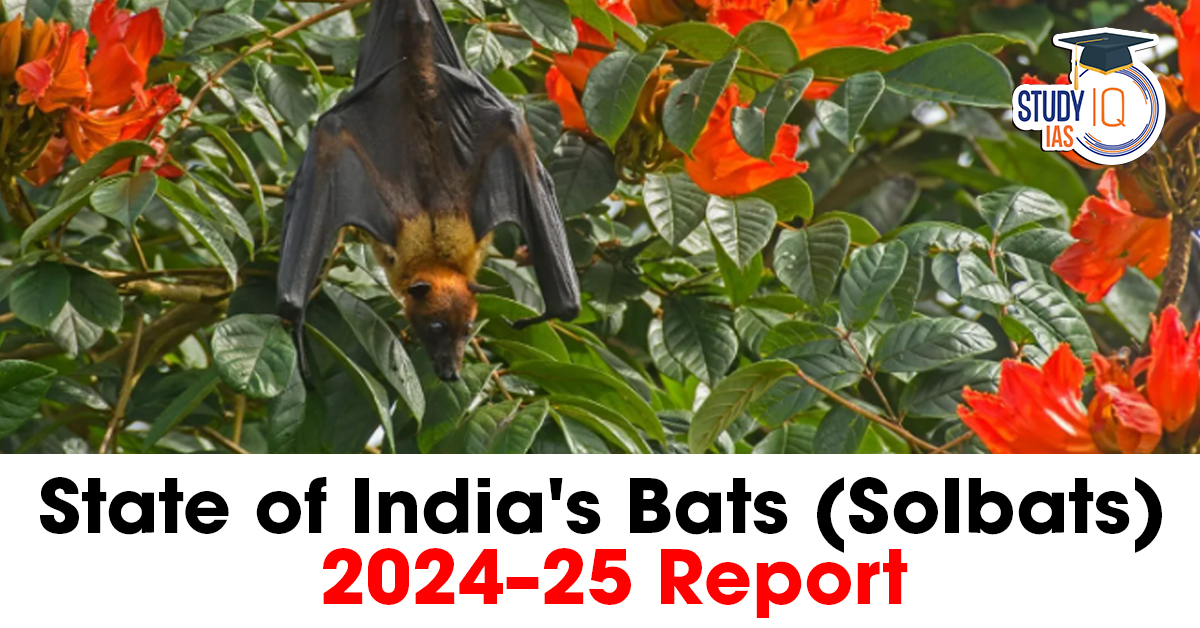
Context: The State of India’s Bats (SoIbats) 2024–25 Report, a joint initiative by the Nature Conservation Foundation (NCF) and Bat Conservation International (BCI), is the first-ever comprehensive national-level assessment of bats in the country.
Key Findings of State of India’s Bats (SoIbats) 2024–25 Report
- India currently hosts 135 recognised species of bats.
- The highest levels of species richness are concentrated in West Bengal (68 species) and Meghalaya (66 species).
- Conservation Status: While many species are stable, 7 species are listed as “Threatened” by the IUCN, and 16 species are endemic to the Indian subcontinent.
- While natural caves and old-growth trees are the primary habitats, bats are increasingly adapting to urban environments, utilising monuments, wooden beams in old houses, and abandoned buildings.
Bats of India
India’s bat population is split into two broad functional groups: the larger fruit bats (Megachiroptera) and the smaller, insect-eating bats (Microchiroptera).
- The Kolar Leaf-nosed Bat: This “Critically Endangered” species is found in only one cave in Karnataka, making it one of the rarest mammals in the world.
- Salim Ali’s Fruit Bat: A rare species endemic to the Western Ghats, named after the legendary “Birdman of India.”
- Island Endemics: The Andaman Horseshoe Bat and the Nicobar Flying Fox represent unique evolutionary lineages restricted to India’s island territories.
- The Giant Indian Flying Fox: One of the largest bats globally, frequently seen in urban canopy trees across the mainland.
About Bats
- Order: Chiroptera (Only mammals capable of true flight).
Ecological Role
- Pollination and Seed Dispersal: Fruit bats are primary pollinators for several economically important plants and are responsible for nearly 40% of forest regeneration in certain tropical regions through seed dispersal.
- Natural Pest Control: Insectivorous bats act as biological pesticides, consuming massive quantities of insects (including mosquitoes and crop-damaging moths), thereby reducing the need for chemical fertilizers.
- Guano as Fertilizer: Bat droppings (guano) are rich in nitrogen and phosphorus, serving as a high-quality natural fertilizer for cave and forest soil health.
Threats and Concerns
- Habitat Fragmentation: Mining (especially in the limestone caves of Meghalaya) and the felling of old-growth trees for infrastructure projects are destroying primary roosting sites.
- Zoonotic Stigma: Since the COVID-19 pandemic, bats have faced increased persecution due to public fear. The report clarifies that bats have co-existed with various viruses for 52 million years; spillover events only occur when humans encroach upon or disturb their habitats.
- Chemical Poisoning: The overuse of pesticides reduces their food source and leads to bioaccumulation of toxins within bat populations.
- Urban Mismanagement: Lack of protection for “man-made” roosts like heritage monuments often leads to colonies being smoked out or excluded during renovations.

 Ramsar Sites in India 2026 List: Names, ...
 Skyroot Vikram-1 Mission Aagaman: India'...
 Oor Pare Prehistoric Site: Location, Roc...














 WhatsApp