Table of Contents
Context
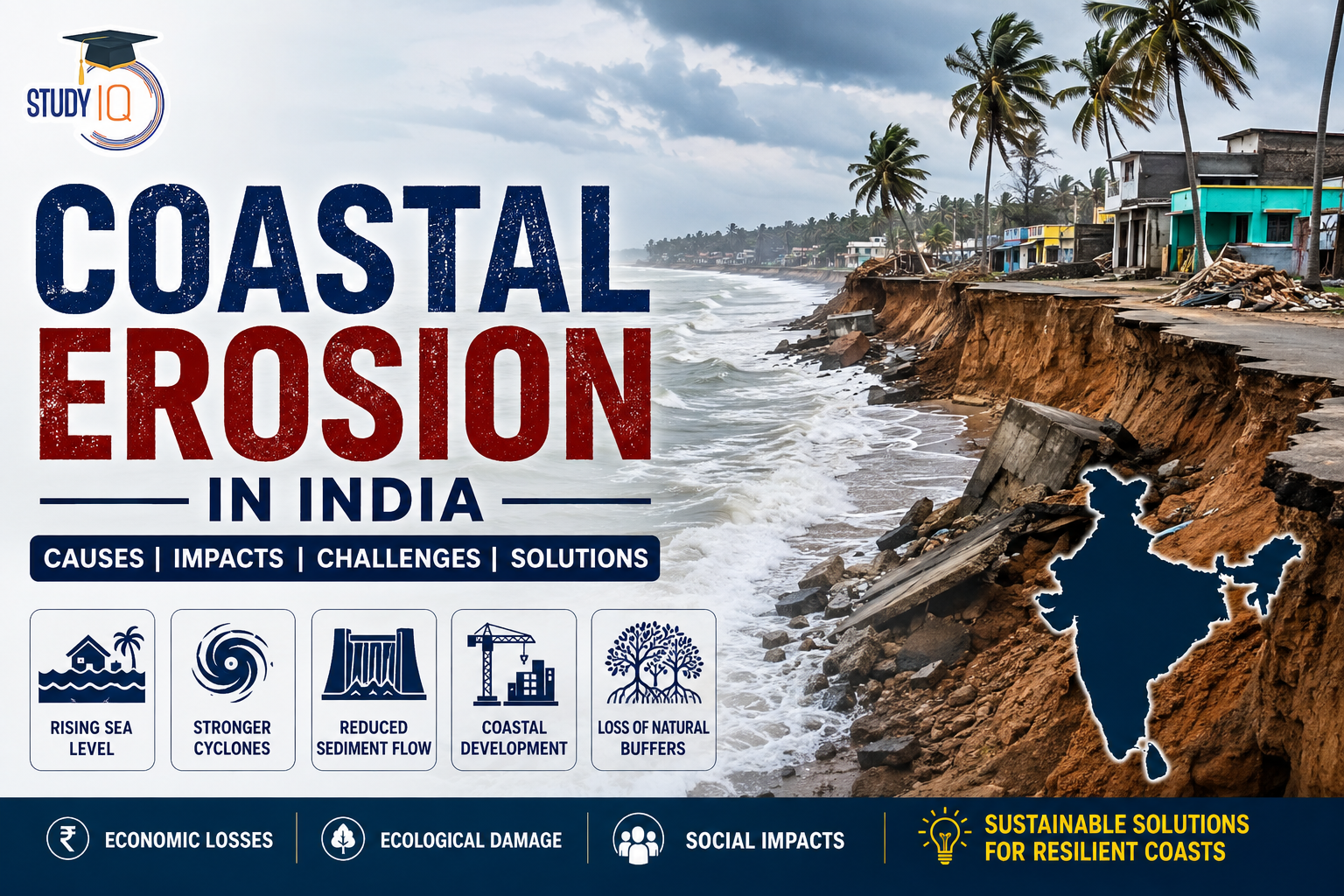
According to data cited by the Union Minister for Ports, Shipping and Waterways in the Rajya Sabha, nearly 28% of Odisha’s 564-km coastline is affected by coastal erosion. The assessment is based on studies by the National Centre for Coastal Research (NCCR), which tracks long-term changes in India’s shoreline.
Read Also: UPSC Daily Current Affairs 2026
Why is coastal erosion highly uneven across different stretches of the Indian coastline?
- Geomorphic baseline: Differences in geology, coastal relief, shoreline orientation and deltaic formation create different inherent levels of erosion susceptibility.
- Example: The low-lying Ganga–Brahmaputra delta is far more mobile than the relatively rocky Konkan coast.
- Sediment imbalance: When the amount of sediment removed from the coast is more than the amount brought by rivers and other sources, the coast gradually loses sediment.
- Example: Dams and other upstream projects have reduced sediment reaching parts of the Krishna delta, weakening natural coastal replenishment.
- Longshore redistribution: Waves and coastal currents move sediment from one part of the coast to another, causing erosion in some areas and sediment build-up (accretion) in others.
- Example: At Ennore, Tamil Nadu, port breakwaters trap sediment on one side, while the nearby northern coast has experienced erosion.
- Extreme-event exposure: Cyclones and storm surges can suddenly increase coastal erosion in areas already affected by sediment loss, causing rapid shoreline retreat.
- Example:Cyclone Fani (2019) affected Odisha’s coast, showing how extreme events can quickly intensify coastal erosion.
- Relative sea-level change: Coastal flooding and erosion become worse when sea levels rise while the land itself sinks or moves downward, making the effective rise in water level greater.
- Example: The low-lying Godavari delta is vulnerable because sea-level rise combines with local land subsidence and deformation.
- Human modification: Ports, breakwaters and seawalls can change the natural movement of coastal sediment, causing more erosion in some areas and more sediment build-up in others.
- Example: At Ennore, NCCR studies found erosion north of the port and accretion south of it, showing how coastal structures can alter sediment movement.
- Natural-buffer capacity: Mangroves, sand dunes and wetlands can reduce wave energy and protect the coast from erosion. Areas where these natural barriers are damaged or removed become more vulnerable.
- Example: The Coringa mangroves in Andhra Pradesh act as a natural coastal buffer, but their protective role can weaken with surrounding development.
What are the major economic, ecological and social consequences of coastal erosion for India?
Economic Consequences
- Loss of coastal land and assets: Permanent shoreline retreat reduces the land available for settlements, industries, tourism and other productive uses.
- Example:Ghoramara Island, West Bengal, has lost substantial land through erosion and submergence.
- Loss of economic infrastructure: Erosion undermines roads, ports, jetties, embankments and other physical assets, disrupting transport and economic activity.
- Example:Coastal erosion along parts of Odisha has damaged roads, embankments and other coastal infrastructure, resulting in recurring repair and reconstruction costs.
- Decline in fisheries and aquaculture productivity: Changes in beaches, estuaries and near-shore environments can damage fish-landing sites and productive aquaculture zones.
- Tourism revenue losses: Retreating beaches and degradation of coastal landscapes reduce the attractiveness and carrying capacity of beach-based tourism.
- Example: Erosion has affected the long-term stability of tourism beaches around Puducherry.
- Rising public expenditure: Governments devote increasing resources to coastal protection, reconstruction and rehabilitation that could otherwise support developmental priorities.
Ecological Consequences
- Habitat loss: Shoreline retreat removes beaches, mudflats, dunes and intertidal habitats used by coastal organisms.
- Example: Erosion threatens the nesting habitat of Olive Ridley turtles at Rushikulya, Odisha.
- Loss of coastal biodiversity: Destruction and fragmentation of habitats reduce the ecological niches available to specialised coastal species.
- Degradation of mangroves and wetlands: Persistent erosion can destabilise or eliminate coastal vegetation and wetland systems that regulate ecological processes.
- Example: Parts of the Sundarbans face simultaneous erosion and pressure on mangrove ecosystems.
- Loss of natural coastal protection: Degradation of dunes, mangroves and wetlands reduces their capacity to dissipate waves and storm energy, making surrounding ecosystems and settlements more exposed.
- Example: Loss of mangrove cover can reduce natural protection in vulnerable deltaic coasts.
- Disruption of biogeochemical functions: Erosion and habitat loss can alter nutrient cycling, sediment trapping, carbon storage and other ecosystem processes.
- Example: Degradation of mangrove ecosystems reduces their role as long-term carbon sinks and sediment stabilisers.
Social Consequences
- Displacement of population: Persistent land loss can make homes and settlements physically unviable, forcing households to relocate.
- Example: Progressive erosion of Ghoramara and other Sundarbans islands has contributed to population displacement.
- Cultural-place loss: Erosion can destroy temples, cemeteries, heritage sites and other places that embody community identity and collective memory.
- Example: Erosion along the Tamil Nadu coast has threatened coastal cultural and religious sites in vulnerable stretches.
- Breakdown of community networks: Relocation separates households from established neighbourhoods, kinship networks and locally embedded support systems.
- Example: Resettlement of erosion-affected island communities in the Sundarbans can fragment traditional social networks.
- Educational and health-service disruption: Repeated erosion can damage or isolate schools, healthcare facilities and access routes, reducing continuity of essential services.
- Example: Vulnerable settlements along the Odisha coast can face disruption of road access and public facilities during repeated coastal hazards.
- Unequal social vulnerability: The consequences are disproportionately severe for households with limited savings, insecure land tenure and few alternative livelihood options.
Why has climate change made coastal erosion a more complex policy challenge for India?
- Higher sea-level baseline: Climate change raises mean sea level, increasing the baseline exposure from which tides, waves and storm surges act on the shoreline.
- Compound coastal hazards: This higher baseline then interacts with cyclones, storm surges, extreme waves and heavy rainfall, making erosion both chronic and episodic.
- Example:Cyclone Amphan (2020) produced extensive inundation, erosion and embankment damage in West Bengal.
- Interaction with existing human pressures: Climate risks are superimposed on altered sediment regimes, river regulation, coastal construction and land-use change, making coastal erosion a multi-causal problem.
- Example:The Mahanadi delta faces the combined challenge of changing sediment dynamics, dense human use and increasing exposure to climate-related coastal hazards.
- Greater planning uncertainty: Coastal changes are harder to predict because sea-level rise, sediment supply, waves, cyclones and land movement can act together and change over time.
- Protection–ecology trade-off: Coastal structures may reduce erosion in one area but damage beaches, wetlands and other natural ecosystems that help protect the coast in the long run.
- Example: Goa’s coast shows the need to balance shoreline protection and development with the conservation of beaches and coastal ecosystems.
- Institutional fragmentation: Coastal management involves many sectors such as climate adaptation, disaster management, fisheries, infrastructure and land use, making coordination difficult when each works separately.
Way Forward
- Integrated coastal planning: Adopt Integrated Coastal Zone Management (ICZM) by bringing climate adaptation, disaster management, fisheries, infrastructure and land-use planning under a common framework.
- Sediment-based management: Plan erosion control at the coastal-cell or sediment-budget level, rather than treating each erosion hotspot as an isolated site.
- Nature-based solutions: Prioritise mangroves, dunes, wetlands and beach nourishment as first-line measures, using hard structures only where necessary.
- Site-specific engineering: Design seawalls, groynes and breakwaters based on local geomorphology, wave conditions and sediment movement to avoid transferring erosion to neighbouring stretches.
- Climate-resilient planning: Incorporate sea-level rise, land subsidence, cyclones and storm surges into coastal infrastructure standards and long-term land-use planning.
- Continuous monitoring: Strengthen shoreline mapping, sediment monitoring and remote-sensing systems to detect erosion trends early and regularly update coastal management plans.
- Regulate development: Enforce Coastal Regulation Zone (CRZ) norms more effectively and restrict construction in highly vulnerable coastal stretches.
- Community participation: Involve coastal communities, fishers and local governments in planning and monitoring because they possess location-specific knowledge and face the direct livelihood impacts of erosion.
 Gandhi Jayanti 2026: History, Significan...
 Right to Vote in India: Constitutional S...
 Daily Mains Articles 2026 – Updated Da...














 WhatsApp