Table of Contents
Context
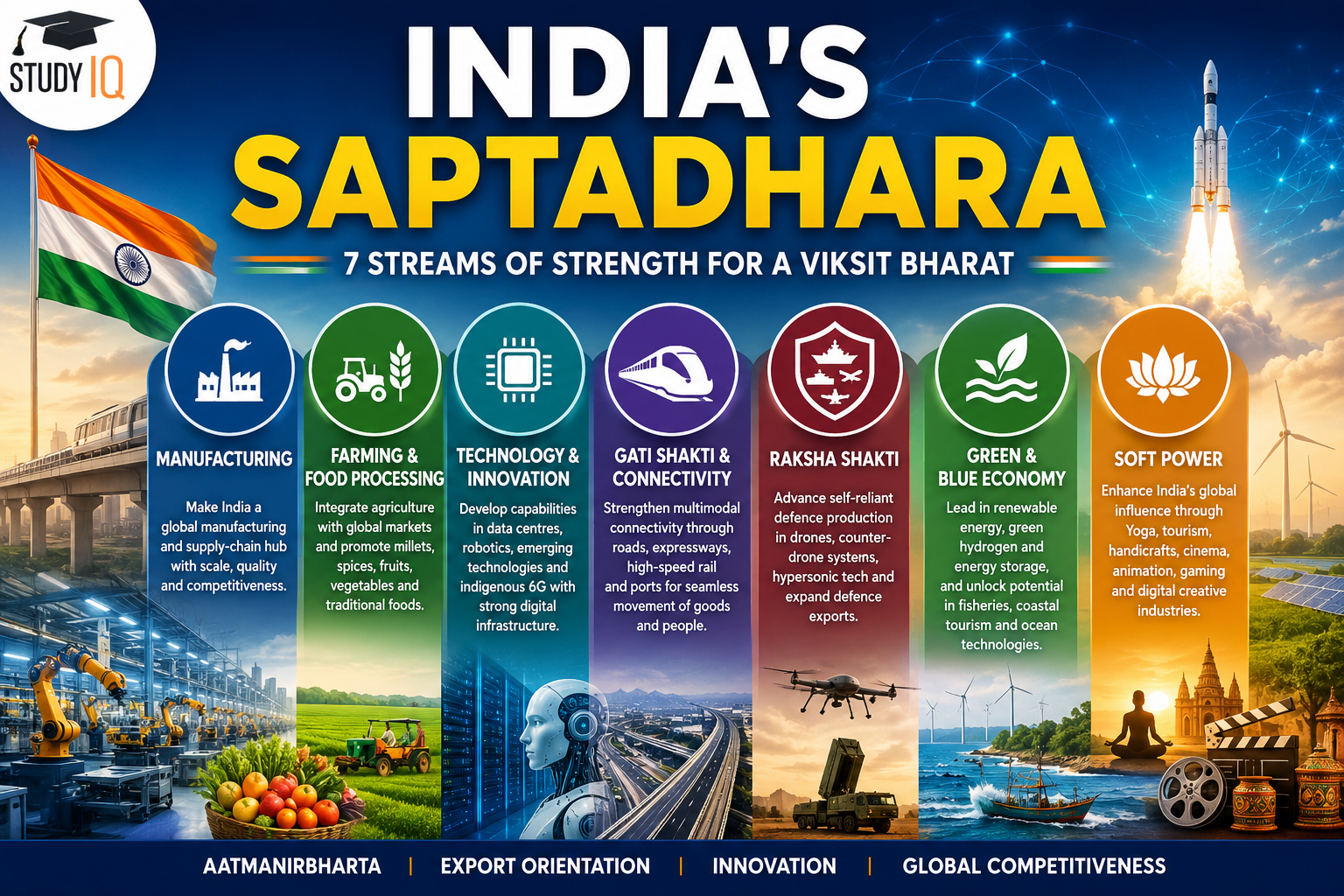
Prime Minister Narendra Modi, in his Independence Day address on 15 August 2026, outlined “Shakti Ki Saptadhara”—seven strategic streams intended to strengthen India’s capabilities and support the goal of Viksit Bharat.
About India’s Saptadhara
- Concept: “Saptadhara” refers to seven streams of national strength covering productive capacity, agriculture, technology, connectivity, defence, ecological resources and cultural influence.
- Development Approach: It adopts an integrated growth framework, linking economic competitiveness with technological capability, strategic autonomy, infrastructure and global influence.
- Core Objective: Emphasises Aatmanirbharta, export orientation, innovation and global competitiveness as foundations for India’s long-term development.

Key Features: Seven Streams
- Manufacturing: Build India into a global manufacturing and supply-chain hub through scale, quality, cost competitiveness, precision manufacturing and stronger domestic component ecosystems.
- Farming & Food Processing: Integrate agriculture with global markets by improving value addition and promoting products such as millets, spices, fruits, vegetables and traditional foods internationally.
- Technology & Innovation: Develop capabilities in data centres, robotics, emerging technologies and next-generation communications, while expanding digital public infrastructure and indigenous 6G
- Gati Shakti & Connectivity: Strengthen multimodal transport and logistics infrastructure through roads, expressways, high-speed rail and ports to improve the movement of goods and people.
- Raksha Shakti: Advance self-reliant defence production with focus on drones, counter-drone systems, hypersonic and other advanced technologies, alongside expansion of defence exports.
- Green & Blue Economy: Expand leadership in renewable energy, green hydrogen and energy storage, while exploiting opportunities in fisheries, coastal tourism and ocean-based technologies.
- Soft Power: Increase India’s international cultural and economic influence through Yoga, tourism, handicrafts, cinema, animation, gaming and digital creative industries.
Read Also: UPSC Daily Current Affairs 2026
 Gandhi Jayanti 2026: History, Significan...
 Right to Vote in India: Constitutional S...
 Daily Mains Articles 2026 – Updated Da...


 WhatsApp