
Table of Contents
Context
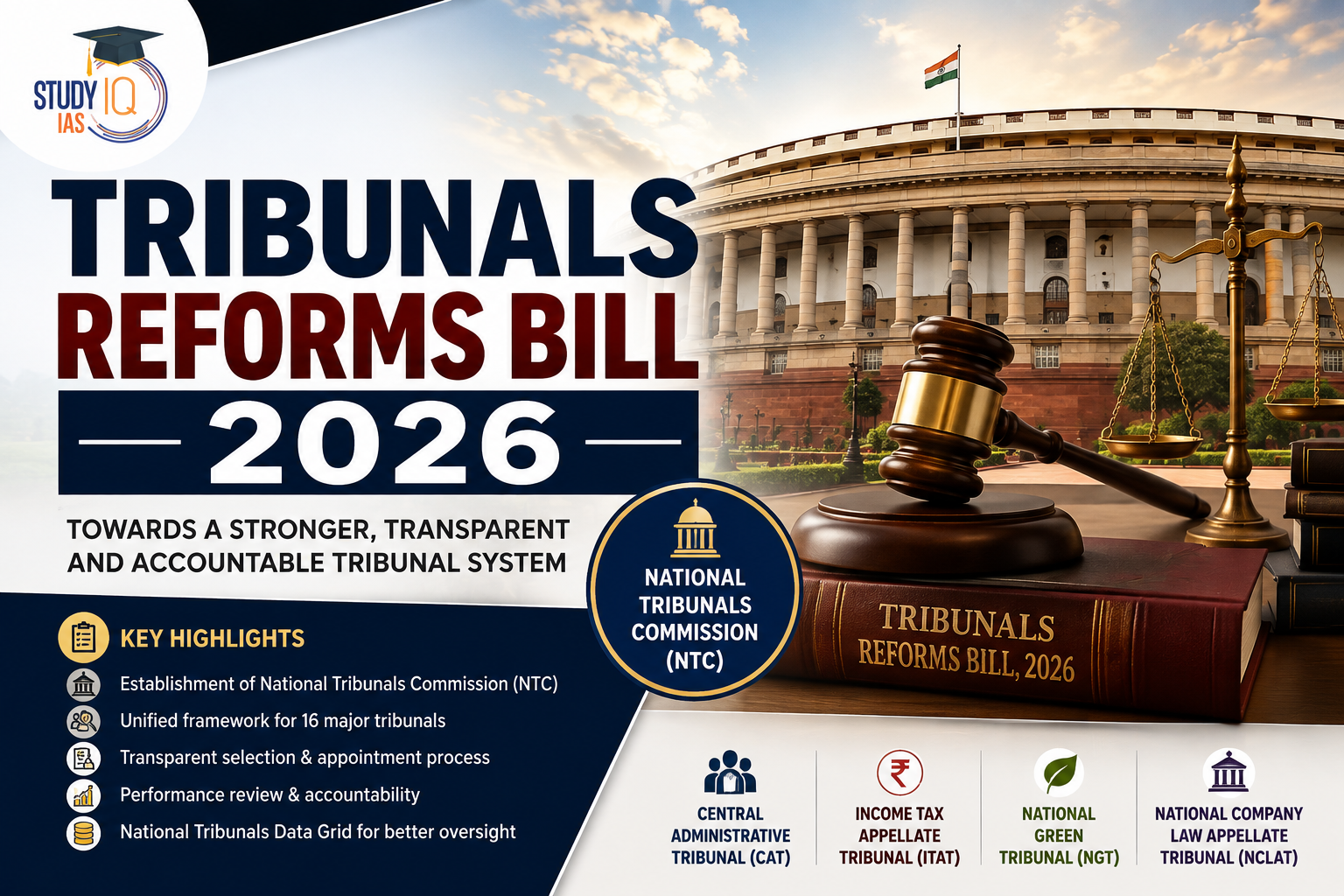
Recently, Parliament passed the Tribunals Reforms Bill, 2026, which proposes an independent National Tribunals Commission (NTC) to oversee the appointments, administration and functioning of 16 major tribunals.
What are the Key Provisions of the Tribunals Reforms Bill, 2026?
The Tribunals Reforms Bill, 2026 seeks to establish a unified institutional framework for the administration, appointment, oversight and functioning of tribunals in India through a proposed National Tribunals Commission (NTC).
Key Provisions of the Tribunals Reforms Bill, 2026
- National Tribunals Commission (NTC)
- Establishment and Functions: The Bill proposes a National Tribunals Commission as the central body responsible for the administration and oversight of tribunals. Its functions include conducting the selection process for tribunal vacancies, reviewing tribunal performance, supervising inquiries into complaints against chairpersons and members, and developing and maintaining the National Tribunals Data Grid.
- Composition: The Commission will comprise a Chairperson, two judicial members, and two technical members. The Chairperson must be a former Supreme Court Judge or Chief Justice of a High Court, while judicial members must have served as Chief Justice or Judge of a High Court. Technical members must possess at least 25 years of experience in fields such as public administration, finance, law, accountancy, banking, management or technology.
- Appointment: Members of the Commission will be appointed by the Central Government. Appointment of the Chairperson and judicial members will require consultation with the Chief Justice of India.
- Tenure: The Chairperson and members will serve for five years or until attaining 70 years of age, whichever is earlier.
- Secretariat: The Commission will have a dedicated Secretariat headed by a Central Government Secretary to provide administrative and institutional support.
- Selection Process for Tribunals
- Search-cum-Selection Committee: The NTC will constitute a Search-cum-Selection Committee for recommending appointments to tribunals. The NTC Chairperson will head the committee for selection of a tribunal chairperson, while a judicial member will head it for selection of other members. For every vacancy, the committee will recommend one candidate and one additional name for the waiting list. The Central Government must make the appointment within three months of receiving the recommendation.
- Composition of Selection Committee: The committee will include a retired Chief Justice of a High Court or a retired High Court Judge, depending on the vacancy; a technical member of the NTC; a Central Government Secretary; two expert members; and the Commission Secretary.
- Voting Rights: The two expert members and the Commission Secretary will not possess voting rights. The Chairperson of the committee will have a casting vote in case of a tie.
- Conditions of Service of Tribunal Members
- Tenure: Tribunal chairpersons will hold office for five years or until 70 years of age, whichever is earlier. Other members will have the same five-year tenure but an upper age limit of 67 years.
- Reappointment: Chairpersons and members may be considered for reappointment based on their previous performance. For members, reappointment will also require consultation with the chairperson of the concerned tribunal.
- Grounds for Removal: The Central Government may remove the Chairperson or a member of the NTC or a tribunal for grounds such as insolvency, conviction for an offence involving moral turpitude, physical or mental incapacity, abuse of position, or acquisition of interests that could adversely affect their functions. Tribunal members may additionally be removed for incompetence, inefficiency or undertaking paid assignments.
- Service Conditions: The Central Government will prescribe through Rules the qualifications, selection procedure, salaries and allowances, resignation, removal and other service conditions of tribunal members.
- Uniform Applicability: The Bill seeks to establish common rules governing selection, tenure and service conditions across 16 major tribunals listed in the First Schedule. These include the Central Administrative Tribunal (CAT), Income Tax Appellate Tribunal (ITAT), National Green Tribunal (NGT) and National Company Law Appellate Tribunal (NCLAT).
Why were tribunals created despite existing courts?
- Specialised Adjudication: Tribunals were designed for disputes where technical, economic or sector-specific expertise could complement conventional judicial adjudication.
- Eg: The National Green Tribunal (NGT) combines judicial adjudication with environmental expertise; the National Company Law Tribunal (NCLT) handles specialised company-law and insolvency disputes.
- Speed and Procedural Flexibility: Tribunalisation was intended to provide faster and less formal adjudication than ordinary courts by using procedures adapted to the subject matter.
- Eg: The NCLT replaced multiple earlier company-law forums with a consolidated specialised mechanism.
- Decongestion as an Institutional Objective: Tribunals were expected to remove specialised caseloads from ordinary courts, although subsequent experience showed that transferring jurisdiction does not automatically reduce total litigation.
- Eg: CAT was created under the Administrative Tribunals Act, 1985 to adjudicate specified service disputes involving government employees.
- Alternative-Theory Phase: In P. Sampath Kumar v. Union of India (1987), the Supreme Court accepted tribunalisation on the premise that a tribunal could provide an equally effective and efficacious alternative to the High Court in the jurisdiction transferred to it.
- Eg: CAT was envisaged as an alternative adjudicatory mechanism for service disputes rather than merely an executive grievance forum.
- Constitutional Enabling Framework: The 42nd Constitutional Amendment Act, 1976 inserted Part XIV-A, comprising Articles 323A and 323B, giving constitutional recognition to specialised tribunals.
- Eg:Article 323A specifically deals with administrative tribunals, while Article 323B provides for tribunals for specified subjects such as taxation and labour disputes.
What explains the tension between tribunal expertise and judicial independence?
- Policy Role: Tribunals often combine legal adjudication with economic, technical and policy considerations, making their role broader than merely determining legal rights.
- Eg: The NCLT applies insolvency law while considering resolution and value maximisation; TDSATadjudicates telecom disputes within a regulated sector.
- Appointment Control: Executive influence over appointments creates a risk of executive influence over adjudication, especially where tribunals review government decisions.
- Eg: In Union of India v. R. Gandhi (2010), the Supreme Court scrutinised the appointment structure of the NCLT/NCLAT to protect judicial independence.
- Tenure Dependence: Short tenure or executive-controlled reappointment can make tribunal members dependent on the authority deciding their continuation.
- Eg: The Supreme Court has repeatedly treated tenure and reappointment as important safeguards of tribunal independence.
- Administrative Control: Executive control over finance, infrastructure and day-to-day administration can weaken the institutional independence of tribunals even when adjudicators have formal security of office.
- Eg: The Madras Bar Association cases called for an independent administrative structure for tribunals rather than continued dependence on parent Ministries.
- Regulatory Conflict: In regulatory tribunals, the executive may be both the regulator and the institutional authority, creating a risk that tribunals become less independent in reviewing regulatory decisions.
- Eg:TDSAT adjudicates telecom disputes within a regulatory framework substantially shaped and administered by the executive.
Why has the expansion of tribunals not produced a proportionate improvement in speedy justice?
- Capacity Deficit: Specialised jurisdiction cannot produce speed when tribunals lack adequate benches, members, staff and infrastructure.
- Vacancy–Backlog Cycle: Delayed appointments reduce bench strength, which increases pendency and further delays appointments and institutional reform.
- Courtification of Tribunals: Forums intended to operate with procedural flexibility can gradually adopt court-like pleadings, extensive oral advocacy and adjournment-heavy practices, eroding their original speed advantage.
- Epistemic Friction: Judicial review creates an institutional interface between specialist expertise and generalist constitutional adjudication: excessive deference may make review ineffective, while intrusive re-evaluation of technical findings can undermine the tribunal’s comparative advantage.
- Fragmented Architecture: Multiple tribunals with different statutes, appointment structures and procedures create jurisdictional complexity and uneven institutional standards, weakening the economies of specialisation.
Way Forward
- Establish an Independent National Tribunals Commission: Create a genuinely autonomous body for appointments, administration, infrastructure and oversight, reducing Ministry-wise control over institutions adjudicating government and regulatory disputes.
- Eg: The Supreme Court directed the Union to establish a National Tribunals Commission in its 2025 Madras Bar Association judgment.
- Secure Appointment and Tenure: Adopt transparent selection, adequate tenure and safeguards against reappointment dependence, making adjudicators less vulnerable to executive influence.
- Reverse Courtification: Simplify pleadings, control adjournments, expand digital procedures and reduce unnecessary oral advocacy so tribunals retain a genuine procedural advantage over conventional courts.
- Rationalise Before Expanding: New or existing tribunal jurisdictions should be justified by a clear specialisation test, caseload threshold and comparative advantage over ordinary courts.
- Undertake Judicial-Impact Assessment: Before transferring jurisdiction, assess likely effects on tribunal workload, High Court review, staffing requirements and total litigation time, rather than measuring success solely by tribunal-level disposal.
Read Also: UPSC Daily Current Affairs 2026
 Gandhi Jayanti 2026: History, Significan...
 Right to Vote in India: Constitutional S...
 Daily Mains Articles 2026 – Updated Da...














 WhatsApp





