Table of Contents
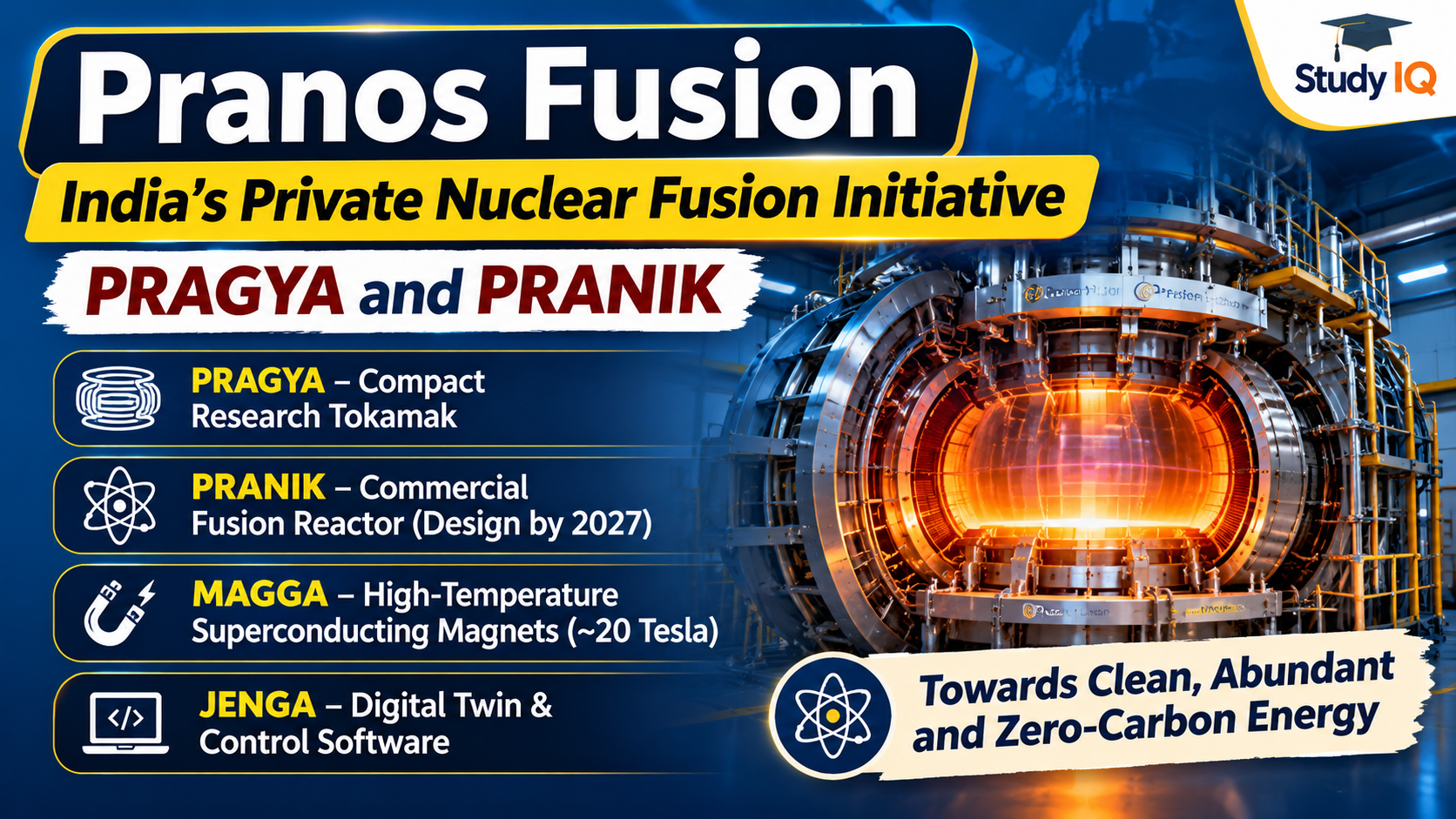
Bengaluru-based Pranos Fusion, founded in 2024, is developing compact nuclear fusion technology to advance India’s private-sector participation in next-generation energy research. The company is developing PRAGYA, a compact research tokamak, and PRANIK, a proposed commercial-scale fusion reactor design, with the aim of making fusion energy more economical and scalable.
Read Also: UPSC Daily Current Affairs 2026
About Pranos Fusion
-
Headquarters: Bengaluru, Karnataka.
-
Founded: 2024.
-
Founders: Shaurya Kaushal (CEO) and Roshan George (COO).
-
Technology: Magnetic confinement nuclear fusion.
-
Objective: Develop compact, low-cost fusion systems for clean and reliable electricity generation.
Key Projects and Technologies
1. PRAGYA
-
Compact, low-aspect-ratio research tokamak.
-
Tests plasma control, magnetic shaping and high-heat materials.
-
Supports the development of future fusion reactors.
2. PRANIK
-
Proposed commercial-scale fusion reactor design.
-
Design finalisation targeted by 2027.
-
Aims to achieve net-positive fusion energy using deuterium-tritium plasma heated above 100 million °C.
3. MAGGA
-
Focuses on High-Temperature Superconducting (HTS) magnets.
-
Targets magnetic fields of approximately 20 Tesla.
-
Stronger magnetic fields can enable smaller and more compact reactors.
4. JENGA
-
In-house digital twin and control software.
-
Models plasma behaviour and Magnetohydrodynamic (MHD) instabilities.
-
Supports reactor simulation and optimisation.
What is Nuclear Fusion?
-
Nuclear fusion is the process in which two light atomic nuclei combine to form a heavier nucleus, releasing enormous energy.
-
It is the process responsible for energy production in the Sun.
-
Common experimental fuel: Deuterium and Tritium (hydrogen isotopes).
-
It has the potential to provide abundant, low-carbon energy.
What is a Tokamak?
-
A tokamak is a device that uses powerful magnetic fields to confine extremely hot plasma.
-
Plasma is the fourth state of matter.
-
It has a doughnut-shaped (toroidal) configuration.
-
Magnetic confinement prevents the hot plasma from directly contacting reactor walls.
Significance for India
-
Energy Security: Potential source of reliable, low-carbon electricity.
-
Private Investment: Encourages private-sector participation in advanced nuclear research.
-
Atmanirbhar Bharat: Promotes indigenous development of magnets, software and reactor technologies.
-
Climate Goals: Could complement solar and wind energy.
-
Deep-Tech Ecosystem: Strengthens India’s scientific research and advanced manufacturing capabilities.
Challenges
-
Maintaining plasma temperatures above 100 million °C.
-
Controlling plasma instability.
-
Developing materials resistant to intense neutron bombardment.
-
Ensuring tritium availability and fuel management.
-
Achieving commercially viable net electricity generation.

 Cyclone Murasu: Formation, Naming, IMD W...
 Digi Yatra International Flights: 7 Airp...
 National Social Security Board for Unorg...














 WhatsApp