Table of Contents
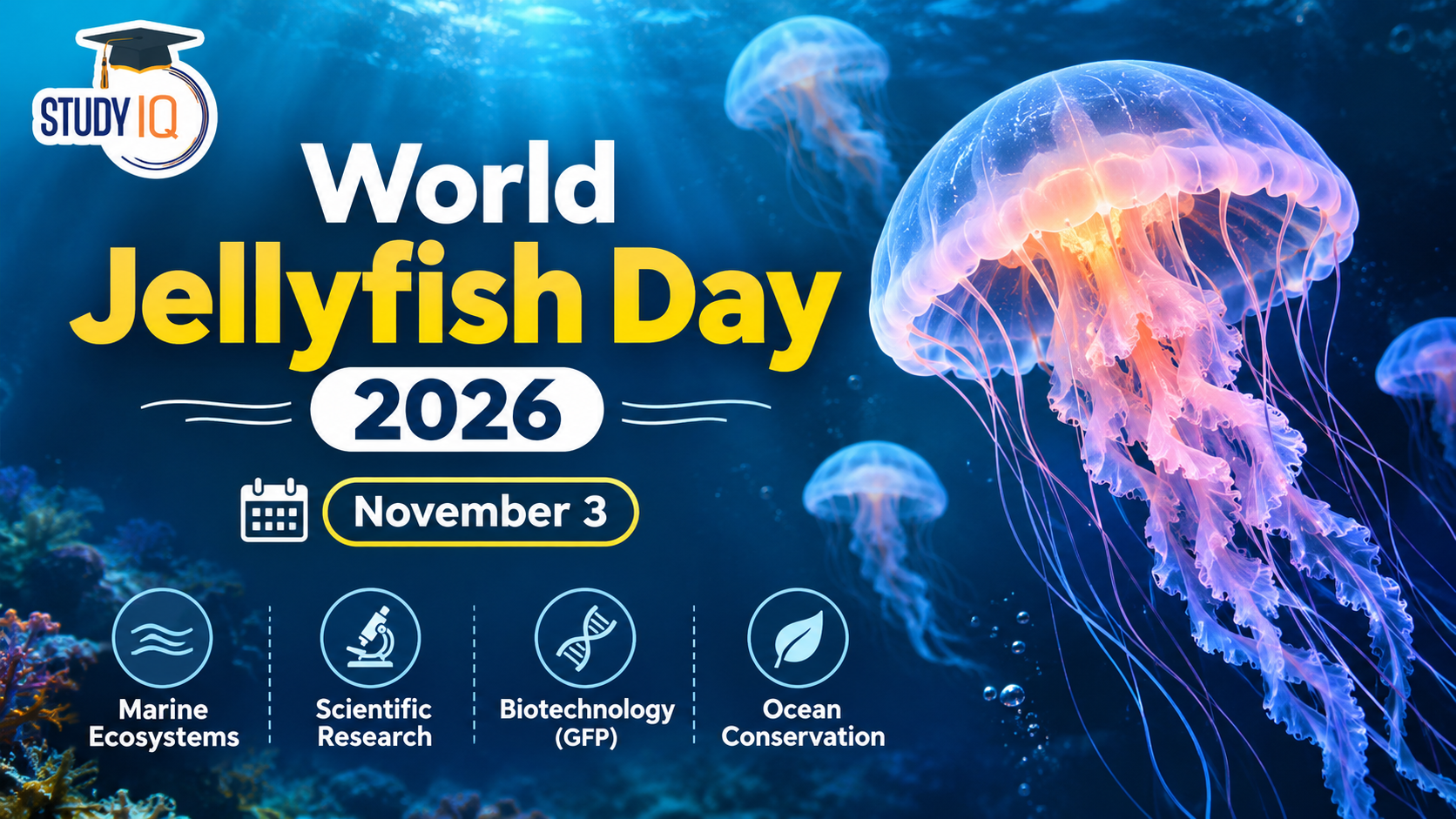
World Jellyfish Day is observed annually on November 3 to raise awareness about jellyfish, their ecological importance, unique biological characteristics and contribution to scientific research. Although jellyfish are often associated with painful stings, they play an important role in maintaining marine food webs and ocean biodiversity.
These ancient marine invertebrates are also significant in biotechnology, particularly because of the discovery of Green Fluorescent Protein (GFP), which has transformed modern biological research.
Read Also: UPSC Daily Current Affairs 2026
World Jellyfish Day 2026: Date and History
-
Date: November 3, 2026.
-
Observation: Every year on November 3.
-
Purpose: To create awareness about jellyfish, marine biodiversity and ocean conservation.
-
History: The day has appeared in various annual observance calendars since 2014.
-
Origin: There is limited reliable historical information identifying the original founder or explaining why November 3 was selected.
World Jellyfish Day is an awareness observance rather than an officially established United Nations international day.
What Are Jellyfish?
Jellyfish are free-swimming marine invertebrates belonging to the phylum Cnidaria, which also includes corals, sea anemones and hydras.
They are recognised by their umbrella-shaped bodies, called bells, and long, trailing tentacles.
Important biological characteristics include:
-
Their bodies consist of approximately 95% water.
-
They do not have a brain, heart, blood or bones.
-
They possess a simple nervous system called a nerve net.
-
Their bodies contain a jelly-like substance called mesoglea.
-
They use specialised stinging cells called cnidocytes to capture prey and defend themselves.
-
Most true jellyfish have a gastrovascular cavity with a single opening that functions as both mouth and exit.
Ecological Importance of Jellyfish in Marine Ecosystems
Jellyfish play an important role in maintaining ecological balance and regulating marine food webs.
1. Maintaining Marine Food Chains
Jellyfish consume plankton, fish eggs, larvae and small crustaceans. They are also an important food source for several marine species.
2. Supporting Marine Biodiversity
They serve as prey for leatherback sea turtles, ocean sunfish and certain fish species, contributing to the interconnected marine ecosystem.
3. Regulating Marine Populations
By feeding on plankton and fish larvae, jellyfish influence the population dynamics of several marine organisms.
4. Nutrient Cycling
Jellyfish contribute to the movement and recycling of nutrients through marine food webs, including through their waste and decomposition.
5. Indicating Marine Environmental Changes
Changes in jellyfish populations can provide useful information about ocean warming, pollution, nutrient availability and changing marine ecosystems.
Importance of Jellyfish in Science and Biotechnology
Jellyfish have made significant contributions to modern biological and medical research through the discovery of Green Fluorescent Protein (GFP).
-
GFP was first isolated from the jellyfish Aequorea victoria.
-
Japanese scientist Osamu Shimomura discovered and studied this fluorescent protein in the 1960s.
-
GFP emits green fluorescence when exposed to suitable light.
-
Scientists use GFP as a biological marker to observe cellular processes and track protein behaviour in living cells.
Nobel Prize in Chemistry 2008:
The Nobel Prize in Chemistry 2008 was awarded to:
-
Osamu Shimomura
-
Martin Chalfie
-
Roger Y. Tsien
They were recognised for the discovery and development of GFP, which became an essential tool in modern life sciences.
10 Interesting Facts About Jellyfish
1. Ancient Marine Creatures: Jellyfish-like organisms have existed in Earth’s oceans for hundreds of millions of years, predating dinosaurs.
2. Approximately 95% Water: Their bodies are composed mainly of water, with the remaining portion containing proteins, muscles and nerve cells.
3. No Brain: Jellyfish lack a centralised brain and use a network of nerves called a nerve net to respond to their surroundings.
4. Single Digestive Opening: Most true jellyfish have one opening that functions as both the mouth and the exit for undigested waste.
5. Carnivorous Nature: They feed on plankton, small crustaceans, fish eggs, larvae and sometimes other jellyfish.
6. Bioluminescence: Some jellyfish produce light through chemical reactions, which can help them defend themselves or interact with their environment.
7. Different Lifespans: Their lifespans vary considerably depending on the species, ranging from relatively short periods to several years.
8. Immortal Jellyfish: Turritopsis dohrnii can revert from its adult medusa stage to an earlier polyp stage under certain conditions, potentially repeating its life cycle.
9. Extremely Long Tentacles: The Lion’s Mane Jellyfish (Cyanea capillata) is known for its exceptionally long tentacles.
10. Contribution to Medical Research: The discovery of GFP from Aequorea victoria has helped scientists study cells, proteins and biological processes.
Jellyfish Conservation: Major Threats and Challenges
Despite their ecological importance, jellyfish populations are influenced by several environmental changes.
Major challenges include:
-
Ocean Warming: Rising sea temperatures can influence jellyfish reproduction, distribution and population dynamics.
-
Marine Pollution: Plastic pollution and chemical contaminants threaten marine habitats.
-
Eutrophication: Excessive nutrient input can alter marine ecosystems and favour jellyfish blooms in certain conditions.
-
Overfishing: Changes in fish populations can disrupt marine food webs and influence jellyfish abundance.
-
Habitat Degradation: Coastal development and marine ecosystem disturbances affect biodiversity.
Large jellyfish blooms can also create problems for fisheries, tourism, and coastal infrastructure by clogging fishing nets and interfering with industrial seawater intake systems.

 National Organ Transplant Games 2026: Or...
 MP ADPO Prelims Exam Analysis 2026: SET ...
 NVS-03 Satellite: NavIC Revival, Feature...














 WhatsApp