Table of Contents
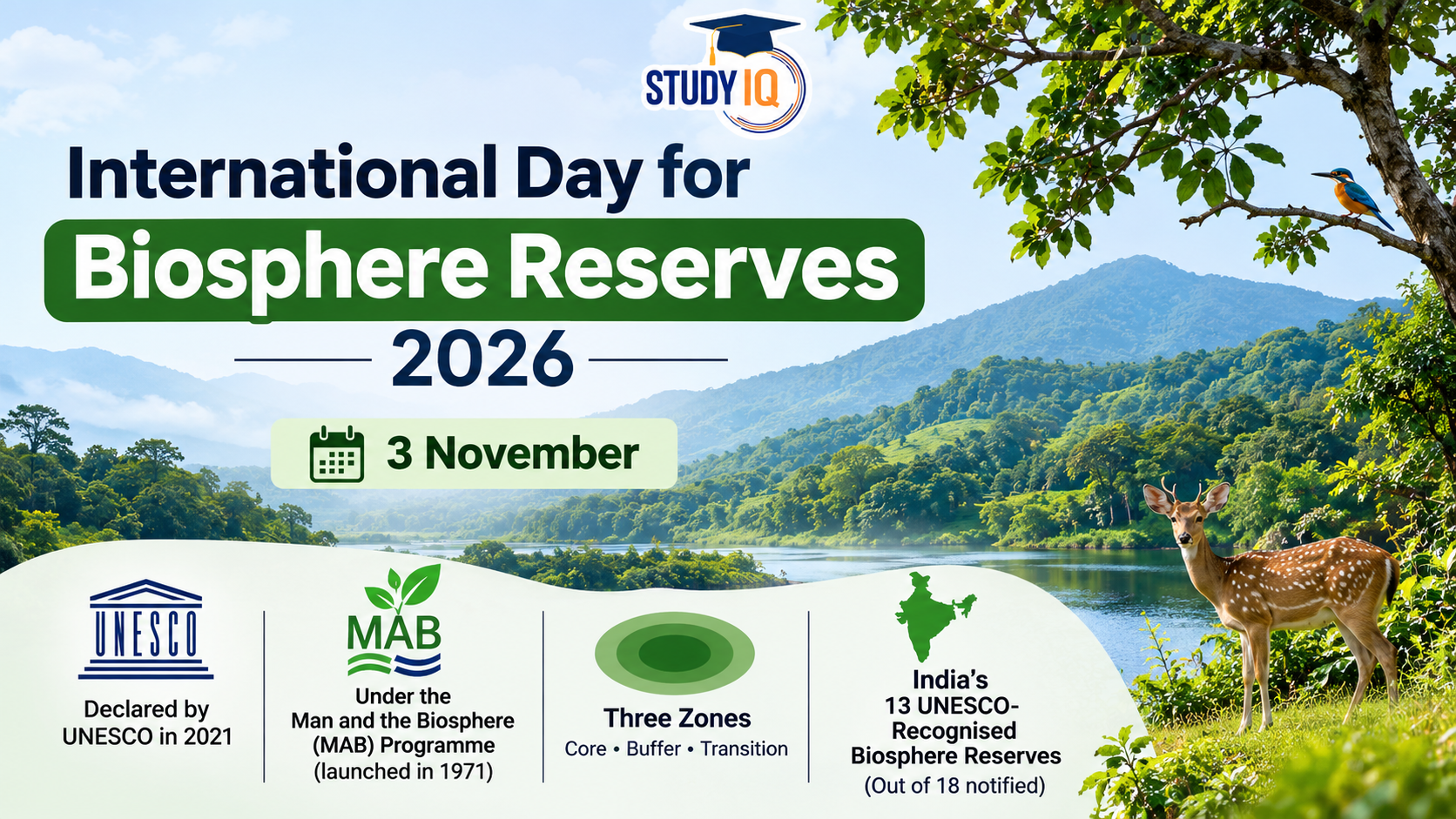
International Day for Biosphere Reserves 2026 is observed on 3 November to promote biodiversity conservation, sustainable development and the harmonious relationship between humans and nature. UNESCO established this international observance in 2021 to highlight the importance of biosphere reserves in protecting ecosystems while supporting local communities.
India has 18 nationally notified biosphere reserves, of which 13 are recognised under UNESCO’s World Network of Biosphere Reserves (WNBR). The latest addition is the Cold Desert Biosphere Reserve in Himachal Pradesh, recognised in September 2025.
Read Also: UPSC Daily Current Affairs 2026
International Day for Biosphere Reserves 2026: Key Highlights
-
Date: 3 November 2026
-
Declared by: UNESCO
-
Declaration year: 2021
-
First observed: 3 November 2022
-
Associated programme: Man and the Biosphere (MAB)
-
MAB Programme launched: 1971
-
Biosphere reserves in India: 18
-
UNESCO-recognised reserves in India: 13
-
Latest addition: Cold Desert Biosphere Reserve, Himachal Pradesh (2025)
Why is International Day for Biosphere Reserves Celebrated?
The day highlights the importance of conserving biodiversity while ensuring sustainable economic and social development.
Biosphere reserves demonstrate how humans can coexist with nature without damaging ecological systems.
Major objectives include:
-
Promoting biodiversity conservation and ecosystem protection.
-
Encouraging sustainable utilisation of natural resources.
-
Protecting endangered species and their habitats.
-
Supporting scientific research and environmental education.
-
Encouraging participation of indigenous and local communities.
-
Promoting international cooperation for sustainable development.
What Are Biosphere Reserves?
Biosphere reserves are terrestrial, marine or coastal areas recognised under UNESCO’s Man and the Biosphere (MAB) Programme.
They aim to conserve biological and cultural diversity while promoting environmentally sustainable development. They are often described as living laboratories for sustainable development.
Biosphere reserves perform three major functions:
-
Conservation: Protect biodiversity, ecosystems, landscapes and genetic resources.
-
Development: Promote sustainable economic activities, ecotourism and local livelihoods.
-
Logistic Support: Encourage scientific research, environmental monitoring, education and training.
Three Zones of Biosphere Reserves
Biosphere reserves are divided into three interconnected zones:
-
Core Zone: Legally protected area dedicated to conserving ecosystems, species and genetic diversity. Human activities are highly restricted.
-
Buffer Zone: Surrounds or adjoins the core zone. It supports research, education, environmental monitoring and sustainable activities.
-
Transition Zone: The outermost zone where local communities live and undertake sustainable economic activities such as agriculture, tourism and fisheries.
UNESCO Man and the Biosphere (MAB) Programme
The Man and the Biosphere Programme was launched by UNESCO in 1971. It is an intergovernmental scientific programme that aims to improve the relationship between humans and their environment.
Its major objectives include biodiversity conservation, sustainable resource management, scientific research, environmental education and international cooperation.
Biosphere reserves recognised under this programme are connected through the World Network of Biosphere Reserves (WNBR).
India’s 13 UNESCO-Recognised Biosphere Reserves
India has 18 nationally notified biosphere reserves, of which 13 are included in UNESCO’s World Network of Biosphere Reserves.
| No. | Biosphere Reserve | State(s) |
|---|---|---|
| 1 | Nilgiri | Tamil Nadu, Kerala, Karnataka |
| 2 | Gulf of Mannar | Tamil Nadu |
| 3 | Sundarbans | West Bengal |
| 4 | Nanda Devi | Uttarakhand |
| 5 | Nokrek | Meghalaya |
| 6 | Pachmarhi | Madhya Pradesh |
| 7 | Similipal | Odisha |
| 8 | Achanakmar-Amarkantak | Madhya Pradesh, Chhattisgarh |
| 9 | Great Nicobar | Andaman and Nicobar Islands |
| 10 | Agasthyamalai | Kerala, Tamil Nadu |
| 11 | Khangchendzonga | Sikkim |
| 12 | Panna | Madhya Pradesh |
| 13 | Cold Desert | Himachal Pradesh |
Important Facts:
-
Nilgiri was India’s first biosphere reserve included in UNESCO’s World Network in 2000.
-
Cold Desert became India’s 13th UNESCO-recognised biosphere reserve in September 2025.
-
India’s Great Rann of Kutch is a nationally notified biosphere reserve but is not part of UNESCO’s World Network.
World Network of Biosphere Reserves (WNBR): 2026 Statistics
According to the June 2026 figures:
-
797 biosphere reserves across the world.
-
145 countries are represented.
-
Approximately 7.5 million square kilometres of area covered.
-
Around 300 million people directly benefit from these sites.
The network promotes international cooperation, scientific knowledge-sharing and sustainable development.
Significance of Biosphere Reserves for India
Biosphere reserves play an important role in India’s environmental conservation and sustainable development.
-
Biodiversity protection: Conserve endangered species and ecologically important habitats.
-
Climate change mitigation: Forests, wetlands and mangroves act as carbon sinks.
-
Sustainable livelihoods: Support ecotourism, traditional occupations and local economic activities.
-
Community participation: Involve indigenous and local communities in conservation.
-
Scientific research: Provide opportunities for ecological monitoring and environmental studies.

 National Social Security Board for Unorg...
 APPSC AEE Recruitment 2026: Notification...
 World Jellyfish Day 2026: Significance a...














 WhatsApp