Table of Contents
Context
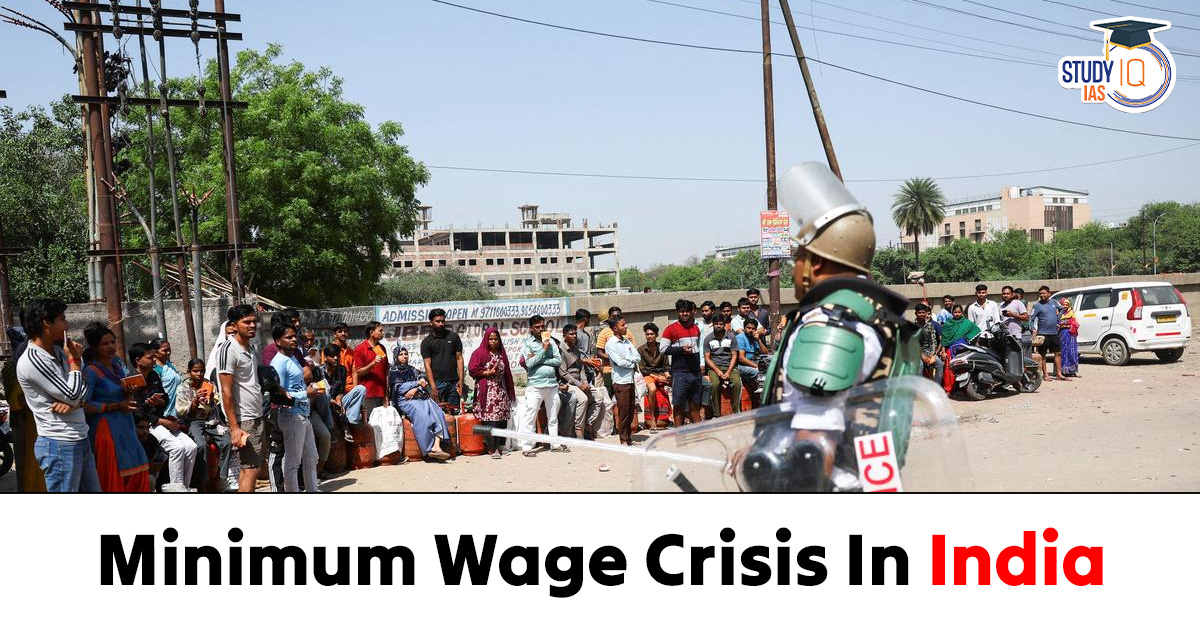
Thousands of factory workers in Noida staged protests demanding:
- Minimum wage hikes
- Better working conditions
- Overtime pay
The protests turned violent in several instances, indicating rising frustration among workers.
Immediate Trigger:
- A 35% minimum wage hike in Haryana (after protests in Manesar) led workers in neighbouring regions like Noida to demand similar revisions.
- These protests reflect growing distress due to rising living costs, especially amid inflation linked to global factors such as the West Asia conflict.
- Workers argue that wages have not kept pace with the increasing cost of living.
Check Here: Noida Workers Protest 2026
Delay in Minimum Wage Revisions
Minimum wage has two components:
- Base Wage
- Fixed component of wages.
- Ideally revised every 5 years.
- Cost of Living Allowance (DA)
- Linked to Consumer Price Index–Industrial Workers (CPI-IW).
- Revised twice a year to reflect inflation changes.
Issue of Delayed Revisions
Base wage revisions have been significantly delayed:
- Haryana revised wages after 10 years
- Uttar Pradesh was last revised in 2012, relying only on interim hikes
- Although many states carried out half-yearly DA revisions, they failed to revise base wages.
- The delays became more pronounced after COVID-19, worsening the situation.
- This has created a widening gap between inflation-driven expenses and stagnant base wages, exposing structural weaknesses in India’s wage policy and labour welfare system.
Rising Cost of Living and Worker Distress
Inflation Trends (CPI-IW Data, Base Year 2016)
- National inflation (Feb 2021 – Feb 2026): 24.8%
- Higher inflation in key industrial regions:
- Gurugram: 27.9%
- Faridabad: 27.2%
- Ghaziabad, Noida, Delhi: 27.4%
- Wage Growth vs Inflation
- Haryana: Wage growth is only 15%
- Uttar Pradesh: 24.6%
- Delhi: 20.6%
This mismatch indicates that the real incomes of workers have declined, particularly in the Delhi-NCR region.
Industrial and Global Pressures
Rising input costs due to:
- US tariffs
- Disruptions like the Strait of Hormuz crisis
- Impact on industries:
- Delayed wage payments
- Increased job insecurity
Rising Household Expenses for Workers
- Workers, many of whom are migrants, face increasing financial pressures:
- LPG cylinders in black markets cost up to ₹4,000
- Rising room rents
- Increasing food prices
These rising expenses have significantly worsened workers’ financial burden.
- The combined effect of:
- Inflation
- Wage stagnation
- Industrial slowdown
has intensified economic stress, leading to protests and labour unrest.
Labour Codes and Worker Expectations
- Expectations After Notification (November 2025)
- Workers expected higher and uniform wages after the introduction of new labour codes.
- Widespread belief that minimum wage would increase to ₹20,000 per month.
Uncertainty in Implementation of Labour Codes
Four Labour Codes in India came into effect in November 2025:
- Code on Wages
- Code on Social Security
- Industrial Relations Code
- Occupational Safety, Health and Working Conditions (OSH) Code
- However:
- Final rules are yet to be notified by the Centre and the states
- Draft rules issued in December 2025 created uncertainty
Concerns Raised by Experts and Workers
Risk of Exploitation
- Flexibility without safeguards may lead to:
- Longer working hours
- Increased workload without proportional pay
Lack of Uniformity Across States
- States frame their own rules:
- Regional disparities in wages
- Differences in working conditions
- Creates confusion for both workers and employers
Weakening of Collective Bargaining
- Trade union recognition is left largely to the states
- No uniform system for collective bargaining
- Reduces workers’ negotiating power
Conclusion
The protests in Noida and Manesar highlight deep structural issues in India’s labour system:
- Delayed wage revisions
- Rising inflation
- Policy uncertainty
- The gap between:
- Rising cost of living
- Stagnant wages
Way Forward
- Ensure timely revision of base wages
- Provide a clear and uniform implementation of labour codes
- Introduce strong safeguards against exploitation
- Align wages more effectively with inflation trends.

 Circular Economy in India: Benefits, Cha...
 India Forex Reserve 2026: Record $785.7 ...
 Skyroot Vikram-1 Mission Aagaman: India'...














 WhatsApp