
Table of Contents
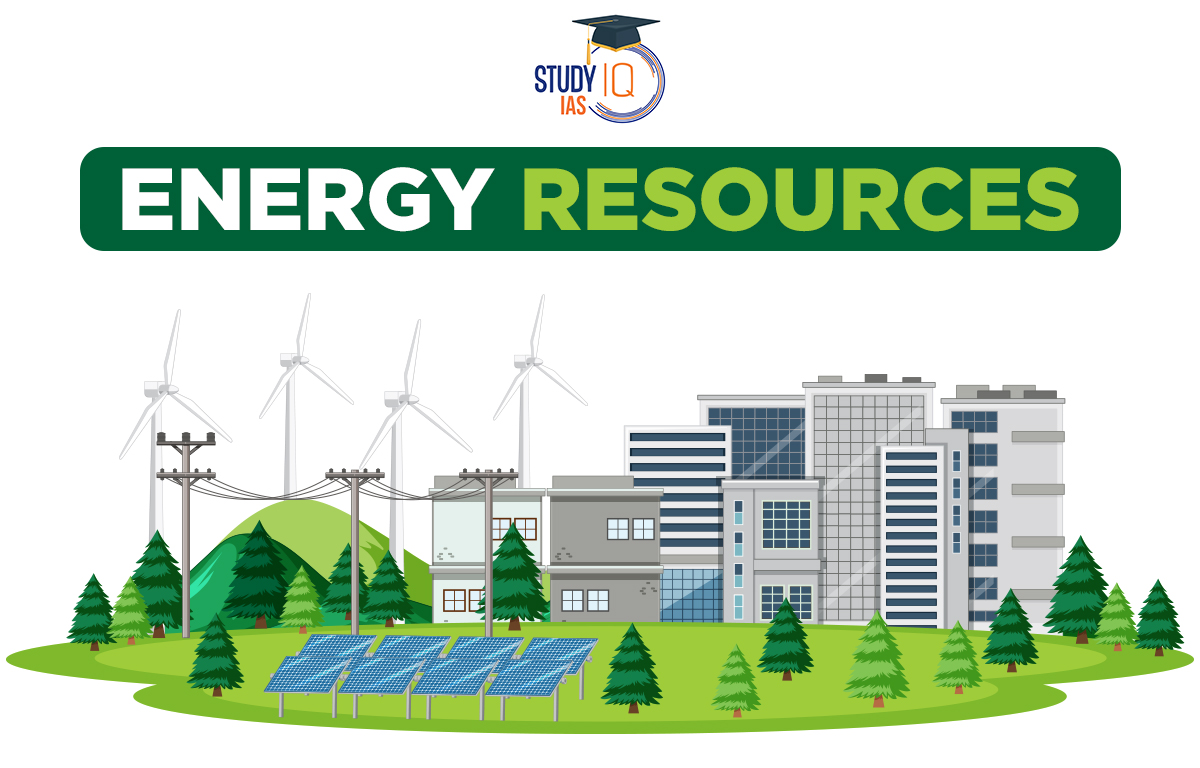
Energy resources are natural or manufactured sources from which energy can be obtained for electricity generation, transportation, heating, industrial production and domestic use. Energy is fundamental to economic development, infrastructure, agriculture and modern lifestyles.
For UPSC, energy resources are important because the topic connects Indian Geography, Economy, Environment, Science & Technology, Energy Security and Climate Change.
What are Energy Resources?
Energy resources are sources that provide usable energy. They may be classified on the basis of their availability, origin, renewability and conventional use.
Major Categories
- Non-renewable energy resources
- Coal
- Petroleum
- Natural Gas
- Nuclear fuels such as uranium and thorium
- Renewable energy resources
- Solar
- Wind
- Hydropower
- Biomass
- Geothermal
- Tidal and wave energy
Important Concept
Renewable does not always mean completely pollution-free.
For example, solar and wind power have very low operational emissions, but their manufacturing, land use, transmission infrastructure, mining requirements and end-of-life waste can have environmental impacts.
Conventional and Non-Conventional Sources
The conventional/non-conventional classification is largely historical and usage-based, rather than a strict scientific classification.
| Conventional Sources | Non-Conventional / Newer Energy Sources |
|---|---|
| Coal | Solar |
| Petroleum | Wind |
| Natural Gas | Tidal |
| Large-scale hydropower in traditional classifications | Geothermal |
| Widely used historically | Biomass and waste-to-energy |
| Mostly established technologies | Emerging/decentralised technologies |
Important: Nuclear energy is not renewable, because uranium and other nuclear fuels are finite. However, nuclear power is generally classified as a low-carbon/non-fossil source of electricity.
Conventional Energy Resources
1. Coal
Coal remains an important source of energy for India’s electricity generation and industrial sectors, particularly thermal power, steel and cement.
Important Facts
- Indian coal deposits are mainly associated with the Gondwana and Tertiary geological formations.
- Major Gondwana coalfields are concentrated in eastern and central India.
- Important coalfields include:
- Jharia
- Raniganj
- Bokaro
- Giridih
- North Karanpura
- South Karanpura
- Talcher
- Korba
- Singrauli
- Major coal-bearing regions are associated with the Damodar, Son, Mahanadi and Godavari river valleys.
- Tertiary coal occurs mainly in parts of Assam, Meghalaya, Arunachal Pradesh and Nagaland.
- Lignite deposits are important in Tamil Nadu, Gujarat, Rajasthan and Jammu & Kashmir.
Why is Coal Important for India?
- Base-load electricity generation
- Steel production
- Industrial heat
- Employment and regional development
- Energy security
Major Concerns
- Air pollution
- Greenhouse-gas emissions
- Land degradation
- Mine fires and subsidence
- Water pollution
- Rehabilitation of mining regions
2. Petroleum
Petroleum or crude oil is a mixture of hydrocarbons occurring mainly in sedimentary basins.
Uses
Petroleum is used for:
- Petrol and diesel
- Aviation fuel
- Lubricants
- Petrochemicals
- Synthetic fibres
- Plastics
- Pharmaceuticals
- Fertilisers and chemicals
Major Oil-Producing Regions of India
Assam
Important oil fields include:
- Digboi
- Naharkatiya
- Moran
Gujarat
Important areas include:
- Ankleshwar
- Kalol
- Mehsana
Western Offshore
- Mumbai High is one of India’s major offshore oil fields.
Eastern Offshore
Hydrocarbon resources are also associated with:
- Krishna-Godavari Basin
- Cauvery Basin
Petroleum Refining
India has a large and geographically diversified refining industry.
Two useful geographical concepts are:
- Field-based refineries: located close to oil-producing areas.
- Market-based refineries: located closer to major consumption and transport centres.
3. Natural Gas
Natural gas is a fossil fuel composed primarily of methane.
It is used for:
- Electricity generation
- Fertiliser production
- City gas distribution
- Industrial fuel
- Domestic cooking
- Petrochemical industries
Major Producing/Resource Regions
Natural gas resources occur in:
- Assam
- Gujarat
- Tripura
- Rajasthan
- Krishna-Godavari Basin
- Cauvery Basin
- Western and eastern offshore areas
Advantages
Natural gas generally produces lower CO₂ emissions per unit of electricity than coal.
Limitations
- It remains a fossil fuel.
- Methane leakage can significantly affect its climate impact.
- India remains dependent on imports for a substantial portion of its gas requirements.
Renewable Energy Resources
Renewable energy comes from sources that are naturally replenished on a human timescale.
Major sources include:
- Solar
- Wind
- Hydropower
- Biomass
- Geothermal
- Tidal
- Wave energy
India’s Renewable Energy Status – 2026
India’s renewable-energy sector has expanded rapidly, particularly solar and wind power.
According to the Ministry of New and Renewable Energy, as of 31 August 2026:
| Energy Source | Installed Capacity |
|---|---|
| Solar | 168.04 GW |
| Wind | 58.52 GW |
| Small Hydro | 5.18 GW |
| Biomass Bagasse Cogeneration | 9.82 GW |
| Biomass Non-Bagasse Cogeneration | 1.05 GW |
| Waste-to-Energy | 0.32 GW |
| Large Hydro | 52.06 GW |
| Total Renewable Energy | 295.55 GW |
| Nuclear | 8.78 GW |
| Total Non-Fossil Capacity | 304.33 GW |
Large hydro is included in the renewable-energy total by MNRE, while nuclear is counted separately as a non-fossil source.
Key Observation
Solar has become India’s largest renewable-energy source by installed capacity, followed by wind and large hydropower.
1. Solar Energy
Solar energy is obtained by converting sunlight into useful energy.
Major Technologies
Solar Photovoltaic (PV)
Converts sunlight directly into electricity.
Solar Thermal
Uses solar radiation to produce heat.
Major Solar Regions
High solar potential is particularly associated with:
- Rajasthan
- Gujarat
- Ladakh
- Maharashtra
- Madhya Pradesh
- Andhra Pradesh
- Telangana
- Karnataka
India’s Solar Capacity
As of 31 August 2026, India’s installed solar capacity stood at approximately 168.04 GW.
This included:
- Ground-mounted solar: about 123.99 GW
- Grid-connected rooftop solar: about 32.59 GW
- Hybrid projects – solar component: about 4.83 GW
- Off-grid solar: about 6.63 GW
Important Solar Initiatives
- National Solar Mission
- Solar Parks
- PM Surya Ghar: Muft Bijli Yojana
- PM-KUSUM
- Rooftop Solar Programme
- International Solar Alliance
Challenges
- Intermittency
- Land requirements
- Grid integration
- Energy storage
- Solar-panel waste
- Dependence on imported components and critical minerals
2. Wind Energy
Wind turbines convert the kinetic energy of moving air into electricity.
Major Wind-Energy States
- Gujarat
- Tamil Nadu
- Karnataka
- Maharashtra
- Rajasthan
- Andhra Pradesh
India’s installed wind capacity reached approximately 58.52 GW by 31 August 2026.
Advantages
- Renewable
- Low operational emissions
- Suitable for utility-scale generation
- Can complement solar generation in some regions
Challenges
- Variable generation
- Land and transmission requirements
- Ecological concerns in sensitive areas
- Need for grid balancing and storage
Emerging Area: Offshore Wind
India has substantial offshore-wind potential, particularly along the Gujarat and Tamil Nadu coasts, although development remains more challenging and capital-intensive than onshore wind.
3. Hydropower
Hydropower converts the potential and kinetic energy of flowing or falling water into electricity.
Major Advantages
- Renewable
- Flexible generation
- Can provide peak-load support
- Important for grid balancing
- Pumped-storage hydropower can function as an energy-storage system
Major Regions
Hydropower potential is particularly significant in:
- Himalayas
- Northeast India
- Western Ghats
Major river systems include:
- Indus
- Ganga
- Brahmaputra
Challenges
- Displacement
- Ecological impacts
- Sedimentation
- Alteration of river flows
- Landslide and seismic concerns in some Himalayan areas
4. Tidal and Wave Energy
India has a long coastline and therefore possesses potential for marine energy.
Tidal Energy
Tidal energy uses the periodic rise and fall of sea levels.
Potential areas include:
- Gulf of Khambhat
- Gulf of Kachchh
- Sundarbans region
Wave Energy
Wave energy uses the movement of ocean waves to generate electricity.
Challenges
- High capital cost
- Difficult marine environment
- Corrosion
- Maintenance challenges
- Limited commercial deployment
5. Geothermal Energy
Geothermal energy uses heat from the Earth’s interior.
Potential geothermal locations in India include:
- Puga Valley, Ladakh
- Manikaran, Himachal Pradesh
- Tattapani, Chhattisgarh
- Cambay Basin, Gujarat
Uses
- Electricity generation
- Heating
- Industrial applications
- Geothermal heat pumps
India’s geothermal potential remains largely underdeveloped compared with solar and wind.
6. Biomass and Bioenergy
Biomass energy is produced from organic material such as:
- Agricultural residues
- Bagasse
- Wood waste
- Animal waste
- Municipal organic waste
- Industrial biological waste
Major Applications
- Biogas
- Electricity generation
- Cooking fuel
- Biofuels
- Industrial heat
Advantages
- Converts waste into useful energy
- Supports rural economies
- Can reduce dependence on traditional biomass
- Provides dispatchable renewable power in suitable applications
Challenges
- Feedstock availability
- Collection and transportation
- Competing uses of agricultural residues
- Air pollution from inefficient combustion
Nuclear Energy
Nuclear power is a non-fossil, low-carbon source of electricity, but it is not renewable.
India uses nuclear technology primarily based on uranium and is pursuing a long-term strategy involving thorium utilisation and fast-breeder technology.
Major Nuclear Power Locations
- Tarapur – Maharashtra
- Rawatbhata – Rajasthan
- Kalpakkam – Tamil Nadu
- Narora – Uttar Pradesh
- Kaiga – Karnataka
- Kakrapar – Gujarat
- Kudankulam – Tamil Nadu
- Gorakhpur – Haryana
Nuclear Capacity in 2026
India’s installed nuclear power capacity was 8,780 MW, with 24 reactors in commercial operation, excluding RAPS-1, according to government data.
Nuclear power contributed about 3.1% of India’s electricity generation in 2025–26.
Nuclear Energy Mission
In 2026, the Government announced a long-term objective of achieving 100 GW of nuclear power capacity by 2047.
The strategy includes:
- Expansion of indigenous PHWR technology
- Greater participation of public and private sectors
- Research and development in Small Modular Reactors (SMRs)
- Advanced nuclear technologies
- Expansion of fast-breeder technology
The government has also announced the SHANTI Act as part of the framework for wider participation in the nuclear sector.
Energy Storage: The Missing Link
The rapid growth of solar and wind has increased the importance of energy storage.
Renewable electricity generation can vary according to:
- Sunshine
- Wind speed
- Weather
- Seasonal conditions
Therefore, India’s energy transition increasingly requires:
Battery Energy Storage Systems (BESS)
Batteries store electricity when supply is high and release it when demand rises.
Pumped Storage Hydropower (PSP)
Water is pumped to an upper reservoir when electricity is available and released through turbines when electricity is required.
Why Storage Matters
Energy storage can help:
- Integrate renewable power
- Meet peak demand
- Improve grid stability
- Reduce renewable-energy curtailment
- Provide round-the-clock renewable electricity
The National Electricity Plan projects substantial growth in battery storage and pumped-storage requirements through 2031–32.
Green Hydrogen
Green hydrogen is hydrogen produced using renewable electricity, generally through electrolysis of water.
India’s National Green Hydrogen Mission, launched in 2023, aims to establish India as a global hub for production, utilisation and export of green hydrogen and its derivatives.
2030 Targets
- At least 5 million metric tonnes per annum of green hydrogen
- Around 125 GW of additional renewable-energy capacity
- Development of domestic electrolyser manufacturing
- Reduction in fossil-fuel dependence
- Decarbonisation of hard-to-abate sectors
Potential applications include:
- Fertiliser
- Refineries
- Steel
- Shipping
- Heavy transport
- Green ammonia
- Green methanol
Major Government Initiatives Related to Energy
1. PM Surya Ghar: Muft Bijli Yojana
Focuses on rooftop solar for households and aims to expand decentralised clean-energy generation.
2. PM-KUSUM
The scheme promotes solarisation of agriculture through:
- Decentralised renewable-energy plants
- Standalone solar agricultural pumps
- Solarisation of grid-connected agricultural pumps and feeders
The PM-KUSUM dashboard reported substantial implementation progress through July 2026.
3. National Green Hydrogen Mission
Focuses on developing India’s green-hydrogen production, manufacturing and export ecosystem.
4. National Solar Mission
Promotes large-scale solar-energy deployment.
5. International Solar Alliance
India and France launched the ISA to promote solar-energy deployment internationally, particularly in solar-rich developing countries.
6. Green Energy Corridors
Designed to strengthen transmission infrastructure required for integrating renewable-energy capacity into the national grid.
India’s Energy Transition
India’s energy transition involves moving towards a system based on:
Renewables + Nuclear + Storage + Grid Modernisation + Energy Efficiency + Green Fuels
However, the transition is not an immediate replacement of fossil fuels.
Coal and other fossil fuels continue to play an important role in meeting India’s electricity and industrial-energy requirements.
The challenge is therefore to achieve:
Energy Security + Economic Growth + Energy Access + Environmental Sustainability
Energy Conservation
Energy conservation means reducing unnecessary energy consumption and using energy more efficiently.
Major Measures
- Energy-efficient appliances
- LED lighting
- Public transport
- Electric mobility
- Energy-efficient buildings
- Industrial energy efficiency
- Smart grids
- Efficient irrigation
- Rooftop solar
- Recycling and circular-economy practices
- Reduced transmission and distribution losses
Why Energy Conservation Matters
Energy efficiency can:
- Reduce fuel consumption
- Lower electricity bills
- Reduce imports
- Improve energy security
- Reduce greenhouse-gas emissions
- Reduce pressure on natural resources
Major Challenges in India’s Energy Sector
1. Energy Security
India imports significant quantities of crude oil and other energy commodities.
2. Import Dependence
Dependence on imported fuels exposes India to:
- Geopolitical tensions
- Price volatility
- Supply disruptions
- Exchange-rate fluctuations
3. Renewable Intermittency
Solar and wind generation varies with weather conditions.
4. Storage
Large-scale deployment of batteries and pumped storage is essential for integrating variable renewable energy.
5. Transmission Infrastructure
Renewable resources are often located far from major consumption centres.
6. Critical Minerals
The clean-energy transition increases demand for minerals such as:
- Lithium
- Cobalt
- Nickel
- Graphite
- Rare earth elements
7. Land and Ecological Concerns
Large renewable-energy projects can create competing demands for land and affect local ecosystems.
Energy Resources: UPSC Prelims Facts
- Coal: Major fossil fuel and important thermal-power source.
- Petroleum: Hydrocarbon resource mainly found in sedimentary basins.
- Natural gas: Primarily methane.
- Solar: India’s largest renewable-energy source by installed capacity as of August 2026.
- Wind: Major potential along western and southern India.
- Hydropower: Renewable and useful for grid balancing.
- Nuclear: Non-fossil and low-carbon, but not renewable.
- Biomass: Converts biological material into useful energy.
- Green hydrogen: Produced using renewable electricity.
- BESS: Battery Energy Storage System.
- PSP: Pumped Storage Project.
- PM-KUSUM: Solarisation of agriculture.
- PM Surya Ghar: Rooftop solar for households.
- National Green Hydrogen Mission: India’s flagship green-hydrogen programme.

 Sangam Period: History, Literature, Soci...
 Home Rule Movement, History, Objectives,...
 Lokmanya Tilak Jayanti 2026: Biography, ...














 WhatsApp





