Table of Contents
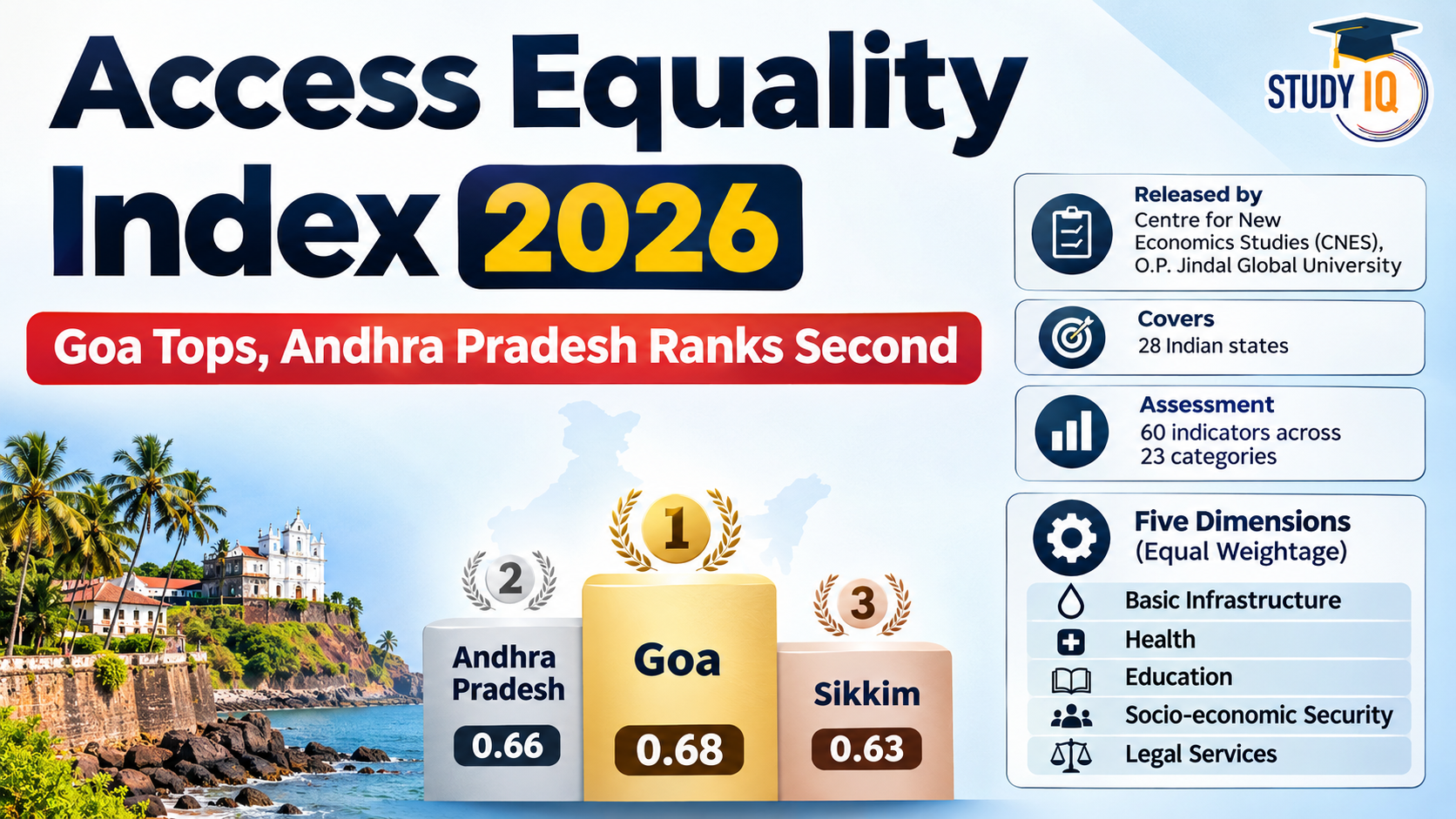
The Access Equality Index 2026 highlights the differences among Indian states in providing equitable access to essential services, infrastructure and economic opportunities. Developed by the Centre for New Economics Studies (CNES) at O.P. Jindal Global University, the index evaluates how effectively people can access basic facilities and opportunities required for a dignified life.
Goa secured the first position with a score of 0.68, followed by Andhra Pradesh at 0.66 and Sikkim at 0.63. The findings underline an important aspect of development: economic growth alone does not guarantee equal access to public services.
The index assesses 28 Indian states through five major dimensions, offering insights into regional inequalities and the quality of public service delivery.
Access Equality Index 2026: Top-Ranked States
The following table presents the leading states and their respective scores.
| Rank | State | Score |
|---|---|---|
| 1 | Goa | 0.68 |
| 2 | Andhra Pradesh | 0.66 |
| 3 | Sikkim | 0.63 |
| 4 | Kerala | 0.60 |
| 5 | Tamil Nadu | 0.57 |
| 5 | Telangana | 0.57 |
Key Findings
-
Goa emerged as the highest-ranked state with a score of 0.68.
-
Andhra Pradesh secured second position nationally.
-
Sikkim ranked third, highlighting the performance of smaller states.
-
Andhra Pradesh emerged as the leading major state.
-
Andhra Pradesh secured the highest position in socio-economic security, with a score of 0.69.
-
Goa ranked second in socio-economic security with a score of 0.50.
What Is the Access Equality Index?
The Access Equality Index measures the extent to which citizens can access essential services and opportunities. Unlike conventional development indicators that focus heavily on income and economic output, this index examines whether people can actually benefit from available public facilities.
Its central objective is to identify inequalities in accessibility across geographical regions and social groups.
The 2026 edition evaluates states using five equally weighted dimensions.
Five Major Dimensions of the Index
| Dimension | Areas Covered |
|---|---|
| Basic Infrastructure | Drinking water, sanitation, housing and clean energy |
| Health | Availability and accessibility of healthcare services |
| Education | Access to educational facilities and opportunities |
| Socio-economic Security | Employment, banking, insurance and pensions |
| Legal Services | Access to legal assistance and justice |
The index uses 60 indicators across 23 categories. All five dimensions carry equal weightage.
It also considers multiple aspects of accessibility, including affordability, geographical availability and service quality.
Importantly, the framework highlights inequalities between rural and urban populations, different caste groups and genders.
Background: Access (In)Equality Index 2021
The original Access (In)Equality Index was introduced in 2021 by the Centre for New Economics Studies at O.P. Jindal Global University.
The earlier edition assessed states and Union Territories across basic amenities, health, education, socio-economic security and justice.
Goa secured the first position in the 2021 edition with a score of 0.67. It performed particularly well in basic amenities, health and socio-economic security.
The earlier classification system divided states into three categories.
| Category | Index Score |
|---|---|
| Aspirants | Below 0.33 |
| Achievers | 0.33 to 0.42 |
| Front Runners | Above 0.42 |
The 2026 edition should be treated as a new assessment framework. Therefore, direct comparisons between the two editions’ scores and rankings should be avoided.
Constitutional Provisions Related to Equal Access
The findings of the index are closely connected with constitutional principles concerning social justice, welfare and equal opportunities.
| Constitutional Provision | Significance |
|---|---|
| Article 21A | Provides free and compulsory education for children aged 6 to 14 years. |
| Article 47 | Directs the State to improve nutrition, living standards and public health. |
| Article 37 | Establishes the importance of Directive Principles of State Policy in governance. |
| 86th Constitutional Amendment Act, 2002 | Introduced Article 21A. |
| Right to Education Act, 2009 | Provides the statutory framework for implementing Article 21A. |
| Legal Services Authorities Act, 1987 | Provides institutional mechanisms for free legal services and Lok Adalats. |
Water supply, irrigation and sanitation are also important areas of public service delivery, with constitutional responsibilities distributed through the Seventh Schedule.
Significance of the Access Equality Index 2026
The index is important because it shifts attention from economic growth towards inclusive development and the actual availability of essential services.
Its major contributions include:
-
Identifying regional disparities in access to essential services.
-
Highlighting inequalities affecting disadvantaged communities.
-
Encouraging evidence-based policymaking.
-
Promoting improvements in healthcare, education and infrastructure.
-
Strengthening the focus on social justice and inclusive growth.
-
Helping policymakers identify gaps in public service delivery.
Conclusion
The Access Equality Index 2026 demonstrates that meaningful development must go beyond economic performance. Equal access to healthcare, education, infrastructure, livelihood opportunities and legal assistance is essential for building an inclusive society.
Goa’s leading position and Andhra Pradesh’s strong performance provide important examples of state-level progress. However, the broader challenge remains ensuring that every citizen, irrespective of geographical location, gender or social background, can access essential services with dignity and equality.

 World Science Day 2026: Theme, History, ...
 COP31 Climate Summit 2026: Key Issues, I...
 Malabar Tree Toad: Karnataka’s State A...














 WhatsApp