
Table of Contents
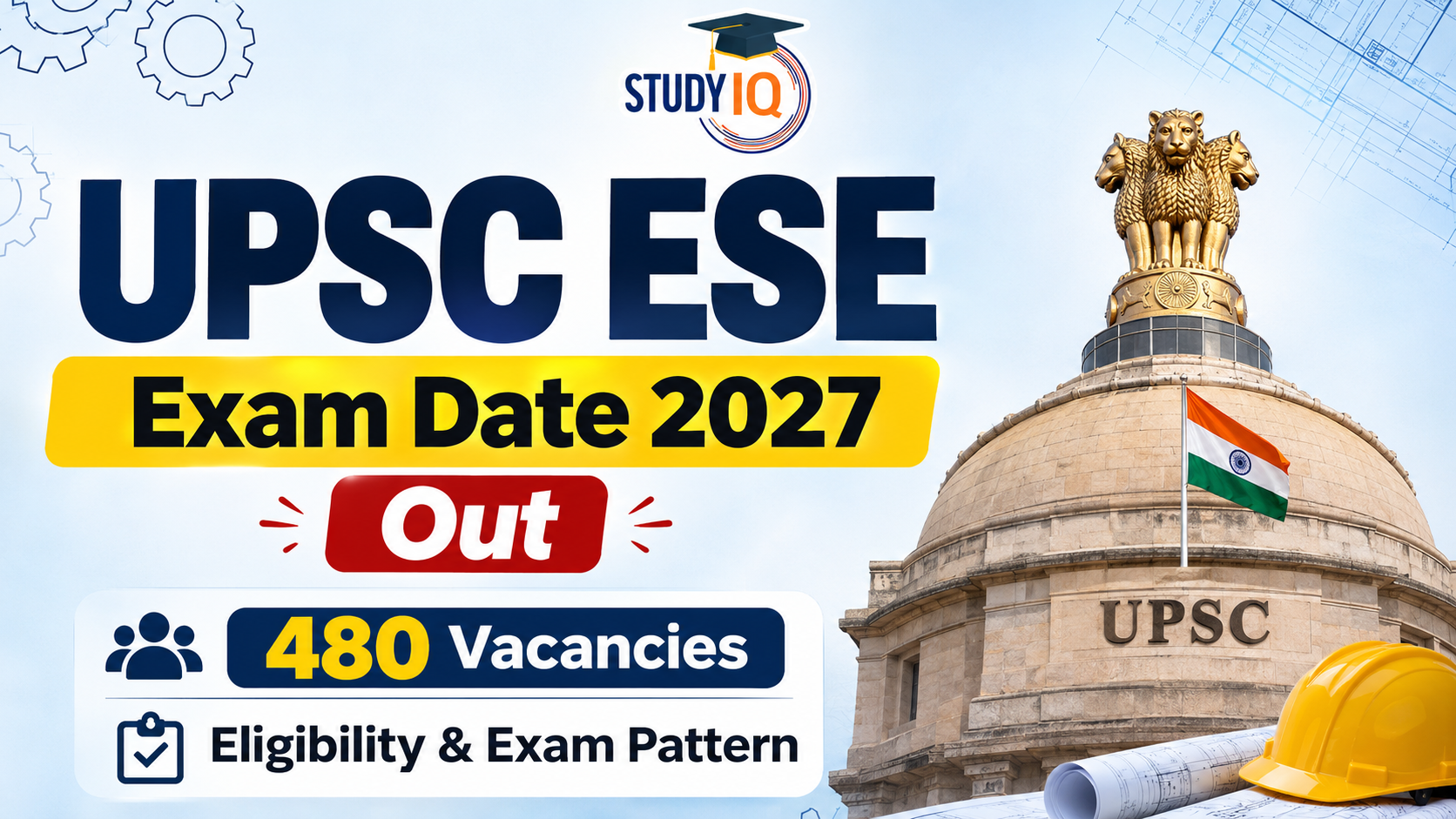
The Union Public Service Commission (UPSC) has announced the Engineering Services Examination (ESE) 2027 for recruitment to 480 engineering posts across various Central Government departments. The examination will be conducted for four engineering disciplines: Civil, Mechanical, Electrical, and Electronics & Telecommunication Engineering.
As per the announced schedule, the UPSC ESE Prelims 2027 will be held on 31 January 2027, while the Mains examination is scheduled for 18 June 2027. Engineering graduates aspiring to join prestigious Group A and Group B services can check the examination dates, vacancies, eligibility criteria, selection process and exam pattern below.
UPSC ESE 2027: Key Highlights
| Particulars | Details |
|---|---|
| Exam Conducting Body | Union Public Service Commission |
| Examination Name | Engineering Services Examination 2027 |
| Advertisement Number | 02/2027-ENGG |
| Total Vacancies | 480 |
| Post Category | Group A and Group B |
| Prelims Exam Date | 31 January 2027 |
| Mains Exam Date | 18 June 2027 |
| Engineering Streams | Civil, Mechanical, Electrical, Electronics & Telecommunication |
| Selection Process | Prelims, Mains and Personality Test |
| Official Website | upsc.gov.in |
UPSC ESE Exam Date 2027
UPSC has announced the examination schedule for the Engineering Services Examination 2027. Candidates should keep the following dates in mind:
-
Preliminary Examination: 31 January 2027
-
Main Examination: 18 June 2027
The Preliminary Examination will consist of two objective-type papers carrying a total of 600 marks. Candidates qualifying in the Prelims will be eligible to appear for the Mains examination.
UPSC ESE Vacancy 2027: 480 Posts
UPSC has announced 480 vacancies for the Engineering Services Examination 2027. Recruitment will cover the following four engineering disciplines:
-
Civil Engineering
-
Mechanical Engineering
-
Electrical Engineering
-
Electronics & Telecommunication Engineering
Selected candidates will be appointed to various technical services and departments of the Government of India, including engineering services associated with railways, defence and water resources.
The final distribution of vacancies among different engineering branches and services should be checked in the official notification.
UPSC ESE 2027 Eligibility Criteria
Candidates must fulfil the educational qualification and age requirements prescribed by UPSC to appear for the Engineering Services Examination.
1. Educational Qualification
Candidates must possess an engineering degree in the relevant discipline from a recognised university or institution.
The notification also recognises certain equivalent qualifications, including:
-
Sections A and B of the Institution Examinations of the Institution of Engineers (India).
-
Engineering qualifications from recognised foreign universities or institutions.
-
Graduate Membership Examination of the Institution of Electronics and Telecommunication Engineers (India).
-
Specified qualifications from the Aeronautical Society of India and other recognised professional institutions.
Candidates should check the official notification for the complete list of accepted qualifications.
2. Age Limit
The prescribed age limit for UPSC ESE 2027 is:
-
Minimum Age: 21 years
-
Maximum Age: 30 years
The age will be calculated as of 1 January 2027. Accordingly, candidates must have been born between 2 January 1997 and 1 January 2006 (both dates inclusive).
Age relaxation is applicable to eligible reserved categories as per government rules.
UPSC ESE 2027 Application Fee
Candidates are required to pay the prescribed examination fee while submitting their application.
| Category | Application Fee |
|---|---|
| General | ₹200 |
| OBC | ₹200 |
| EWS | ₹200 |
| SC/ST | Exempted |
| Female Candidates | Exempted |
| Persons with Benchmark Disabilities | Exempted |
The application fee is non-refundable.
UPSC ESE 2027 Selection Process
The selection process consists of three major stages:
-
Preliminary Examination: Objective-type screening examination covering General Studies, Engineering Aptitude and the relevant engineering discipline.
-
Main Examination: Conventional written examination consisting of two technical papers.
-
Personality Test: Candidates qualifying in the written examinations are called for an interview to assess their technical understanding, communication skills and suitability for engineering services.
Document verification and medical examination are also conducted as part of the recruitment process.
UPSC ESE Exam Pattern 2027
Understanding the examination pattern is important for candidates preparing for the three-stage selection process.
Stage 1: Preliminary Examination
The Preliminary Examination consists of two objective-type papers.
| Paper | Subject | Marks | Duration |
|---|---|---|---|
| Paper 1 | General Studies and Engineering Aptitude | 200 | 2 Hours |
| Paper 2 | Relevant Engineering Discipline | 300 | 3 Hours |
| Total | 500 | 5 Hours |
Stage 2: Main Examination
The Mains examination consists of two conventional-type papers based on the candidate’s engineering discipline.
| Paper | Subject | Marks | Duration |
|---|---|---|---|
| Paper 1 | Engineering Discipline | 300 | 3 Hours |
| Paper 2 | Engineering Discipline | 300 | 3 Hours |
| Total | 600 | 6 Hours |
Candidates should also prepare for the Personality Test, which evaluates their technical knowledge, decision-making ability and overall suitability for engineering services.
How to Prepare for UPSC ESE 2027?
With the Preliminary Examination scheduled for 31 January 2027, candidates should follow a focused preparation strategy.
-
Complete the technical syllabus: Prioritise core engineering subjects according to the UPSC syllabus.
-
Practise previous year questions: Analyse at least 10 years of ESE question papers to understand question patterns.
-
Prepare General Studies: Cover engineering aptitude, current developments in science and technology, project management and relevant general studies topics.
-
Take mock tests: Attempt regular full-length tests to improve speed and accuracy.
-
Practise conventional questions: Develop conceptual clarity and answer-writing skills for the Mains examination.
 UPSC CSE Mains Result 2026 Out: 2,526 Ca...
 UPSC EPFO Interview Schedule 2026 Out, E...
 How to Prepare for UPSC Prelims 2027 in ...



 WhatsApp






