Table of Contents
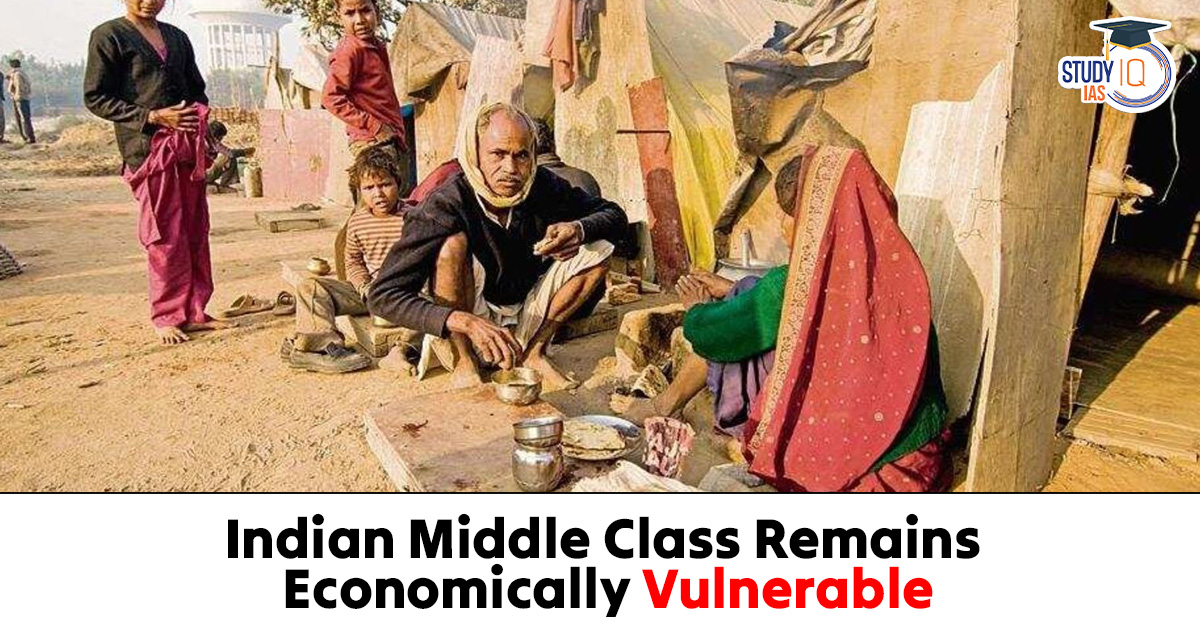
Context: Recent economic debates and policy discussions suggest that although India’s economic expansion has significantly reduced extreme poverty, it has also produced a large section of households that can be described as a “vulnerable middle class.”
Indian Middle Class Remains Economically Vulnerable: Introduction
- India has made notable progress in poverty reduction, with the proportion of people living below the World Bank’s lower-middle-income poverty threshold declining from nearly 50% a decade ago to around 30% in recent years. While economic growth has helped alleviate extreme deprivation, it has not translated into widespread and sustained upward mobility.
- This has led to the rise of a “vulnerable middle”, a segment positioned between poverty and prosperity, marked by unstable incomes, limited social security, and restricted access to opportunities.
- In response, a significant shift in policy thinking is emerging: moving beyond the conventional poor vs non-poor classification towards a more nuanced, spectrum-based understanding of well-being.
- This approach seeks to assess how close individuals are to achieving a dignified standard of living, rather than merely determining whether they fall above or below a fixed poverty line.
Why does the traditional poverty line fall short?
- Binary classification issue: The poverty line divides the population into poor and non-poor, failing to reflect varying levels of economic well-being.
- Neglect of economic mobility: It does not indicate whether individuals are improving their economic status or remaining stagnant over time.
- Threshold limitation: Crossing the poverty line does not guarantee financial stability or resilience to shocks.
- Empirical evidence: Despite poverty declining from nearly 50% to about 30%, a large proportion of people continue to remain economically vulnerable just above the threshold.
Alternative approach to measuring welfare and Development
- Continuum-based assessment: Replaces the rigid binary framework with a graded evaluation of economic well-being.
- Distance from prosperity indicator: Measures how far households are from achieving a reasonable standard of living, rather than mere survival.
- Focus on the most deprived: Gives greater policy weight to those who are farthest behind, ensuring targeted interventions.
- Tracking upward mobility: Evaluates progress in income and living standards, not just exit from poverty.
- Capturing vulnerability and risk: Identifies households at risk of slipping back into poverty due to shocks or instability.
- Policy effectiveness: Helps design more precise welfare policies by going beyond simplistic poverty-line classifications.
- Supporting evidence: Even with poverty levels falling to around 30%, a significant share of the population remains clustered just above the poverty line, underscoring the need for such a refined framework.
Reasons behind the economic vulnerability of the middle class
- Post-poverty yet insecure: A family earning slightly above the poverty line (e.g., ₹15,000–₹20,000/month in urban areas) may afford basic needs but cannot handle unexpected expenses like hospitalisation.
- Eg: A single medical emergency (like a ₹1–2 lakh surgery) can force families to sell assets or take high-interest loans.
- Income instability: Gig workers (delivery agents, drivers) or daily wage earners face fluctuating incomes depending on demand, season, or platform algorithms.
- Weak financial cushion: Many households lack even 2–3 months of savings; for instance, during the COVID-19 lockdowns, numerous families exhausted their savings within weeks.
- Inadequate social protection: Informal workers often lack health insurance or pensions; e.g., a construction worker has no coverage for accidents or old age security.
- Stalled upward mobility: A first-generation graduate may secure a low-paying job but struggle to move into higher income brackets due to limited opportunities.
- Cycle of fragility: A family that escapes poverty through a stable job may fall back due to job loss, then recover again creating a repeated cycle of vulnerability.
- Economic anxiety: Fear of job loss in sectors like IT or startups, especially during global slowdowns, creates constant financial uncertainty.
Significance of the Issue
- Implications for inclusive growth: The persistence of a vulnerable middle class highlights the limitations of a growth strategy that does not sufficiently address employment generation and income inequality.
- Risk of a middle-income trap: If wage growth remains slow and structural constraints persist, India may find it difficult to transition smoothly from a middle-income to a high-income economy.
- Impact on consumption: The middle class plays a critical role in driving domestic demand and consumption.
- If households feel financially insecure, their spending may decline, potentially slowing economic growth.
- Social and political consequences: Economic insecurity among the middle class may increase demand for welfare programmes, generate social dissatisfaction, and influence political dynamics.
Way Forward
- Shift from public sector dependence to private-led growth: Encourage the expansion of high-skilled employment in sectors such as IT, finance, and emerging industries, while ensuring adequate job security and fair compensation.
- Revitalising manufacturing for job creation: Strengthen industrial growth by scaling up Production-Linked Incentive (PLI) schemes, supporting MSMEs, and improving the ease of doing business to create durable employment opportunities.
- Breaking the informality cycle through skills and security: Combine expanded social security coverage with large-scale skill development initiatives to transition workers into stable and productive jobs.
- Balancing gig economy growth with worker protection: Enhance regulatory frameworks, ensure contractual safeguards, and improve income stability for gig and service sector workers.
- Encouraging entrepreneurship and self-employment: Promote innovation, startups, and digital enterprises to transform job seekers into job creators and drive inclusive workforce participation.

 Circular Economy in India: Benefits, Cha...
 India Forex Reserve 2026: Record $785.7 ...
 Skyroot Vikram-1 Mission Aagaman: India'...














 WhatsApp