Table of Contents
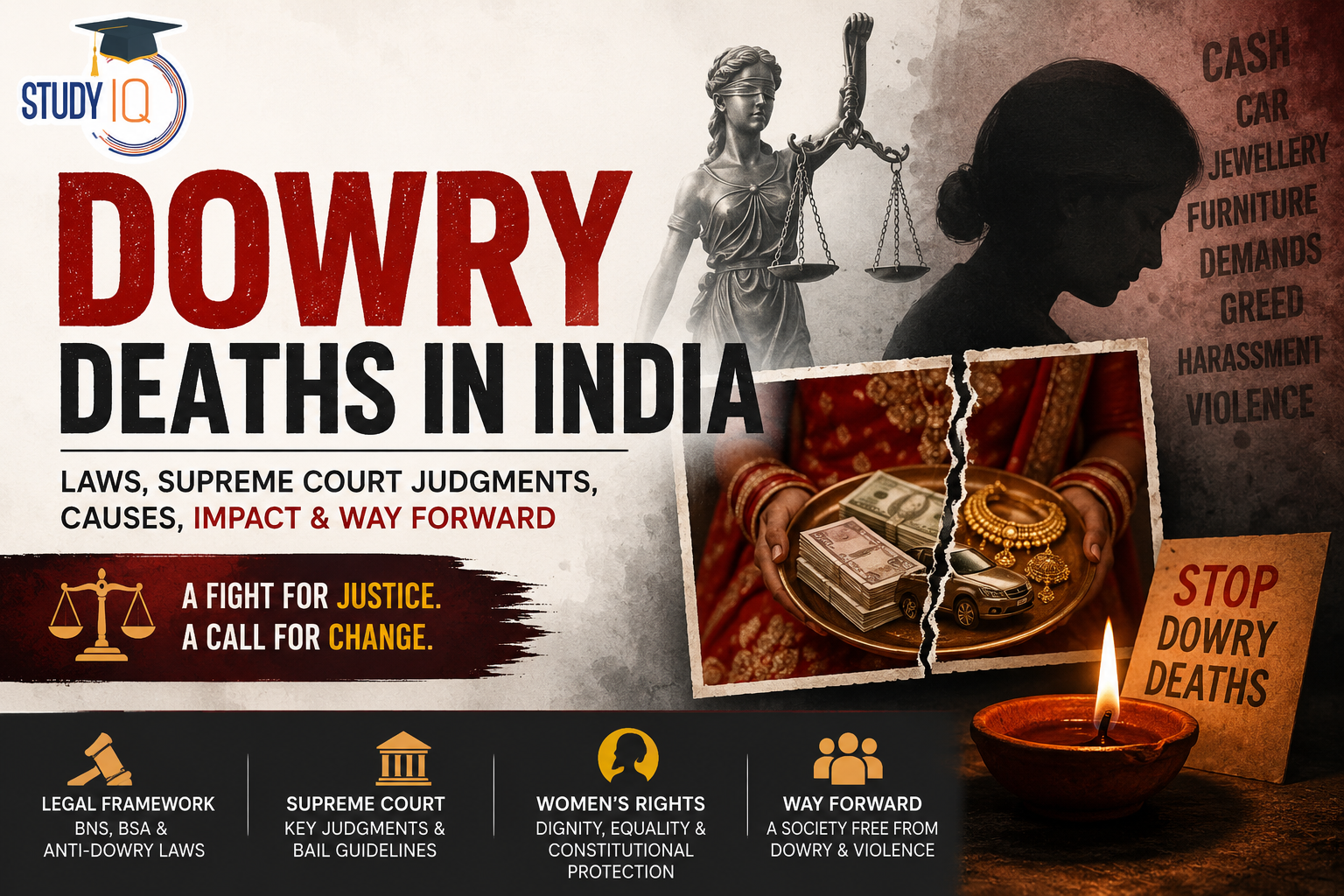
Dowry deaths remain one of India’s gravest manifestations of gender-based violence. Despite decades of legal reforms, constitutional safeguards, judicial interventions, and public awareness campaigns, thousands of women continue to lose their lives due to dowry-related harassment every year.
The recent deaths of Twisha Sharma (Bhopal) and Deepika Nagar (Greater Noida) have once again reignited the national debate on the effectiveness of anti-dowry laws and the need for stronger implementation. The Supreme Court has repeatedly emphasized that dowry deaths are not merely criminal offences but a reflection of deeply entrenched patriarchy and systemic gender inequality.
What is a Dowry Death?
A dowry death occurs when a married woman dies under abnormal circumstances—such as burns, bodily injuries, poisoning, or suicide—within seven years of marriage, and it is established that she was subjected to cruelty or harassment over dowry demands shortly before her death.
The offence is specifically recognized under India’s criminal law because of its unique social context and the difficulty of obtaining direct evidence from within matrimonial homes.
Historical Evolution of Dowry in India
Historically, gifts given to daughters during marriage were voluntary and intended to provide financial security.
Over time, however, this tradition gradually transformed into a compulsory financial transaction involving:
- Cash
- Gold
- Vehicles
- Real estate
- Luxury goods
- Household appliances
This commercialization of marriage created enormous financial pressure on brides’ families and often resulted in:
- Domestic violence
- Mental harassment
- Physical abuse
- Forced suicides
- Murders disguised as accidents
Despite modernization and increasing female education, dowry continues to influence marriages across socio-economic and religious communities.
Legal Framework Against Dowry Deaths
India has developed a comprehensive legal framework to combat dowry-related offences.
1. Dowry Prohibition Act, 1961
The Act:
- Prohibits giving and taking of dowry
- Criminalizes demanding dowry
- Provides penalties for offenders
It remains the primary legislation governing dowry offences.
2. Bharatiya Nyaya Sanhita (BNS)
Following the replacement of the Indian Penal Code (IPC), provisions relating to:
- Dowry death
- Cruelty by husband or relatives
continue under the Bharatiya Nyaya Sanhita (BNS) with substantially similar legal protection.
3. Cruelty Against Married Women
The earlier Section 498A IPC, now substantially incorporated under Section 85 of the Bharatiya Nyaya Sanhita, criminalizes:
- Physical cruelty
- Mental cruelty
- Dowry harassment
- Domestic abuse
It remains one of the most important legal safeguards for married women.
4. Evidentiary Presumption
Under Section 118 of the Bharatiya Sakshya Adhiniyam, 2023 (earlier Section 113B of the Indian Evidence Act), courts may presume that the husband or his relatives caused the dowry death if:
- the woman died within seven years of marriage,
- the death occurred under abnormal circumstances, and
- she was subjected to dowry-related harassment shortly before her death.
This shifts the evidentiary burden to the accused while preserving the right to a fair trial.
Supreme Court’s Recent Stand on Dowry Deaths
In recent years, the Supreme Court has consistently adopted a stricter approach toward dowry-related crimes.
The Court has highlighted three major principles:
- Bail should not be granted casually.
- Statutory presumptions must be meaningfully applied.
- Dowry reflects structural gender inequality rather than isolated criminal acts.
Important Supreme Court Judgments
1. Mahesh Chand v. State of Uttar Pradesh
The Supreme Court cancelled the husband’s bail, observing that casual grant of bail in dowry death cases undermines public confidence and defeats the legislative intent of anti-dowry laws.
2. Chetram Verma v. State of Uttar Pradesh
The Court criticized an Allahabad High Court bail order and held that courts must consider:
- medical evidence
- nature of allegations
- statutory presumptions
- relationship of the accused with the deceased
before granting bail.
3. Lal Muni Devi v. State of Bihar
The Court reiterated that dowry death prosecutions require heightened judicial scrutiny because of the seriousness of the offence.
4. Shabeen Ahmed v. State of Uttar Pradesh
The Supreme Court cancelled the bail granted to the parents-in-law, emphasizing that suspicious deaths of young brides demand greater judicial caution.
5. Gour Acharjee v. State of Tripura
The Court upheld the husband’s conviction and held that where a death occurs inside the matrimonial home, those present must satisfactorily explain the circumstances.
The judgment also reinforced principles similar to Section 106 of the Evidence Act, recognizing that certain facts lie especially within the knowledge of the occupants of the house.
6. Janshruti (People’s Voice) v. Union of India
Addressing concerns about misuse of anti-dowry laws, the Supreme Court upheld the constitutional validity of Section 498A (now largely reflected in Section 85 BNS).
The Court observed:
Even if some misuse occurs, it cannot justify weakening protections meant for countless genuine victims of domestic violence.
7. Rahul Gupta v. Station House Officer
The Court protected complainants by holding that women reporting dowry demands cannot be prosecuted merely because they admitted giving dowry under pressure.
This interpretation encourages victims to approach law enforcement without fear of self-incrimination.
Why Are Dowry Death Cases Different?
Unlike ordinary homicide cases, most dowry deaths occur:
- inside the matrimonial home
- without eyewitnesses
- within the exclusive knowledge of the husband and in-laws
Recognizing this evidentiary challenge, Parliament introduced statutory presumptions to strengthen prosecution while maintaining procedural fairness.
Constitutional Perspective
Dowry violates several constitutional guarantees:
- Article 14 – Equality before law
- Article 15 – Prohibition of discrimination
- Article 21 – Right to life and dignity
The Supreme Court has repeatedly held that dowry perpetuates patriarchal structures incompatible with constitutional morality and gender justice.
Challenges in Eliminating Dowry
Despite strong laws, several challenges remain:
- Deep-rooted patriarchal attitudes
- Social acceptance of dowry as a “custom”
- Under-reporting of domestic violence
- Witness intimidation
- Delayed investigations
- Slow judicial processes
- Economic dependence of women
- Social stigma surrounding marital disputes
Way Forward
India’s fight against dowry requires a multidimensional strategy.
Strengthen law enforcement
- Speedy investigation
- Fast-track trials
- Better forensic support
Social transformation
- Promote gender equality from school level
- Discourage lavish marriages
- Encourage community-led campaigns
Women’s empowerment
- Financial independence
- Equal inheritance rights
- Skill development
- Employment opportunities
Institutional reforms
- Better protection officers
- Strong victim support systems
- Legal aid
- Counseling services
Public awareness
- Community engagement
- Religious and social leaders promoting dowry-free marriages
- Digital awareness campaigns
Conclusion
The Supreme Court’s recent jurisprudence sends a clear message: dowry deaths are not isolated crimes but symptoms of a larger social malaise rooted in patriarchy, inequality, and the commercialization of marriage. Strong laws alone cannot eliminate the practice unless accompanied by societal transformation, institutional accountability, and genuine commitment to gender justice.
India’s constitutional vision demands that marriage cease to be an economic transaction and instead become a partnership founded on equality, dignity, and mutual respect. Eliminating dowry is therefore not only a legal necessity but also a moral and constitutional imperative for achieving an inclusive and just society.
Read Also: Judiciary Current Affairs
 Supreme Court Dowry Enforcement Order 20...
 Supreme Court Modifies 3-Year Practice R...
 Doctrine of Per Incuriam Explained: Supr...





 WhatsApp