Table of Contents
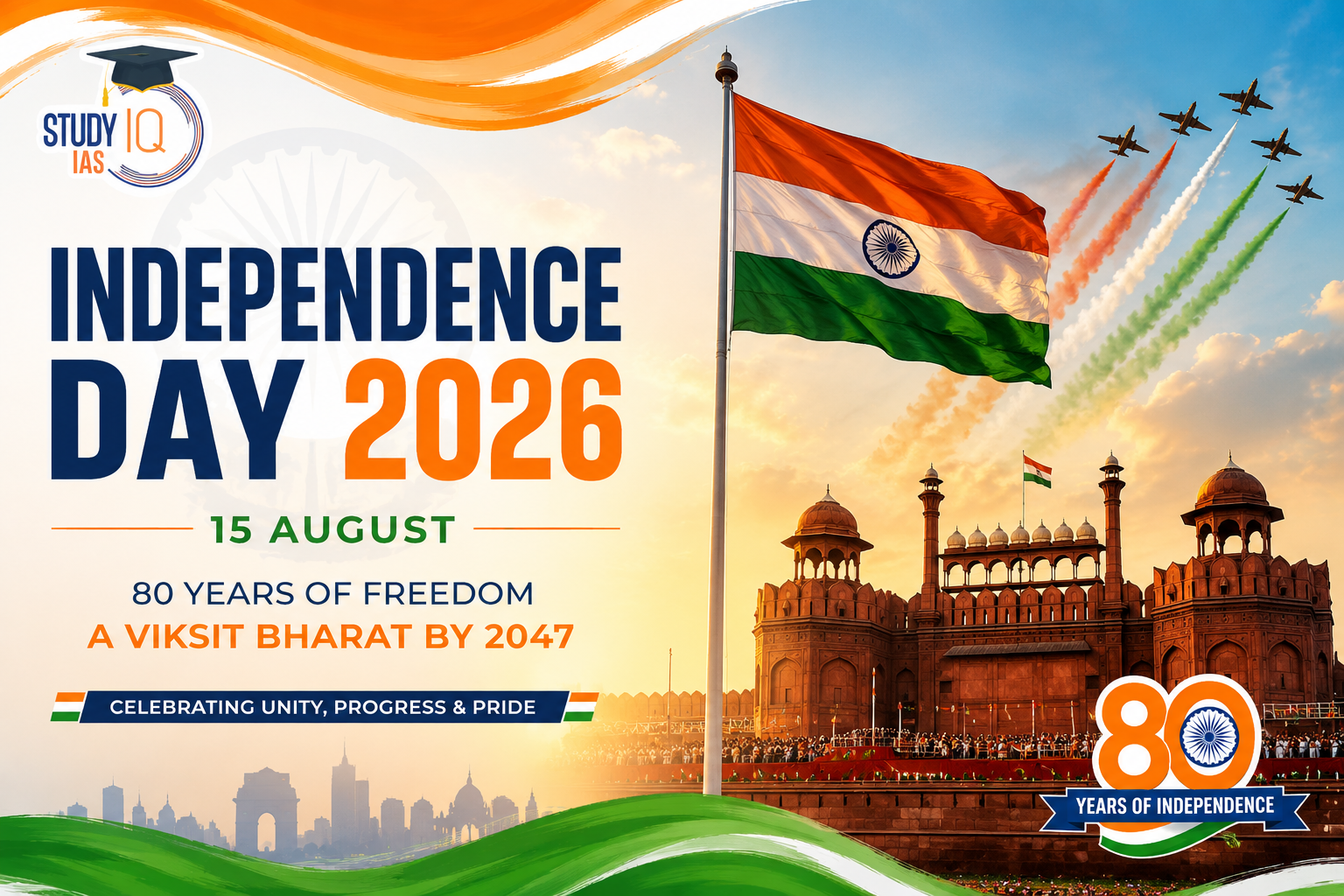
India will celebrate its 80th Independence Day on August 15, 2026, commemorating 79 years since the country became independent from British colonial rule in 1947. The national occasion provides an opportunity to remember the sacrifices of the freedom fighters while reflecting on India’s journey as a sovereign republic and its aspirations for Viksit Bharat 2047.
The main national celebration will take place at the Red Fort in New Delhi, where the Prime Minister traditionally unfurls the National Flag and addresses the nation. Independence Day is observed across the country through flag-hoisting ceremonies, cultural programmes, patriotic activities and public participation.
Independence Day 2026: Key Highlights
| Particular | Details |
|---|---|
| Date | August 15, 2026 |
| Day | Saturday |
| Occasion | 80th Independence Day |
| Independence achieved | August 15, 1947 |
| Years since Independence | 79 years |
| Main national ceremony | Red Fort, New Delhi |
| Major national vision | Viksit Bharat 2047 |
| Historical milestone | 79 years since the end of British rule |
Why Is Independence Day Celebrated on August 15?
India celebrates Independence Day on August 15 because British rule formally ended and India became an independent Dominion on August 15, 1947.
The road to independence was not a single event but the culmination of decades of political mobilisation, mass movements, constitutional negotiations, revolutionary activities and sacrifices.
The Indian Independence Act, 1947, passed by the British Parliament, provided for the creation of two independent Dominions—India and Pakistan. The transfer of power took place around midnight between August 14 and 15, 1947.
Jawaharlal Nehru delivered his historic “Tryst with Destiny” speech before the Constituent Assembly as India entered independence.
80th Independence Day: What Does It Mean?
There is an important distinction between the 80th Independence Day and 79 years of independence.
India became independent on August 15, 1947. Therefore:
- August 15, 1947 = 1st Independence Day
- August 15, 2025 = 79th Independence Day
- August 15, 2026 = 80th Independence Day
Thus, 2026 marks the 80th observance of Independence Day and 79 completed years since independence.
Red Fort Independence Day Ceremony 2026
The Red Fort has become one of the most important symbols of India’s Independence Day celebrations.
The Prime Minister traditionally:
- Arrives at the Red Fort.
- Inspects or receives the ceremonial Guard of Honour.
- Unfurls the National Flag.
- Participates in the National Anthem ceremony.
- Addresses the nation from the Red Fort.
- Outlines major achievements, challenges and national priorities.
The ceremony is followed by celebrations involving cultural performances and participation from citizens and invited guests.
The Prime Minister’s Independence Day address is particularly significant because it provides an overview of India’s development priorities and the government’s vision for the coming years.
Independence Day and Viksit Bharat 2047
One of the major themes associated with India’s long-term national development agenda is Viksit Bharat 2047.
The objective is to transform India into a developed country by 2047, the centenary year of independence.
The vision encompasses multiple dimensions of development, including:
- Economic growth and higher productivity
- Improved infrastructure
- Technological innovation
- Human capital development
- Quality education and healthcare
- Sustainable development
- Women’s participation in the economy
- Youth empowerment
- Digital transformation
- Stronger manufacturing capabilities
- Energy security
- Greater global competitiveness
Therefore, Independence Day is increasingly used not only to remember India’s freedom struggle but also to articulate the country’s future development goals.
Role of Youth in Viksit Bharat 2047
India’s young population is expected to play a critical role in achieving the objectives associated with Viksit Bharat 2047.
Youth participation is particularly important in areas such as:
- Start-ups and entrepreneurship
- Artificial intelligence and emerging technologies
- Research and innovation
- Sports
- Defence technology
- Digital economy
- Green technologies
- Agriculture and rural innovation
- Skill development
For UPSC aspirants, the relationship between demographic dividend, human capital and Viksit Bharat 2047 is an important area for both General Studies and Essay preparation.
Historical Background of India’s Independence
India’s freedom struggle developed through several phases.
Revolt of 1857
The Revolt of 1857 was one of the earliest major challenges to British rule. Although it was suppressed, it had a profound impact on the subsequent political and administrative structure of British India.
Formation of the Indian National Congress
The establishment of the Indian National Congress in 1885 created an important political platform for articulating Indian demands.
Swadeshi and Anti-Partition Movement
The Partition of Bengal in 1905 triggered the Swadeshi Movement and strengthened indigenous economic and political mobilisation.
Gandhian Mass Movements
Mahatma Gandhi transformed the freedom struggle into a mass movement through campaigns including:
- Non-Cooperation Movement
- Civil Disobedience Movement
- Salt Satyagraha
- Quit India Movement
These movements brought large sections of Indian society into the national movement.
Quit India Movement
The Quit India Movement of 1942 represented one of the most significant mass movements against British rule. Its famous call of “Do or Die” reflected the determination of the national movement to achieve independence.
Transfer of Power
The Second World War weakened Britain’s economic and political position. Growing nationalist mobilisation, changing international circumstances and political negotiations eventually culminated in the transfer of power in 1947.
Freedom Fighters and Independence Day
Independence Day is also an occasion to remember the contributions of numerous individuals and groups involved in India’s freedom struggle.
Important personalities included:
- Mahatma Gandhi
- Jawaharlal Nehru
- Sardar Vallabhbhai Patel
- Subhas Chandra Bose
- Bhagat Singh
- Chandrashekhar Azad
- Sarojini Naidu
- Bal Gangadhar Tilak
- Lala Lajpat Rai
- Bipin Chandra Pal
- Maulana Abul Kalam Azad
- Annie Besant
The freedom movement, however, was not limited to prominent national leaders. Millions of ordinary citizens, peasants, workers, students, women and tribal communities participated in different forms of resistance.
Independence Day vs Republic Day
Independence Day and Republic Day commemorate two different milestones in India’s constitutional history.
| Independence Day | Republic Day |
| August 15 | January 26 |
| Marks independence from British rule | Marks the commencement of the Constitution |
| Celebrated since 1947 | Celebrated since 1950 |
| Prime Minister leads the main Red Fort ceremony | President leads the national Republic Day ceremony |
| Focuses on independence and national development | Focuses on the Constitution and republican values |
India became independent in 1947, but became a sovereign democratic republic when the Constitution came into force on January 26, 1950.
Significance of Independence Day 2026
The 80th Independence Day has historical and contemporary significance.
1. Remembering the Freedom Struggle
The occasion honours the sacrifices made during India’s long struggle against colonial rule.
2. Celebrating Sovereignty
Independence Day represents India’s emergence as an independent nation capable of determining its own political, economic and strategic priorities.
3. Reinforcing Constitutional Values
The occasion provides an opportunity to reflect on democracy, equality, liberty, justice and national unity.
4. Looking Towards 2047
As India approaches the centenary of independence, the focus increasingly includes long-term development and the goal of building a developed India.
5. Encouraging Citizen Participation
Independence Day encourages citizens to contribute to nation-building through responsible citizenship, innovation, public service and community participation.
Independence Day 2026: Important Facts for UPSC
- Independence Day: August 15
- India became independent: August 15, 1947
- 80th Independence Day: August 15, 2026
- Indian Independence Act: 1947
- Transfer of power: Midnight of August 14–15, 1947
- First Prime Minister: Jawaharlal Nehru
- Historic speech: “Tryst with Destiny”
- Main national venue: Red Fort, New Delhi
- Constitution came into force: January 26, 1950
- Republic Day: January 26
- Viksit Bharat target year: 2047
Read Also: UPSC Daily Current Affairs 2026
 Anti-Goonda Bill 2026 Explained: Why Pre...
 Cool Leaders Award 2026: Winners, Global...
 Black Carbon and Himalayan Glacier Melt:...






 WhatsApp