
Table of Contents
Context
The advent of Assisted Reproductive Technology (ART), especially In Vitro Fertilisation (IVF), has revolutionised the field of reproductive medicine globally. For several couples’ facing infertility, IVF is not just a medical intervention but the realisation of an emotional desire to attain parenthood. In India, where traditional norms about marriage and procreation are firmly established, infertility frequently results in significant psychological, family, and social repercussions. In this context, IVF has emerged as a significant medical development of the twenty-first century, allowing numerous individuals and couples to achieve parenthood despite biological constraints.
India has concurrently developed into one of the world’s foremost fertility treatment hubs. The nation’s advanced medical competence, relatively low treatment costs, growing number of reproductive clinics, and a conducive medical tourism environment have established it as a global center for assisted reproduction. The implementation of the Assisted Reproductive Technology (Regulation) Act, 2021, and the Surrogacy (Regulation) Act, 2021, signifies a crucial legislative initiative to govern a rapidly growing industry that previously operated with limited regulation.
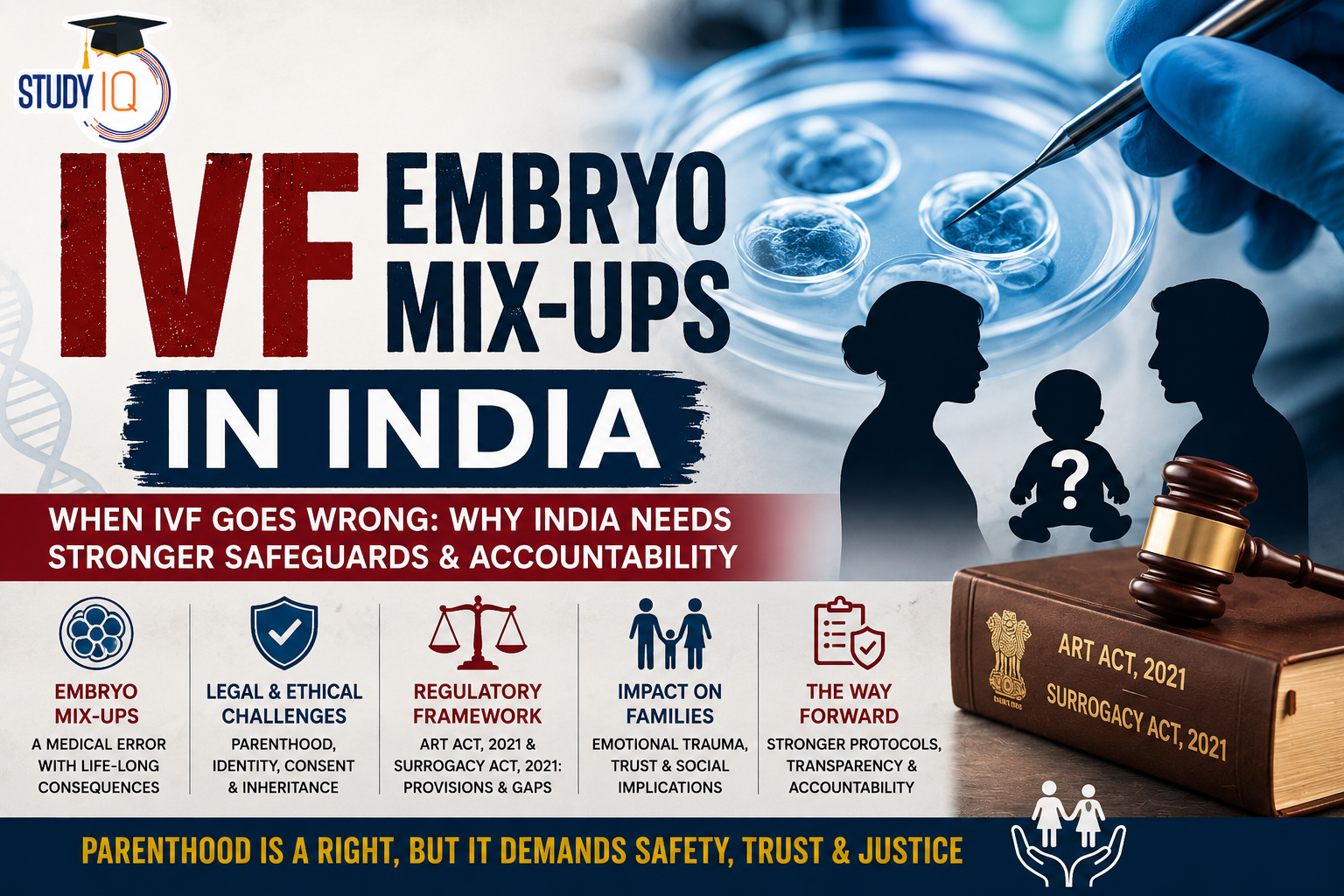
Recent occurrences of embryo mix-ups have shown substantial deficiencies in India’s regulatory structure. Incidents of infants conceived by IVF lacking a biological connection to the intended parents have prompted complex legal, ethical, constitutional, and medical enquiries. These instances are not just technical failures inside laboratory settings; they fundamentally contest established concepts of parentage, identity, consent, inheritance, and reproductive autonomy. An embryo mix-up is a significant violation of trust between patients and healthcare providers, with ramifications that extend well beyond monetary loss. It influences the emotional identity of families, the legal status of children, and public trust in reproductive medicine.
Advancement of In Vitro Fertilisation in India
In Vitro Fertilisation is the procedure in which fertilisation transpires externally to the human body by the amalgamation of an ovum and sperm in a regulated laboratory setting. Following fertilisation, the resulting embryo is cultured for many days prior to transfer into the uterus to achieve pregnancy.
India’s foray into assisted reproduction started with notable scientific accomplishments. In 1978, Dr. Subhash Mukhopadhyay successfully created India’s inaugural test-tube baby, although his groundbreaking achievement was mostly overlooked throughout his lifetime. Subsequently, Dr. T.C. Anand Kumar and Dr. Indira Hinduja advanced IVF procedures, resulting in broader clinical approval and institutional acknowledgement. In the past two decades, IVF has shown remarkable growth across India. Fertility centers now function in both metropolitan and smaller urban areas, providing services including IVF, Intracytoplasmic Sperm Injection (ICSI), embryo cryopreservation, donor gametes, fertility preservation, preimplantation genetic testing, and gestational surrogacy within legal constraints.
A multitude of variables have facilitated this extraordinary rise. The rising infertility rates due to postponed marriages, altered lifestyles, environmental contamination, endocrine problems, stress, obesity, and reproductive ailments have markedly heightened the need for fertility treatments. Concurrently, heightened understanding of reproductive technology and enhanced medical infrastructure have rendered assisted conception more accessible. Medical tourism has significantly bolstered India’s IVF sector. International patients often pursue medical treatment in India due to reduced prices relative to Europe or North America, while upholding globally competitive medical standards.
However, this swift commercial growth has also generated significant regulatory concerns. Numerous clinics currently function nationwide, exhibiting diverse standards in laboratory infrastructure, embryology methods, staffing qualifications, quality control, and patient safety regulations.
The Rise of Embryo Mistakes: A Crisis Exceeding Medical Negligence
While IVF has facilitated several successful pregnancies, new instances of embryo mix-ups have uncovered one of the most significant hazards linked to assisted reproductive technology. An embryo mix-up transpires when embryos from one partner are erroneously implanted into another patient’s uterus or when sperm, eggs, or embryos are improperly labelled, stored, or managed during laboratory processes. Such instances may arise from administrative neglect, insufficient paperwork, human mistakes, technological breakdowns, or the lack of proper verification methods.
In contrast to traditional medical neglect, such as erroneous medication or surgical errors, embryo mix-ups result in irrevocable outcomes. After implantation and the advancement of pregnancy, no medical intervention can rectify the intended biological connection. The emotional repercussions are catastrophic. Couples who have undergone years of infertility treatments, many hormonal therapies, unsuccessful implantation attempts, financial strain, and emotional turmoil may find months or even years post-childbirth that their child has no biological connection to them.
Equally unsettling is the potential that another family may inadvertently be nurturing their biological offspring. Such circumstances engender significant psychological damage affecting several families concurrently. Consequently, these instances cannot be regarded as just solitary laboratory mistakes. They signify the shortcomings of institutional structures tasked with safeguarding fundamental elements of human identity.
Parenthood Beyond Biology: Legal and Philosophical Enquiries
Embryo mix-ups compel society to reevaluate a fundamental legal inquiry: what defines parenthood? Traditionally, legal systems presumed that biological parenthood, gestation, and child-rearing transpired inside a singular family unit. IVF fundamentally challenges these ideas by distinguishing genetic parenting, gestational parenthood, and social parenthood. In circumstances of embryo mix-ups, many conflicting claims may arise concurrently.
- The genetic parents may contend that a biological relationship constitutes legal parentage.
- The gestational mother may assert that pregnancy, delivery, and maternal attachment establish legal motherhood.
- The intended parents may assert that they willingly engaged in the IVF treatment with the explicit aim of rearing the resultant kid.
Ultimately, the kid cultivates autonomous interests related to identity, emotional stability, familial continuity, inheritance, and psychological well-being. In contrast to adoption or donor-assisted conception, embryo mix-ups happen without informed consent. The lack of permission essentially differentiates these situations from other types of non-biological fatherhood.
Adoptive parents consciously embrace a kid devoid of genetic affiliation.Parents utilising donor sperm or donor eggs deliberately consent to the reproductive arrangement. Surrogacy agreements are established through legally authorised contracts. Embryo mix-ups, however, impose involuntary parenthood onto couples due to a medical mistake rather than voluntary reproductive choice. This divergence presents significant constitutional issues about reproductive autonomy and informed consent under Article 21 of the Constitution.
The Legal Framework of India Regulating Assisted Reproductive Technology
In response to the fast growth of fertility therapy, Parliament passed two important laws in 2021. The Assisted Reproductive Technology (Regulation) Act, 2021, mandates registration for ART clinics and banks, governs donor qualifications, stipulates record-keeping responsibilities, and sets up National and State Boards to oversee assisted reproductive services. The Surrogacy (Regulation) Act, 2021 concurrently governs altruistic surrogacy and forbids commercial surrogacy, establishing qualifying standards for prospective couples and surrogate moms.
These acts signify a significant transition from the predominantly uncontrolled landscape that hitherto defined India’s reproductive sector. They implement licensing procedures, inspection authorities, criteria for gamete storage, consent stipulations, and punishments for diverse legislative infractions. Nonetheless, despite their extensive legal framework, both acts mainly neglect to address embryo mix-ups.
- Neither statute explicitly resolves the issue of legal parentage subsequent to inadvertent embryo exchange.
- Neither statute delineates custodial concepts relevant when biological and intentional parenting disagree.
- Neither statute establishes a systematic compensation scheme for impacted families.
- Neither statute mandates compulsory DNA verification in cases of contested paternity.
- Likewise, neither regulation delineates immediate licence suspension protocols subsequent to verified laboratory carelessness related to embryo mistreatment.
As a result, courts facing these challenges must depend on overarching constitutional principles, tort law, medical negligence jurisprudence, family law doctrines, and equitable factors instead of explicit legislative direction. This legal ambiguity substantially escalates litigation and extends emotional distress for impacted families.
Constitutional Aspects of IVF Mistakes
Embryo mix-ups include many constitutional rights safeguarded by Part III of the Constitution. Article 21 safeguards the right to life and personal liberty, which the Supreme Court has consistently construed to encompass dignity, reproductive autonomy, privacy, physical integrity, and decisional freedom.
In Suchita Srivastava v. Chandigarh Administration (2009), the Supreme Court acknowledged reproductive choice as an integral aspect of human liberty safeguarded by Article 21.
In a similar vein, Justice K.S. Puttaswamy v. Union of India (2017) broadened constitutional privacy to encompass decisional autonomy about intimate personal choices, including reproductive decisions.
Embryo mix-ups clearly contravene fundamental constitutional guarantees, since patients forfeit control over one of the most intimate decisions conceivable- the procreation of genetically linked progeny.
Article 14 holds substantial importance. Patients receiving the same medical procedures are entitled to uniform standards of care, professional proficiency, and regulatory safeguards. Systemic failures due to inadequate monitoring may thus prompt enquiries into arbitrariness in public control.
Article 19 is pertinent when the publication of sensitive reproductive information, genetic identity, or medical data impacts informational privacy and the right to be free from unjustified governmental intrusion. Consequently, embryo mix-ups transcend mere carelessness and enter the realm of fundamental rights.
The Ethical Basis of Assisted Reproductive Technology
Beyond the legal intricacies associated with embryo mix-ups exists a significant ethical quandary. Assisted Reproductive Technology is predicated on a remarkable level of trust between patients and healthcare providers. Couples pursuing IVF voluntarily entrust fertility clinics with their reproductive cells, eggs, sperm, embryos, and genetic material, anticipating that they will be managed with utmost scientific accuracy and professional integrity. Unlike most medical therapies, IVF entails both the maintenance of health and the generation of new human life. Thus, each phase of the process needs unwavering compliance with ethical standards.
Medical ethics has historically been governed by the ideas of autonomy, beneficence, non-maleficence, and fairness. Embryo mix-ups concurrently contravene all of these rules. The idea of autonomy is compromised if the reproductive decisions of prospective parents are obstructed by neglect instead of informed consent. Beneficence is undermined if the technique finally fails to achieve its intended aim. The ideal of non-maleficence, embodied in the Hippocratic dictum “first, do no harm,” is violated as preventable errors cause enduring emotional and psychological trauma to several families. Ultimately, distributive justice necessitates responsibility and equitable restitution for victims whose reproductive rights have been infringed upon due to institutional deficiencies.
The ethical ramifications transcend the impacted households. Public trust in reproductive care relies on the belief that laboratories uphold stringent standards of precision and responsibility. Every documented embryo mix-up diminishes this trust, deterring prospective parents from pursuing essential reproductive help and even jeopardising the integrity of the whole healthcare industry.
Comparative Global Experience and Optimal Practices
Numerous governments have addressed embryo mix-ups and have reacted by enhancing regulatory control. In the United Kingdom, fertility clinics function under the oversight of the Human Fertilisation and Embryology Authority (HFEA), which formulates extensive laboratory procedures, performs routine inspections, and requires meticulous record-keeping. Clinics must use electronic witnessing systems that consistently authenticate the identification of embryos and gametes throughout laboratory processes.
Many reproductive centers in the United States, Australia, Canada, and other European nations utilise electronic barcode or radio-frequency identification (RFID) systems to electronically correlate patient identities with laboratory specimens at each pivotal step of therapy. These technologies significantly diminish the probability of human mistakes.
A crucial protection is the requirement of “double witnessing,” in which two independent embryologists confirm patient identities prior to fertilisation, embryo freezing, thawing, storage, and embryo transfer. Such protocols guarantee that the oversight of any single individual does not lead to irrevocable repercussions. Numerous international governments impose stringent professional responsibility on fertility clinics. Regulatory bodies have the authority to revoke licenses, inflict significant financial fines, and commence disciplinary actions against careless medical practitioners. These strategies enhance institutional accountability and foster public trust in assisted reproductive services.
Judicial Perspective on Reproductive Rights in India
While Indian courts have not explicitly established comprehensive law on embryo mix-ups, constitutional jurisprudence related to reproductive liberty offers a significant legal basis.
In Suchita Srivastava v. Chandigarh Administration (2009), the Supreme Court explicitly acknowledged reproductive choice as a fundamental aspect of human liberty safeguarded by Article 21 of the Constitution. The Court noted that reproductive autonomy includes the freedom to make procreation decisions without arbitrary intervention.
The pivotal ruling in Justice K.S. Puttaswamy (Retd.) v. Union of India (2017) broadened the constitutional right to privacy by acknowledging physical integrity, informational privacy, decisional autonomy, and reproductive freedom as fundamental components of human dignity. The Court confirmed that personal decisions about family life and reproduction are fundamental to constitutional freedom.
The Supreme Court reinforced reproductive rights in X v. Principal Secretary, Health and Family Welfare Department (2022) by asserting that reproductive autonomy is inherent to every individual, regardless of marital status, and is an integral aspect of dignity under Article 21.
While such decisions do not pertain directly to embryo mix-ups, they establish constitutional concepts that will likely inform future court resolutions of claims related to IVF malpractice. Courts are anticipated to safeguard reproductive autonomy, informed consent, and the dignity of impacted families, while prioritising the welfare of the child.
Medical Negligence and Civil Responsibility
Embryo mix-ups unequivocally constitute a kind of medical negligence. According to Indian law, hospitals and medical practitioners have an obligation to provide patients with a standard of reasonable care. Negligence may arise from the inability to uphold proper laboratory standards, correctly identify biological specimens, or adhere to established medical protocols.
In Jacob Mathew v. State of Punjab (2005), the Supreme Court established the rules of medical negligence, determining that liability occurs when medical professionals do not uphold the standard of care expected from competent practitioners.
Indian Medical Association v. V.P. Shantha (1995) included medical services under consumer protection legislation, allowing individuals to pursue compensation in consumer tribunals for inadequate medical treatment.
Embryo mix-ups may thus render fertility clinics liable for civil compensation due to mental agony, emotional distress, infringement of reproductive autonomy, breach of contract, and professional negligence. Criminal responsibility may occur under conditions when gross carelessness or fraudulent behaviour is demonstrated.
Legislative Deficiencies and the Necessity for Holistic Reform
The Assisted Reproductive Technology (Regulation) Act, 2021, and the Surrogacy (Regulation) Act, 2021, signify important advancements in the regulation of reproductive services; yet, they fail to thoroughly address the legal ramifications of embryo mix-ups. This statutory ambiguity engenders doubt about parenthood, custody, inheritance, compensation, and regulatory penalties.
Future legislative reform should develop a comprehensive legal framework particularly regulating laboratory mistakes related to reproductive material. Such a law must explicitly delineate legal paternity in cases of inadvertent embryo exchange, while concurrently prioritising the child’s best interests. Mandatory DNA testing should be mandated anytime parentage is contested, ensuring that judicial determinations are grounded in scientific certainty rather than conjecture.
The legislation should mandate that all fertility clinics have sophisticated electronic tracking devices to monitor each embryo throughout its lifespan. Surprise inspections, regular accreditation assessments, and independent laboratory evaluations should be established as standard regulatory practices rather than infrequent measures.
Fertility clinics should be mandated to meet comprehensive insurance criteria to guarantee that victims obtain sufficient compensation without enduring protracted litigation. Moreover, professional therapy services have to be accessible to impacted families, acknowledging that emotional recovery is as crucial as financial compensation.
Legislation must mandate explicit reporting requirements for clinics to promptly inform regulatory authorities and impacted patients of laboratory mistakes. Neglecting to disclose such occurrences should incur severe civil and criminal sanctions.
Conclusion
The extraordinary success of IVF has revolutionised several lives by providing hope to people and couples facing infertility. The rising incidence of embryo mix-ups illustrates that scientific progress must be matched by strong legal protections, ethical responsibility, and institutional transparency. India has made substantial progress by implementing the Assisted Reproductive Technology (Regulation) Act, 2021, and the Surrogacy (Regulation) Act, 2021. Nevertheless, these rules are inadequate in addressing one of the most catastrophic failures that might arise in assisted reproduction. The lack of definitive legal standards regulating embryo mix-ups subjects families to extended uncertainty and forces courts to address very intricate cases without sufficient statutory direction.
As assisted reproductive technologies advance, the legal framework regulating them must also progress accordingly. Enhanced regulatory control, sophisticated technology protections, obligatory electronic tracking, independent audits, specialist counselling services, extensive compensation systems, and explicit regulations regarding parentage have transitioned from policy preferences to legal imperatives.
The efficacy of IVF should not be evaluated exclusively by pregnancy rates or technical advancement. It should be evaluated based on how effectively the legal and medical processes safeguard the dignity, autonomy, individuality, and trust of each individual who places their aspirations of parenting in the hands of science. India can ensure that assisted reproductive technology fulfils its intended purpose of creating families while protecting the rights and dignity of individuals by integrating scientific innovation with constitutional values, ethical responsibility, and robust legal regulation.
 Anti-Goonda Bill 2026 Explained: Why Pre...
 Cool Leaders Award 2026: Winners, Global...
 Black Carbon and Himalayan Glacier Melt:...














 WhatsApp





