
Table of Contents
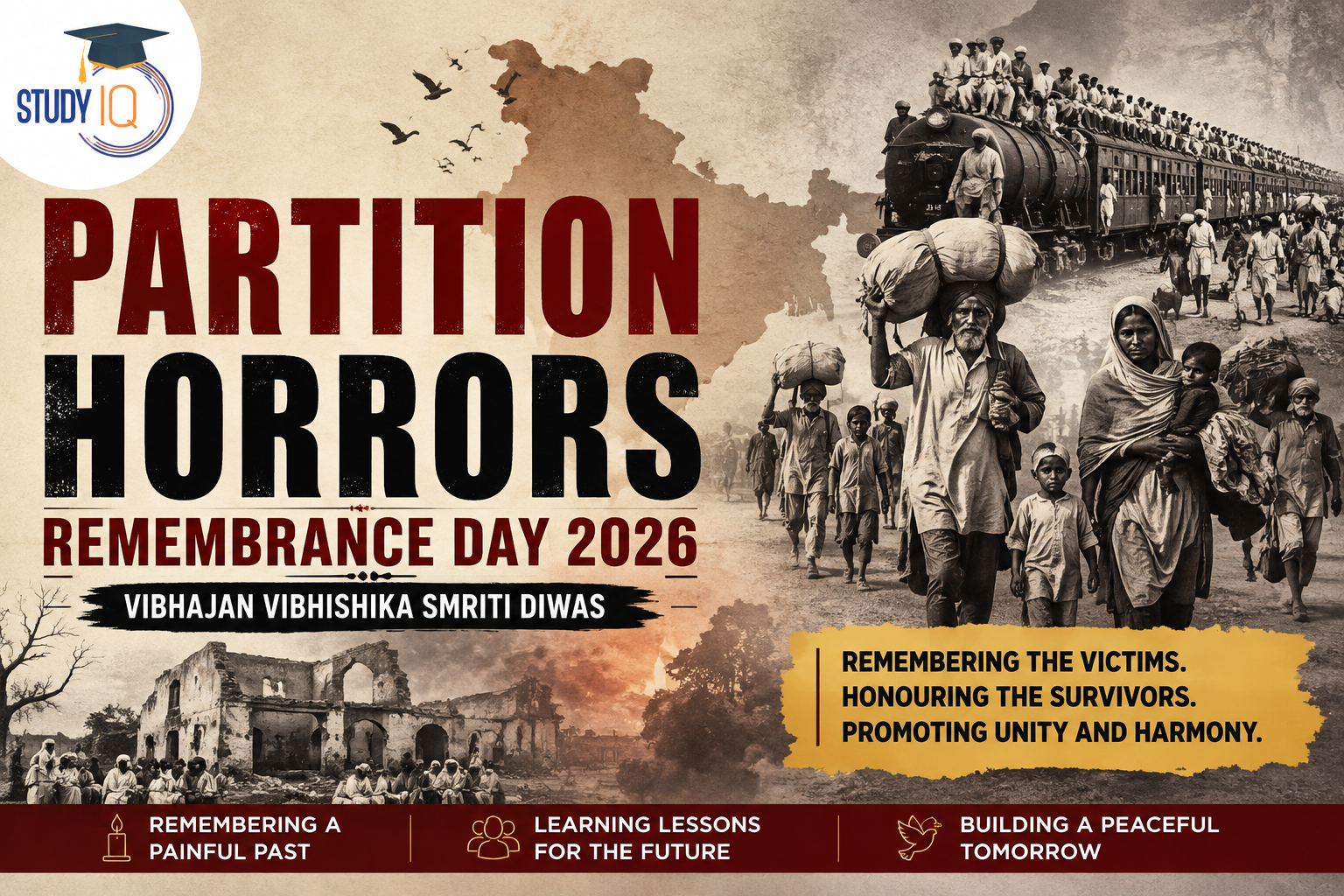
Partition Horrors Remembrance Day 2026, also known as Vibhajan Vibhishika Smriti Diwas, is observed on August 14 every year to remember the victims and survivors of the Partition of British India in 1947. The day commemorates the immense suffering caused by communal violence, forced migration, family separation and loss of homes and livelihoods.
The Government of India announced August 14 as Partition Horrors Remembrance Day in 2021. The observance seeks to preserve the memories of those affected by Partition and remind future generations of the devastating human consequences of hatred, violence and social division.
Partition Horrors Remembrance Day 2026: Key Facts
| Particular | Details |
|---|---|
| Day | August 14, 2026 |
| Day of the week | Friday |
| Also known as | Vibhajan Vibhishika Smriti Diwas |
| First observed | August 14, 2021 |
| Historical event | Partition of British India, 1947 |
| Majorly affected regions | Punjab and Bengal |
| Key political framework | 3 June 1947 Plan |
| Boundary mechanism | Radcliffe Boundary Commissions |
| Core purpose | Remember victims and survivors and promote social harmony |
What Is Partition Horrors Remembrance Day?
Partition Horrors Remembrance Day is an annual observance dedicated to remembering the human cost of the Partition of British India in 1947.
Partition accompanied the end of British colonial rule and resulted in the creation of the two dominions of India and Pakistan. The political division was accompanied by one of the largest episodes of forced migration in modern history.
Millions of people were uprooted from their homes. Communities experienced communal violence, killings, abductions, destruction of property and separation from family members.
The remembrance day therefore focuses not only on the political history of Partition but also on the individual experiences of ordinary people who suffered displacement and violence.
Why Is August 14 Observed as Partition Horrors Remembrance Day?
The Government of India announced August 14 as Partition Horrors Remembrance Day in 2021.
The choice of August 14 is significant because it falls immediately before India’s Independence Day on August 15.
The two dates therefore provide an opportunity to remember two interconnected dimensions of 1947:
- August 14: Remembering the suffering and displacement associated with Partition.
- August 15: Celebrating India’s independence from British colonial rule.
This juxtaposition highlights an important historical paradox: India achieved independence in 1947, but independence was accompanied by an immense humanitarian tragedy.
Partition of British India in 1947: Historical Background
The Partition of British India was the culmination of complex political developments, including communal tensions, competing political demands, the demand for Pakistan and disagreements over the constitutional future of British India.
On 3 June 1947, Viceroy Lord Mountbatten announced the plan for the transfer of power and Partition.
The Indian Independence Act, 1947, subsequently provided the legal framework for the creation of the two dominions of India and Pakistan.
The task of demarcating the boundaries between the two dominions was entrusted to Boundary Commissions chaired by Sir Cyril Radcliffe.
The final boundary awards were published on 17 August 1947, after India and Pakistan had become independent.
Why Did Partition Become So Disruptive?
The new boundaries cut across regions where communities had lived together for generations.
The impact was particularly severe in Punjab and Bengal, where the division affected:
- Villages and towns
- Agricultural land
- Property ownership
- Trade networks
- Transport links
- Families and communities
- Religious and cultural institutions
The sudden uncertainty over the location of the new international boundary contributed to a massive movement of people.
Partition and Mass Migration
The Partition triggered one of the largest forced migrations in modern history.
Historical estimates commonly suggest that around 14–15 million people were displaced or migrated across the newly created borders, although exact figures vary among scholars.
Hindus, Muslims and Sikhs were among those affected.
People travelled:
- By train
- On foot
- By road
- In caravans
- Through refugee camps
Many travelled with very little information about their destination or what had happened to their homes.
The migration was accompanied by widespread violence, insecurity and humanitarian distress.
Human Cost of the 1947 Partition
The human cost of Partition extended far beyond the number of people displaced.
1. Loss of Life
Large-scale communal violence resulted in extensive loss of life. The precise death toll remains disputed because no comprehensive record was maintained during the upheaval.
Scholarly estimates vary widely, with figures ranging from hundreds of thousands to around two million.
2. Displacement
Millions lost their ancestral homes and had to rebuild their lives in unfamiliar surroundings.
3. Family Separation
Families were separated during the chaotic movement of populations, and many people never found their relatives again.
4. Violence Against Women
Women were particularly vulnerable during Partition. Abduction, sexual violence and forced displacement left deep physical and psychological scars.
5. Loss of Property and Livelihood
People abandoned houses, agricultural land, businesses and other assets. Newly independent governments faced the enormous task of refugee rehabilitation and property settlement.
Punjab and Bengal: Major Regions Affected
Punjab
Punjab witnessed some of the most intense violence and displacement associated with Partition.
The division disrupted communities, agricultural systems, transportation networks and established economic relationships.
Large-scale refugee movements took place in both directions across the new border.
Bengal
Bengal was also divided, with West Bengal becoming part of India and East Bengal becoming part of Pakistan.
The consequences included migration, communal tension and disruption of social and economic relationships.
East Bengal later became East Pakistan and ultimately Bangladesh in 1971.
Partition Horrors Remembrance Day: Significance
Remembering Victims
The observance honours people who lost their lives, homes, property and livelihoods during Partition.
Preserving Historical Memory
Survivor testimonies, photographs, letters, literature, official documents and oral histories provide valuable insights into the experiences of ordinary people.
Understanding the Human Cost
Partition should not be viewed only as a political or geographical division. It was also a major humanitarian crisis involving displacement, violence and trauma.
Promoting Communal Harmony
The remembrance day highlights the destructive consequences of communal hatred and intolerance.
Strengthening National Unity
Remembering the past can reinforce the importance of social cohesion, fraternity and peaceful coexistence in a diverse country.
Learning from History
The central lesson is not merely to remember suffering but to understand how social divisions and violence can produce long-term consequences.
How Is Partition Horrors Remembrance Day Observed?
Various government institutions, museums and cultural organisations have organised programmes to preserve and communicate memories of Partition.
Activities may include:
- Exhibitions of photographs and archival documents
- Oral-history projects
- Seminars and discussions
- Documentary screenings
- Cultural programmes
- Memorial events
- Displays of personal belongings and survivor accounts
- Educational programmes for younger generations
Such initiatives help connect large historical events with the experiences of individuals and families.
Partition Museum and Preservation of Memory
Institutions such as the Partition Museum in Amritsar have played an important role in documenting personal stories associated with Partition.
Museums and oral-history initiatives help preserve:
- Personal testimonies
- Photographs
- Letters
- Refugee experiences
- Family histories
- Objects carried during migration
- Accounts of resettlement
This approach makes Partition history more accessible by placing human experiences alongside political history.
Partition Horrors Remembrance Day and Independence Day
The proximity of the two observances makes August 14 and August 15 historically significant.
Partition Horrors Remembrance Day focuses on the suffering, displacement and resilience associated with Partition.
Independence Day celebrates India’s independence from British colonial rule.
Together, they underline the complexity of 1947: freedom was achieved, but it came amid enormous human suffering.
Message of Vibhajan Vibhishika Smriti Diwas
The observance carries three broad messages:
- Remember: Preserve the memories of victims and survivors.
- Reflect: Understand the consequences of communal violence, intolerance and forced displacement.
- Reconcile: Strengthen unity, fraternity, tolerance and peaceful coexistence.
Remembrance should therefore focus on the experiences of people from all communities affected by Partition, rather than becoming a source of renewed hatred or collective blame.
Read Also: UPSC Daily Current Affairs 2026
 Anti-Goonda Bill 2026 Explained: Why Pre...
 Cool Leaders Award 2026: Winners, Global...
 Black Carbon and Himalayan Glacier Melt:...










 WhatsApp





