
Table of Contents
The principle of res judicata is one of the cornerstones of the justice system. It ensures that once a dispute has been decided by a competent court, the same issue cannot be litigated repeatedly. The doctrine protects judicial resources, promotes certainty in legal relationships, and prevents harassment through endless litigation.
A closely related concept is constructive res judicata, which bars parties from raising issues in later proceedings that could and should have been raised in earlier litigation.
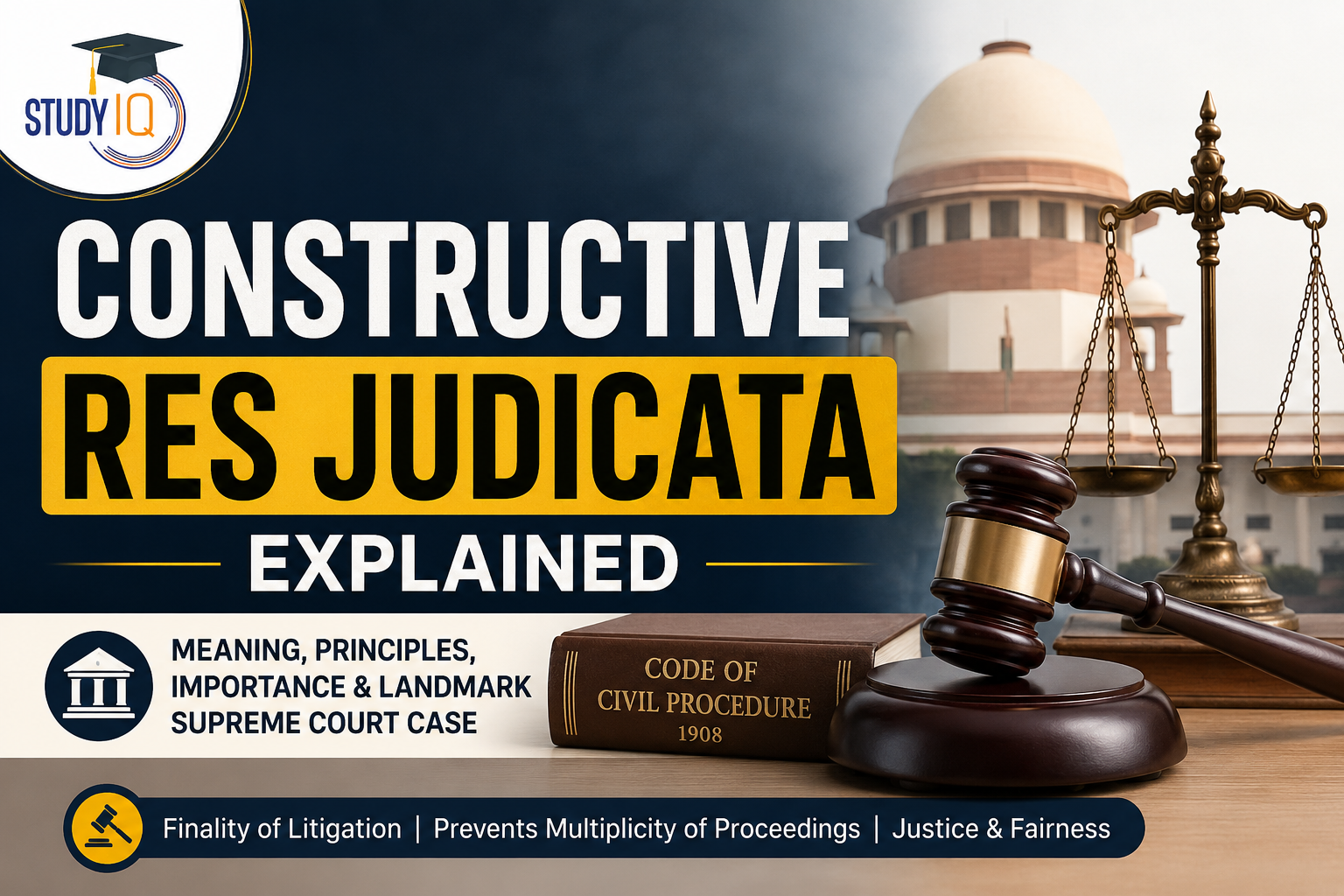
In the landmark case of Makardhwaj Ram v. Jagdish Rai (Civil Appeal No. 2950 of 2011), the Supreme Court of India revisited this doctrine and clarified its scope, limitations, and practical application. The judgment strikes an important balance between ensuring finality in litigation and protecting substantive justice.
What is Res Judicata?
The doctrine of res judicata is codified under Section 11 of the Code of Civil Procedure (CPC), 1908.
It prevents courts from trying a matter that has already been conclusively decided between the same parties.
The doctrine is based on two fundamental legal principles:
1. Interest Reipublicae Ut Sit Finis Litium
“It is in the interest of the State that litigation must come to an end.”
2. Nemo Debet Bis Vexari Pro Una Et Eadem Causa
“No person should be vexed twice for the same cause.”
These principles ensure certainty, stability, and public confidence in the legal system.
Understanding Constructive Res Judicata
Constructive res judicata is contained in Explanation IV of Section 11 CPC.
Unlike ordinary res judicata, which applies to issues actually raised and decided, constructive res judicata applies to matters:
- That could have been raised earlier, and
- That ought to have been raised earlier.
If a party deliberately or negligently fails to raise an available ground, the law treats that issue as having been decided against that party.
Why Does This Doctrine Exist?
The doctrine prevents:
- Splitting of claims
- Piecemeal litigation
- Repeated lawsuits on the same dispute
- Abuse of judicial process
Courts seek to ensure that all connected issues are resolved in one proceeding whenever possible.
Evolution of the Doctrine Through Judicial Decisions
State of Uttar Pradesh v. Nawab Hussain (1977)
The Supreme Court held that a ground not raised in earlier proceedings could not be raised later if it should have been asserted initially.
Forward Construction Co. v. Prabhat Mandal (1986)
The Court ruled that constructive res judicata applies even to writ petitions under Article 226 of the Constitution.
Direct Recruit Class II Engineering Officers’ Association v. State of Maharashtra (1990)
The Supreme Court emphasized that the doctrine is based on public policy and extends beyond ordinary civil disputes.
Daryao v. State of Uttar Pradesh (1961)
The Court recognized the importance of finality in litigation and restricted repeated constitutional challenges.
Hope Plantations Ltd. v. Taluk Land Board (1999)
The Court reaffirmed that constructive res judicata is rooted in justice, equity, and good conscience.
Facts of the Makardhwaj Ram Case
The dispute involved a complex chain of property transactions spanning several decades.
Key Events
- In 1960, Mahabir Rai transferred approximately 95.80 acres of land to:
- His mother Raj Mohani (Roopjhari)
- His son Makardhwaj Ram
- In 1962, a General Power of Attorney was granted to Rambhajan.
- Using this authority, Rambhajan executed:
- A sale of 21.43 acres in January 1969
- A sale of 33.76 acres in February 1969
- The Power of Attorney was revoked in June 1969.
Subsequent litigation challenged these sale deeds, but those challenges failed.
Later, when Rambhajan sought mutation of his name in revenue records, Makardhwaj Ram filed a fresh suit seeking:
- Declaration of title
- Recovery of possession
The Trial Court partly accepted his claim.
However, the High Court dismissed the suit, holding that it was barred by constructive res judicata because Makardhwaj Ram could have raised his title claim in earlier litigation.
Supreme Court’s Analysis
The Supreme Court disagreed with the High Court.
It observed that:
Earlier Litigation Was Limited
The previous suits only challenged specific sale transactions executed under the Power of Attorney.
Their purpose was not to determine ownership of the entire property.
Title Issue Was Different
The later suit involved:
- Declaration of title
- Possession over a larger property
These issues were substantially broader than the earlier disputes.
Cause of Action Emerged Later
The Court noted that the need to assert title over the larger property arose only after Rambhajan sought mutation of revenue records.
Therefore, the title issue was not one that necessarily had to be raised in earlier litigation.
As a result, constructive res judicata could not be invoked.
Supreme Court’s Key Principles on Constructive Res Judicata
The judgment systematically summarized the governing principles.
1. All Grounds Should Generally Be Raised Together
Litigants must ordinarily present every available ground in the first proceeding.
2. Doctrine Is Based on Public Policy
Constructive res judicata exists to:
- Prevent endless litigation
- Protect judicial resources
- Ensure legal certainty
3. “Might and Ought” Must Coexist
A matter is barred only when:
- It could have been raised earlier, and
- It should reasonably have been raised earlier
Both conditions must be satisfied.
4. Reasonable Diligence Is Essential
Courts assess whether a prudent litigant exercising reasonable care would have raised the omitted issue in the earlier proceeding.
5. Ignorance or Inadvertence Is Usually No Defence
The Court clarified that omissions caused by:
- Negligence
- Ignorance
- Accident
- Inadvertence
do not automatically prevent the application of constructive res judicata.
Reasonable Diligence: The Core Test
One of the most significant contributions of the judgment is its emphasis on reasonable diligence.
The Court clarified that constructive res judicata does not apply merely because an argument was theoretically available.
Courts must ask:
Would a reasonable litigant, exercising due diligence, have raised this issue in the earlier proceedings?
If the answer is yes, the issue may be barred.
If the issue genuinely arose later or was unrelated to the earlier dispute, the doctrine cannot be mechanically applied.
Application Beyond Civil Suits
The doctrine extends far beyond ordinary civil litigation.
Indian courts have repeatedly applied constructive res judicata to:
Writ Petitions under Article 226
Recognized in:
- Forward Construction Co. v. Prabhat Mandal
- Devilal Modi v. Sales Tax Officer
Constitutional Remedies under Article 32
The Supreme Court has held that constitutional remedies cannot be repeatedly used to reopen issues that have already been decided or should have been raised earlier.
Thus, constructive res judicata is now firmly established across multiple areas of Indian law.
Public Policy Behind the Doctrine
The Supreme Court highlighted several important objectives:
Protecting Litigants
Repeated litigation imposes:
- Financial burden
- Emotional stress
- Uncertainty
Conserving Judicial Resources
India’s courts already face significant pendency.
Preventing repetitive litigation helps reduce unnecessary judicial workload.
Ensuring Stability
Final judicial decisions provide certainty in:
- Property rights
- Commercial transactions
- Family arrangements
- Contractual relationships
Without finality, legal disputes could continue indefinitely.
Special Significance in Family Property Disputes
The Court made an important observation regarding family disputes.
According to the Bench:
The application of law in family disputes requires judges to consider surrounding facts and circumstances rather than mechanically enforcing legal rules.
Family property conflicts often involve:
- Informal arrangements
- Long-standing relationships
- Emotional considerations
- Historical complexities
Therefore, courts must exercise caution before applying constructive res judicata in a rigid manner.
Why the Judgment Matters
The decision is important because it:
✔ Clarifies the meaning of “might and ought” under Explanation IV of Section 11 CPC.
✔ Reinforces the requirement of reasonable diligence.
✔ Prevents mechanical application of constructive res judicata.
✔ Balances procedural discipline with substantive justice.
✔ Guides courts handling property, family, and constitutional disputes.
Conclusion
The Supreme Court’s decision in Makardhwaj Ram v. Jagdish Rai is a significant reaffirmation of the doctrine of constructive res judicata.
The Court clarified that litigants must raise all grounds that both might and ought to have been raised earlier. At the same time, the doctrine cannot be applied mechanically without examining the nature of the earlier proceedings, the relationship between the issues, and the factual circumstances of the case.
By setting aside the High Court’s decision, the Supreme Court ensured that procedural rules serve the cause of justice rather than defeat legitimate claims. The judgment strengthens both litigation finality and fairness—two essential pillars of India’s legal system.
Read Also: Judiciary Current Affairs
 CG ADPO 2026 Answer Key (Set A): Answer ...
 Chhattisgarh Judicial Service Exam 2026:...
 Supreme Court Dowry Enforcement Order 20...





 WhatsApp





