
Table of Contents
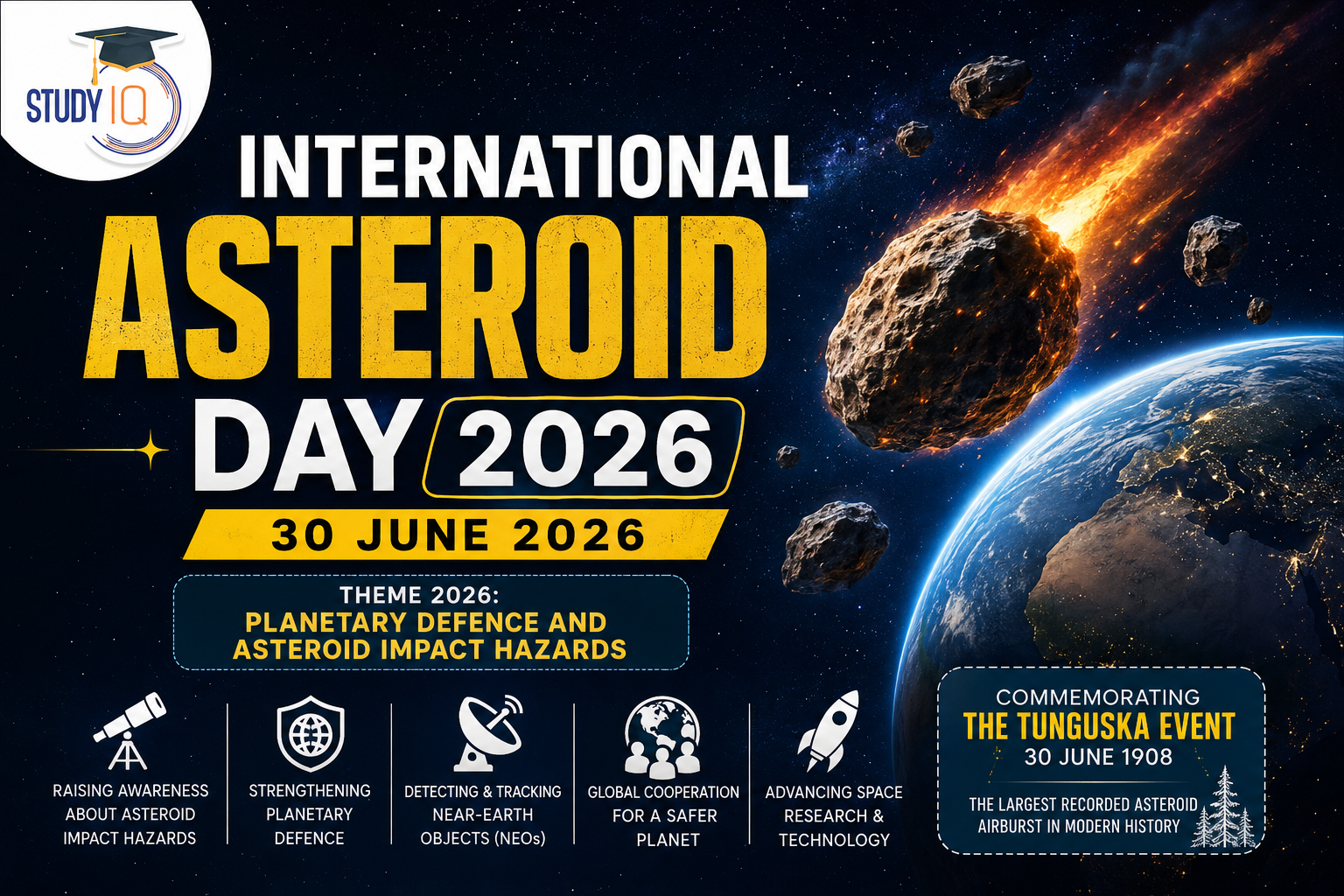
International Asteroid Day 2026 is observed worldwide on 30 June 2026 to raise awareness about asteroid impact hazards and the importance of protecting Earth through planetary defence. The annual observance commemorates the 1908 Tunguska Event, the largest recorded asteroid airburst in modern history, and highlights the need for international cooperation in tracking and mitigating threats from Near-Earth Objects (NEOs).
The United Nations General Assembly (UNGA) officially proclaimed 30 June as International Asteroid Day through Resolution A/RES/71/90 in 2016, making it an important global observance for promoting space science, disaster preparedness, and public awareness.
International Asteroid Day 2026 Overview
| Particular | Details |
|---|---|
| Event | International Asteroid Day 2026 |
| Date | 30 June 2026 |
| Theme | Planetary Defence and Asteroid Impact Hazards |
| Established By | United Nations General Assembly (UNGA) |
| UN Resolution | A/RES/71/90 |
| First UN Observance | 2017 |
| Commemorates | Tunguska Event (1908) |
| Objective | Raise awareness about asteroid hazards and planetary defence |
International Asteroid Day 2026 Theme
The International Asteroid Day 2026 theme is:
Planetary Defence and Asteroid Impact Hazards
The theme underscores the importance of:
- Detecting and tracking potentially hazardous asteroids.
- Strengthening global planetary defence capabilities.
- Advancing scientific research on Near-Earth Objects.
- Enhancing emergency preparedness and crisis communication.
- Promoting collaboration among governments, scientists, educational institutions, and space agencies.
Why Is International Asteroid Day Celebrated?
International Asteroid Day is celebrated to educate people about asteroid impact risks and encourage global efforts to protect Earth from potential asteroid collisions.
The observance aims to:
- Raise awareness about asteroid hazards.
- Promote scientific research on asteroids.
- Encourage international cooperation in planetary defence.
- Inspire interest in astronomy and space science.
- Support early warning systems for asteroid detection.
Through exhibitions, workshops, public lectures, astronomy events, and online campaigns, the day highlights how science and technology contribute to safeguarding our planet.
History of International Asteroid Day
The idea of Asteroid Day was launched in 2014 after the release of the science-fiction film 51 Degrees North, which explored the consequences of an asteroid strike. The initiative was supported by astronauts, scientists, and educators seeking to increase public awareness about asteroid threats.
Timeline
- 2014: Asteroid Day initiative launched.
- 2015: First International Asteroid Day celebrated.
- December 2016: UNGA officially declared 30 June as International Asteroid Day.
- 2017 onwards: Annual global observance under the United Nations.
The proposal was supported by the Association of Space Explorers (ASE) and endorsed by the Committee on the Peaceful Uses of Outer Space (COPUOS).
Why Is International Asteroid Day Observed on 30 June?
The date marks the anniversary of the Tunguska Event, which occurred on 30 June 1908 over Siberia, Russia.
Tunguska Event
- A large asteroid or comet fragment exploded in Earth’s atmosphere.
- Flattened approximately 80 million trees over nearly 2,000 square kilometres.
- No impact crater was formed because the object disintegrated before reaching the ground.
- It remains the largest recorded asteroid airburst in modern history.
The event serves as a powerful reminder of the destructive potential of asteroid impacts and the importance of planetary defence.
What Is an Asteroid?
An asteroid is a small rocky or metallic object that orbits the Sun. These celestial bodies are remnants from the formation of the Solar System around 4.6 billion years ago.
Key Features
- Smaller than planets.
- Composed mainly of rock, metal, or carbon-rich material.
- Sizes range from a few metres to hundreds of kilometres.
- Most are located in the Asteroid Belt between Mars and Jupiter.
- Some travel close to Earth and are classified as Near-Earth Objects (NEOs).
What Is the Asteroid Belt?
The Asteroid Belt is a region between the orbits of Mars and Jupiter containing millions of rocky and metallic objects.
These asteroids are remnants of the early Solar System that never formed into a planet due to Jupiter’s strong gravitational influence. While most remain within the belt, a few are occasionally nudged into Earth-crossing orbits.
Types of Asteroids
Asteroids are broadly classified into three major categories:
| Type | Composition | Characteristics |
|---|---|---|
| C-type | Carbon-rich | Dark and most abundant |
| S-type | Silicate rocks and nickel-iron | Rocky and relatively bright |
| M-type | Iron and nickel | Metallic and dense |
Understanding asteroid composition helps scientists predict their behaviour and develop effective deflection strategies.
Near-Earth Objects (NEOs)
Near-Earth Objects (NEOs) are asteroids or comets whose orbits bring them close to Earth’s orbit.
Scientists monitor NEOs because:
- They may pose impact hazards.
- Early detection improves preparedness.
- Tracking enables accurate orbit prediction.
- It provides time for potential mitigation measures.
More than 36,000 Near-Earth Asteroids have been discovered, with most posing no immediate threat.
Planetary Defence: Protecting Earth from Asteroid Threats
Planetary Defence involves international efforts to detect, monitor, and, if necessary, deflect potentially hazardous asteroids.
Major activities include:
- Asteroid discovery.
- Orbit tracking.
- Impact prediction.
- Scientific research.
- Deflection mission planning.
- Emergency communication systems.
Global Planetary Defence Organisations
- International Asteroid Warning Network (IAWN)
- Space Mission Planning Advisory Group (SMPAG)
These operate under the guidance of:
- United Nations Office for Outer Space Affairs (UNOOSA)
- Committee on the Peaceful Uses of Outer Space (COPUOS)
Major Asteroid Missions
Several space missions have strengthened planetary defence capabilities.
NASA DART
The first successful planetary defence mission that intentionally changed the orbit of asteroid moonlet Dimorphos.
OSIRIS-REx
Collected and returned samples from asteroid Bennu, helping scientists understand asteroid composition.
ESA Hera
Will study the long-term effects of the DART impact and improve future asteroid deflection strategies.
International Year of Asteroid Awareness and Planetary Defence 2029
The United Nations General Assembly declared 2029 as the International Year of Asteroid Awareness and Planetary Defence.
The declaration coincides with the close flyby of asteroid 99942 Apophis on 13 April 2029.
Apophis Flyby
- Distance from Earth: Approximately 32,000 km
- Safe flyby within the orbit of geostationary satellites.
- No collision risk.
- Provides a unique opportunity for scientific observation and public education.
Significance of International Asteroid Day
International Asteroid Day is significant because it:
- Raises awareness about asteroid impact hazards.
- Promotes planetary defence research.
- Encourages international cooperation.
- Supports disaster preparedness.
- Inspires interest in astronomy and STEM education.
- Highlights the importance of early warning systems.
Key Facts About International Asteroid Day 2026
- Date: 30 June
- Theme: Planetary Defence and Asteroid Impact Hazards
- Established by: United Nations General Assembly
- UN Resolution: A/RES/71/90
- Commemorates: Tunguska Event (1908)
- Largest asteroid airburst: Tunguska, Siberia
- Most asteroids: Located between Mars and Jupiter
- Planetary Defence Bodies: IAWN and SMPAG
- Major Missions: DART, OSIRIS-REx, Hera
- International Year: 2029
Latest UPSC Updates
| Resource | Link |
|---|---|
| UPSC Prelims Result 2026 | Check Here |
| UPSC Exam Calendar 2027 | View Calendar |
| UPSC Question Paper 2026 | Download PDF |
| UPSC Prelims Answer Key 2026 | Check Answer Key |
| UPSC Cut Off 2026 | View Cut Off |
| UPSC Syllabus 2026 | Read Syllabus |
| Daily Current Affairs 2026 | Read Updates |
| StudyIQ UPSC IAS Foundation 2027 (English) | Join Course |
| StudyIQ UPSC IAS Foundation 2027 (Hindi) | Join Course |
| StudyIQ UPSC IAS Foundation 2027 (Bilingual) | Join Course |
 Anti-Goonda Bill 2026 Explained: Why Pre...
 Cool Leaders Award 2026: Winners, Global...
 Black Carbon and Himalayan Glacier Melt:...














 WhatsApp





