Table of Contents
The Supreme Court’s decision in Parveen Kumar @ Parveen Chauhan v. State of Haryana (2026) is a landmark judgment that reinforces one of the most fundamental principles of the Indian legal system—judicial precedent. The Court clarified the limited scope of the doctrine of per incuriam, emphasizing that courts cannot disregard binding precedents merely because they disagree with an earlier interpretation.
Read Also: Judiciary Current Affairs
What is the Doctrine of Per Incuriam?
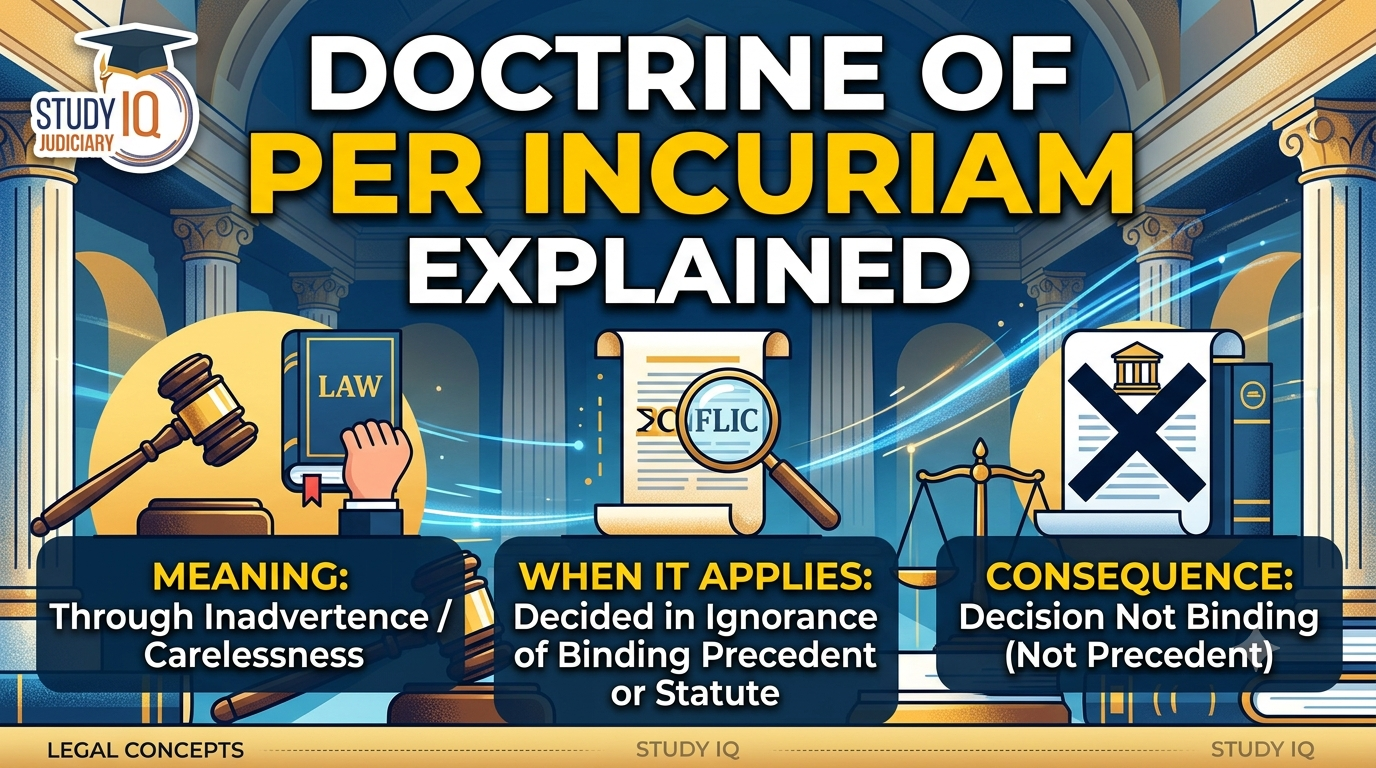
The Latin expression per incuriam means “through lack of care.” In legal jurisprudence, a judgment is considered per incuriam when it is delivered without considering a binding statutory provision or a binding judgment of a coordinate or larger bench.
The doctrine acts as a narrow exception to the principle of stare decisis (judicial precedent). It ensures that decisions rendered in ignorance of binding law do not continue to operate as authoritative precedents. However, the Supreme Court reiterated that this doctrine must be used sparingly and only in exceptional circumstances.
Supreme Court’s Clarification
The Court held that a judgment can be declared per incuriam only in two situations:
- When its ratio decidendi directly conflicts with a prior decision of a bench of equal or larger strength.
- When it ignores a relevant statutory provision, rule, or regulation that would have materially affected the decision.
The Court also clarified that mere disagreement with the reasoning of an earlier judgment is not sufficient to declare it per incuriam. Judicial discipline requires courts to follow binding precedents unless a larger bench overrules them.
Background of the Case
The dispute arose over Haryana’s remission policies governing the premature release of convicted prisoners.
Earlier, a three-judge bench in State of Haryana v. Jagdish held that the State’s remission policy was framed under Article 161 of the Constitution and therefore possessed a constitutional character.
Later, a two-judge bench in State of Haryana v. Raj Kumar (2021) treated a substantially similar remission policy as merely statutory under the Code of Criminal Procedure, leading to a direct conflict with the larger bench decision.
The Supreme Court resolved the inconsistency by declaring Raj Kumar to be per incuriam, since it failed to follow the binding precedent established by the larger bench in Jagdish.
Judicial Discipline and Hierarchy of Benches
A significant aspect of the judgment is its emphasis on judicial discipline.
The Supreme Court reiterated that:
- A smaller bench cannot overrule a larger bench.
- A coordinate bench cannot ignore another coordinate bench merely because it disagrees with it.
- If disagreement exists, the proper course is to refer the matter to a larger bench, rather than delivering a conflicting judgment.
This principle preserves consistency, certainty, and institutional integrity within the judicial system.
Ratio Decidendi vs. Obiter Dicta
The judgment also distinguishes between ratio decidendi and obiter dicta.
- Ratio decidendi is the legal principle essential to deciding the case and has binding force under Article 141.
- Obiter dicta are incidental observations that may be persuasive but are not binding.
The Court clarified that the doctrine of per incuriam applies only to the ratio decidendi of a judgment and not to incidental observations.
Constitutional Importance of Article 141
Article 141 of the Constitution provides that the law declared by the Supreme Court is binding on all courts in India.
The Court observed that this constitutional mandate:
- Ensures uniformity in legal interpretation.
- Promotes certainty and predictability in the law.
- Strengthens public confidence in the judiciary.
- Preserves the rule of law through consistent judicial reasoning.
Frequent or casual invocation of the doctrine of per incuriam would undermine these constitutional objectives.
Key Takeaways
- Per incuriam is a narrow exception to the doctrine of precedent.
- A judgment becomes per incuriam only if it ignores a binding statute or a binding precedent of an equal or larger bench.
- Mere disagreement with an earlier judgment does not justify ignoring it.
- Coordinate benches must refer conflicting issues to a larger bench.
- The judgment reinforces judicial discipline, stare decisis, and the constitutional mandate of Article 141.
- The Supreme Court declared State of Haryana v. Raj Kumar (2021) per incuriam for conflicting with the larger bench ruling in State of Haryana v. Jagdish.
Conclusion
The Supreme Court’s ruling in Parveen Kumar @ Parveen Chauhan v. State of Haryana (2026) is a significant reaffirmation of the principles governing judicial precedent in India. By clearly defining the scope of the doctrine of per incuriam, the Court has reinforced that the stability of the legal system depends on adherence to binding precedents and respect for judicial hierarchy.
The judgment strikes a careful balance between correcting fundamental legal errors and preserving the certainty and consistency that are essential to the rule of law. It serves as an important guide for courts, legal practitioners, and students in understanding when a precedent can legitimately lose its binding force while safeguarding the integrity of India’s constitutional framework.
Sharing is caring!
 Supreme Court Dowry Enforcement Order 20...
 Supreme Court Modifies 3-Year Practice R...
 AI Hallucinations in Legal Research: Sup...







 WhatsApp