

Table of Contents
Context: The debate around constitutional morality has resurfaced in judicial and political discourse, particularly during hearings related to the Sabarimala case. Questions have been raised about the legitimacy and clarity of the concept, with some arguing that it is prone to judicial overreach.
About Constitutional Morality
- Constitutional Morality refers to the guiding values enshrined in the Constitution that must be protected to uphold the integrity and vision of the Constitution.
- It goes beyond the literal interpretation to encompass a commitment to values such as sovereignty, social justice and equality in constitutional adjudication.
- Constitutional morality offers a mature form of constitutionalism, balancing respect for the Constitution with the ability to challenge and reform it when necessary.
- This balance prevents a shift towards fundamentalism while allowing for stability and change.
Distinction from Constitutional Patriotism
- The concept of constitutional morality is distinct from Jürgen Habermas’ constitutional patriotism, which emphasises solidarity and allegiance based on shared norms and values in a constitution.
- While constitutional morality focuses on process and critique, constitutional patriotism leans more towards a singular national identity.
Historical Origin
- Constitutional Morality was first conceptualized by George Grote, a British classist, in his historical work A History of Greece.
- Ambedkar, in his speech on The Draft Constitution (1948), also emphasized that constitutional morality must be cultivated to sustain democracy.
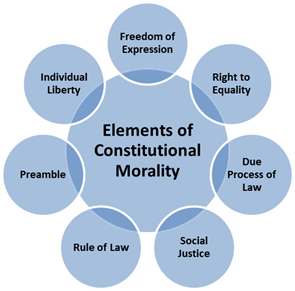
Constitutional Morality in the Indian Context
Constitutional Basis
- Preamble: Reflects foundational values such as justice, liberty, equality, and fraternity
- Fundamental Rights (Part III): Safeguards individual freedoms against arbitrary state action (e.g., Article 32)
- Directive Principles (Part IV): Provides ethical guidance for governance and social justice
- Fundamental Duties (Part IV-A): Emphasises citizens’ responsibilities toward the nation
- Checks and Balances: Separation of powers among the legislature, executive, and judiciary prevents concentration of authority
- The term “morality” itself appears in specific provisions, including:
- Article 19(2) and 19(4) (reasonable restrictions on freedoms)
- Article 25(1) and Article 26 (freedom of religion subject to morality)
Judicial Interpretation
- Rathinam v. Union of India (1994): Recognised that laws are rooted in moral principles such as fairness.
- Naz Foundation v. Government of NCT of Delhi (2009): Distinguished constitutional morality from societal morality, giving primacy to constitutional values.
- Manoj Narula v. Union of India (2014): Defined it as adherence to constitutional norms and governance free from arbitrariness.
- K.S. Puttaswamy v. Union of India (2017): Linked it to the rule of law, dignity, and protection of individual rights.
- Navtej Singh Johar v. Union of India (2018): Reinforced its role in promoting inclusivity and protecting LGBTQ+ rights.
- Indian Young Lawyers Association v. State of Kerala (2018): Held that constitutional morality prevails over public morality in ensuring gender equality in religious spaces.
- Government of NCT of Delhi v. Union of India (2018): Expanded its scope to include cooperative federalism, institutional respect, and participatory governance.
| Views of Dr. B.R. Ambedkar |
B. R. Ambedkar highlighted during the Constituent Assembly debates that the success of a Constitution ultimately depends on the conduct of those who implement it. He viewed constitutional morality as:
|
Significance of Constitutional Morality
- Guiding constitutional interpretation: It reflects core values such as liberty, equality, pluralism, and respect for due process.
- Protecting individual rights: It provides a framework to question entrenched social practices that may undermine dignity and civic equality.
- Enabling reasoned adjudication: It encourages courts to engage with substantive questions rather than relying on majoritarian or traditional norms.
- Acting as a normative compass: Even if not a strict legal rule, it helps identify when power becomes arbitrary or unaccountable.
- Balancing competing claims: It frames critical questions such as reconciling institutional autonomy with individual freedoms.
Alternative Perspective
- Guiding principle, not a rigid doctrine: It should shape reasoning rather than act as a standalone legal test.
- Emphasising procedural virtues: These include judicial restraint, respect for institutional processes, and openness to criticism.
- Balancing judicial and legislative roles: Avoid excessive judicial dominance while preserving the Court’s role as a rights protector.
- Rejecting blind reliance on “societal morality”: Social norms should not be used to shield practices from constitutional scrutiny.
- Focusing on substantive values: The emphasis should remain on freedom, equality, and dignity rather than labels.
Associated Challenges
- Conceptual ambiguity: The term lacks a precise definition, leading to varied interpretations.
- Judicial inconsistency: Uneven application across cases creates unpredictability in outcomes.
- Risk of judicial overreach: Courts may expand their authority under their broad umbrella.
- Misuse of societal morality: Invoking tradition or majority views can suppress critical reasoning.
- Erosion of institutional credibility: Perceived arbitrariness in judicial conduct weakens trust in constitutional governance.
Way forward
- Clarify its role: Treat constitutional morality as a normative guide rather than a binding rule.
- Ensure judicial discipline: Promote consistency, transparency, and reasoned decision-making.
- Strengthen institutional balance: Maintain a healthy equilibrium between the judiciary, legislature, and executive.
- Encourage reasoned debate: Courts must engage with competing values rather than foreclose discussion.
- Reaffirm core constitutional values: Liberty, equality, and dignity should remain central to all adjudication.

 Anti-Defection Law: Origin, Provisions o...
 Central Information Commission (CIC): Ap...
 Panchayati Raj Institutions (PRI): Evolu...













 WhatsApp





