Table of Contents
Context
Despite rapid growth in data generation, India’s governance architecture continues to face major challenges.
Read Also: UPSC Daily Current Affairs 2026
Data Standardisation
- Data standardisation refers to the process of collecting, storing, processing, and presenting information in a uniform format across institutions and departments.
- It ensures that data generated by different agencies follows common:
- Definitions
- Formats
- Classification systems
- Reporting methodologies
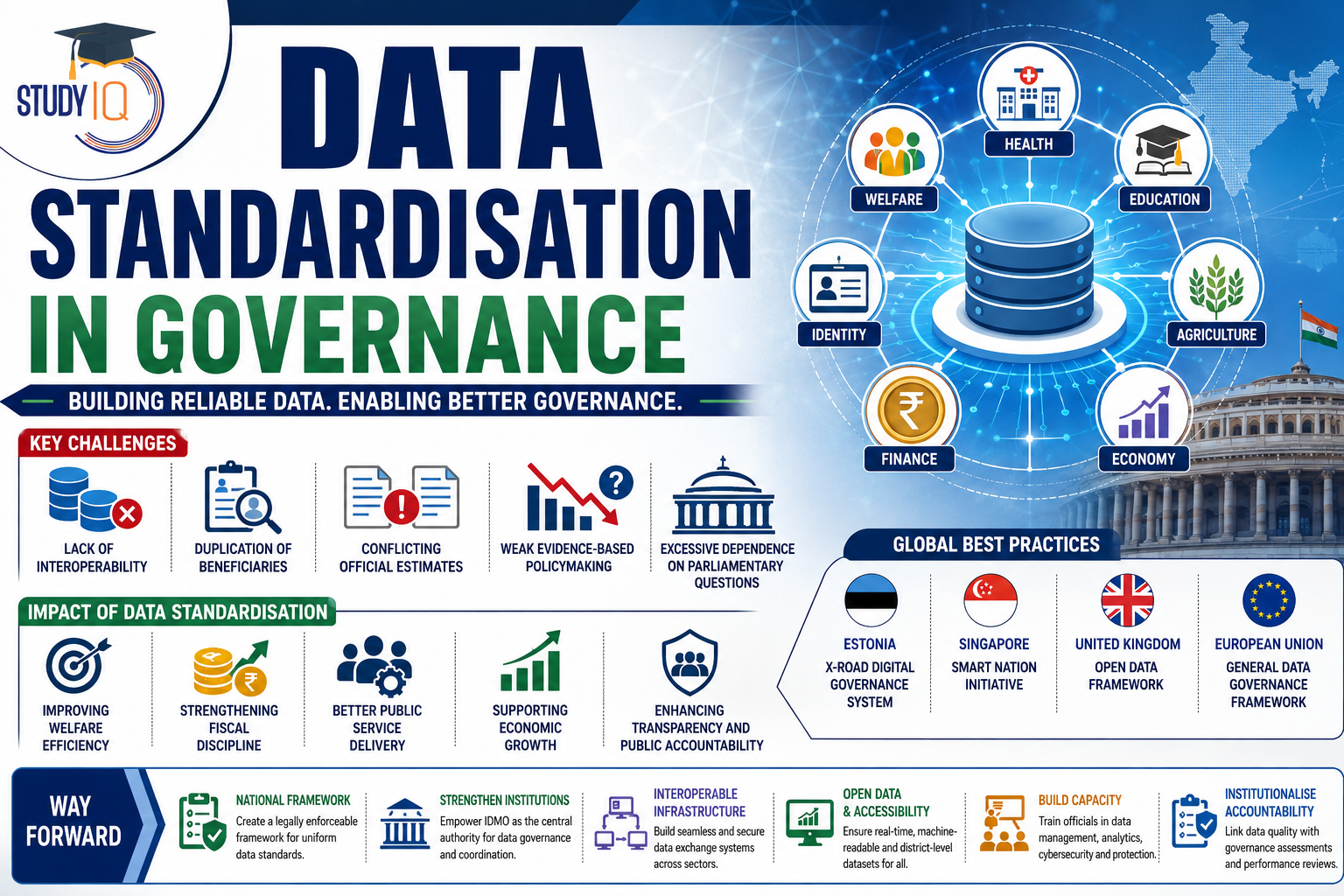
Poor data systems and governance-related challenges
- Lack of interoperability: Different Ministries and departments often maintain isolated databases with little coordination leading to administrative duplication, weak policy coordination, delayed implementation and inefficient service delivery
- Eg: Separate databases for healthcare, nutrition, and immunisation may record overlapping information for the same beneficiary.
- Duplication of Beneficiaries: Weak verification mechanisms can result in duplicate or fake entries and lead to fiscal leakages, misallocation of resources, inflated welfare expenditure
- Eg: Fake LPG connections removed under PAHAL
- Eg: Ineligible beneficiaries removed from PM-KISAN
- Conflicting Official Estimates: Different departments may report contradictory statistics for the same issue..
- Eg: Childhood tuberculosis cases may be separately recorded in Health Management Information Systems (HMIS), Disease surveillance systems and Immunisation databases leading to the same patient being counted multiple times.
- Weak Evidence-Based Policymaking: Inconsistent and unreliable data undermine scientific policymaking, poor targeting of beneficiaries, and weak development planning.
- Excessive Dependence on Parliamentary Questions: Basic administrative information is often unavailable in standardised public formats which reflects in weak public data infrastructure, poor transparency and lack of real-time governance dashboards
Impact of Data Standardisation
- Improving Welfare Efficiency: Standardised databases improve targeting and reduce duplication.
- Eg: Direct Benefit Transfer (DBT) systems linked with Aadhaar have reduced leakages in welfare schemes.
- Report Reference: According to government estimates, DBT reforms have contributed to significant savings by eliminating duplicate beneficiaries.
- Strengthening Fiscal Discipline: Reliable databases reduce wasteful expenditure and improve auditing processes.
- Eg: Digitisation and beneficiary verification have improved efficiency in food subsidy and LPG subsidy systems.
- Better Public Service Delivery: Integrated digital systems improve responsiveness and coordination.
- Eg: The CoWIN platform demonstrated the importance of interoperable and real-time digital infrastructure during COVID-19 vaccination management.
- Supporting Economic Growth: Efficient data systems improve productivity and investment planning.
- Eg: Studies by organisations such as the OECD and World Bank suggest that improved public-sector data sharing enhances economic efficiency and governance outcomes.
- Enhancing Transparency and Public Accountability: Open-data systems strengthen democratic oversight.
- Eg: Platforms such as data.gov.in enable researchers, journalists, and citizens to access government dataset.
|
Global best practices |
| ● Estonia’s X-Road Digital Governance System: Estonia has developed one of the world’s most advanced interoperable digital governance systems with secure data-sharing architecture, interconnected public databases, and real-time digital governance.
● Singapore’s Smart Nation Initiative: Singapore has integrated data systems across sectors to improve urban governance and public service delivery. ● United Kingdom’s Open Data Framework: It promotes standardised and publicly accessible government datasets. ● European Union’s General Data Governance Framework: The European Union promotes harmonised standards for data sharing and digital governance for consistency and comparability across member states. |
Way Forward
- Comprehensive National Data Standardisation Framework: India should create a legally enforceable national framework that prescribes uniform standards for data collection, classification, storage, and reporting across all Ministries and States to strengthen evidence-based governance.
- Strengthen Institutional Mechanisms for Data Governance: The proposed India Data Management Office (IDMO) should function as the central coordinating authority for public-sector data governance to harmonise methodologies, and facilitate coordination between the Union and State governments.
- Interoperable Digital Infrastructure: Government departments should build interoperable digital systems that enable secure and seamless exchange of information across sectors such as health, education, agriculture, and welfare.
- Open Data and Public Accessibility: India should strengthen platforms such as data.gov.in by ensuring real-time updates, standardised machine-readable formats, and district-level datasets for wider public access.
- Technical and Statistical Capacity within Government: Continuous training programmes should be introduced for government officials in areas such as data management, statistical analysis, digital governance, cybersecurity, and data protection.
- Institutionalise Accountability: Data quality should become an important parameter in governance assessments and administrative performance reviews.
 UAPA Act 1967: Key Provisions, Supreme C...
 Sarus Crane: Habitat, Features, Conserva...














 WhatsApp