Table of Contents
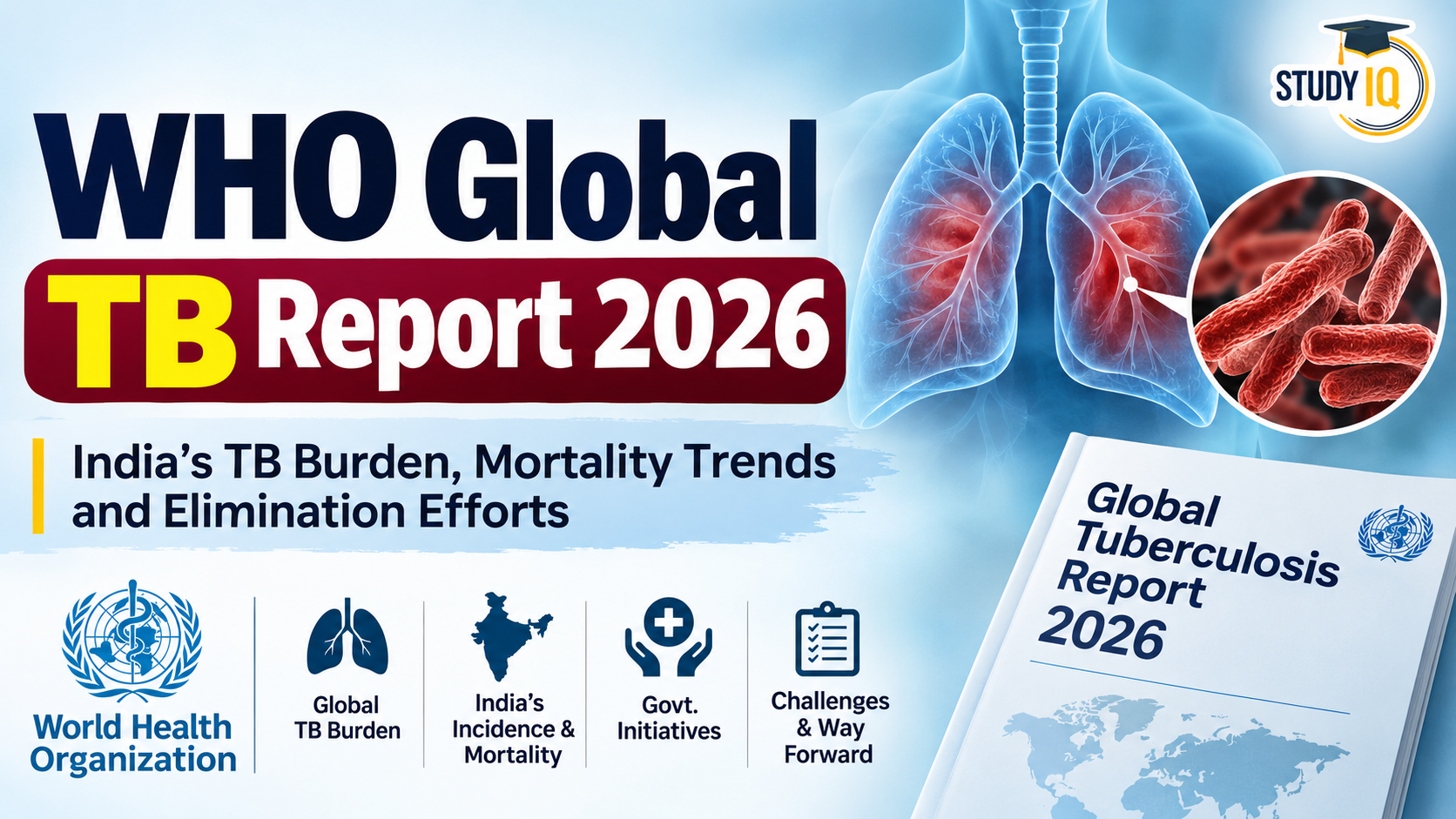
WHO Global TB Report 2026: The World Health Organization (WHO) Global Tuberculosis Report 2026 highlights global progress in combating tuberculosis (TB) and India’s efforts towards eliminating the disease. However, India’s estimated TB incidence figures have been kept under review pending the finalisation of data from a 50-district sentinel surveillance survey conducted in 2025.
Read Also: UPSC Daily Current Affairs 2026
What is the WHO Global TB Report?
-
An annual flagship publication released by the World Health Organization.
-
Provides an assessment of the global tuberculosis epidemic.
-
Tracks progress in TB prevention, diagnosis, treatment and elimination.
-
Evaluates countries against the WHO End TB Strategy.
Why is TB Incidence Estimation Important?
-
Estimated incidence: Total number of new and recurrent TB cases occurring in a population during a given period.
-
Notified cases: Diagnosed TB cases reported to the national surveillance system.
Significance:
-
Identifies undiagnosed and unreported TB cases.
-
Helps estimate the actual disease burden.
-
Supports resource allocation and public health planning.
-
Measures the effectiveness of TB detection programmes.
Key Findings of the WHO Global TB Report 2026
| Indicator | Key Statistics |
|---|---|
| Global TB cases (2025) | 10.6 million |
| Global TB deaths (2025) | 1.13 million |
| India’s notified TB cases (2025) | 25.3 lakh |
| India’s TB deaths (2025) | 2.63 lakh |
| Reduction in India’s TB mortality since 2015 | 38% |
| Domestic funding share of India’s TB programme | Approximately 96% |
Important observations:
-
India accounts for nearly one-fourth of the global TB burden.
-
India’s notified cases declined from 26.18 lakh in 2024 to 25.3 lakh in 2025.
-
TB mortality declined by 38% since 2015.
-
India has exceeded the WHO’s interim 2020 target of reducing TB mortality by 35%.
-
However, the country remains short of the 2025 target of a 75% reduction in TB deaths.
India’s TB Surveillance Methodology
India has undertaken efforts to improve the accuracy of TB burden estimation.
-
Nationwide TB prevalence surveys are resource-intensive.
-
India conducted a population-level sentinel surveillance survey across 50 representative districts in 2025.
-
The findings are being calibrated against the 2020–21 national TB prevalence survey baseline.
-
The WHO is reviewing the estimates before finalising India’s incidence figures.
Why does it matter?
Reliable surveillance helps identify geographical variations, hidden cases and gaps in diagnosis and treatment.
Major Government Initiatives for TB Elimination
1. National Tuberculosis Elimination Programme (NTEP)
-
Reoriented India’s approach from TB control towards elimination.
-
Promotes early diagnosis and complete treatment.
-
Mandates notification of TB cases, including those diagnosed in the private sector.
-
Uses the Ni-kshay digital platform for patient tracking.
2. Ni-kshay Poshan Yojana
-
Provides nutritional financial assistance through Direct Benefit Transfer (DBT).
-
Aims to improve patients’ nutritional status and treatment adherence.
3. Ni-kshay Mitra Initiative
-
Encourages individuals, organisations and institutions to support TB patients.
-
Provides nutritional and social support through community participation.
4. Pradhan Mantri TB Mukt Bharat Abhiyaan
-
Promotes a community-led approach to TB elimination.
-
Encourages public participation in supporting TB patients.
5. Advanced Diagnostic Technologies
-
Expansion of CBNAAT and Truenat molecular diagnostic facilities.
-
Early detection of drug-resistant TB.
-
Deployment of AI-enabled portable chest X-ray technology for screening.
6. Shorter All-Oral Treatment Regimens
-
Introduction of shorter treatment options such as BPaL and BPaLM for eligible drug-resistant TB patients.
-
Reduces dependence on injectable medicines.
-
Improves treatment convenience and adherence.
Major Challenges in TB Elimination
| Challenge | Explanation |
|---|---|
| Missing TB cases | Undiagnosed patients continue transmitting infection. |
| Diagnostic delays | Limited access to molecular testing in remote areas. |
| Private-sector fragmentation | Inconsistent treatment and incomplete notification. |
| Drug resistance | Increasing complexity of MDR-TB treatment. |
| Malnutrition | Weakens immunity and increases vulnerability to TB. |
| Social stigma | Discourages early diagnosis and treatment. |
| Surveillance gaps | Delayed and incomplete epidemiological data. |
Way Forward
-
Strengthen surveillance: Publish timely and granular state- and district-level TB data.
-
Expand early diagnosis: Improve access to molecular testing and AI-enabled screening at primary healthcare facilities.
-
Integrate private healthcare: Ensure mandatory notification, quality-assured treatment and patient follow-up.
-
Address malnutrition: Strengthen nutritional support for vulnerable patients.
-
Control drug resistance: Promote drug-susceptibility testing and appropriate treatment regimens.
-
Improve community participation: Expand awareness, contact tracing and TB Preventive Treatment (TPT).
-
Strengthen accountability: Conduct systematic TB death audits to identify preventable gaps in healthcare delivery.
Conclusion
India has made significant progress in reducing TB mortality through improved diagnostics, nutritional support, digital surveillance and domestic financing. However, the omission of estimated incidence figures from the WHO Global TB Report 2026 highlights the importance of reliable epidemiological data.
Achieving TB elimination requires a comprehensive approach based on early diagnosis, universal access to quality treatment, nutritional security, private-sector participation and transparent surveillance.

 World Diabetes Day 2026: Theme, History,...
 Children’s Day 2026: Date, History, Si...
 Climate Change Performance Index 2027: I...













 WhatsApp