Table of Contents
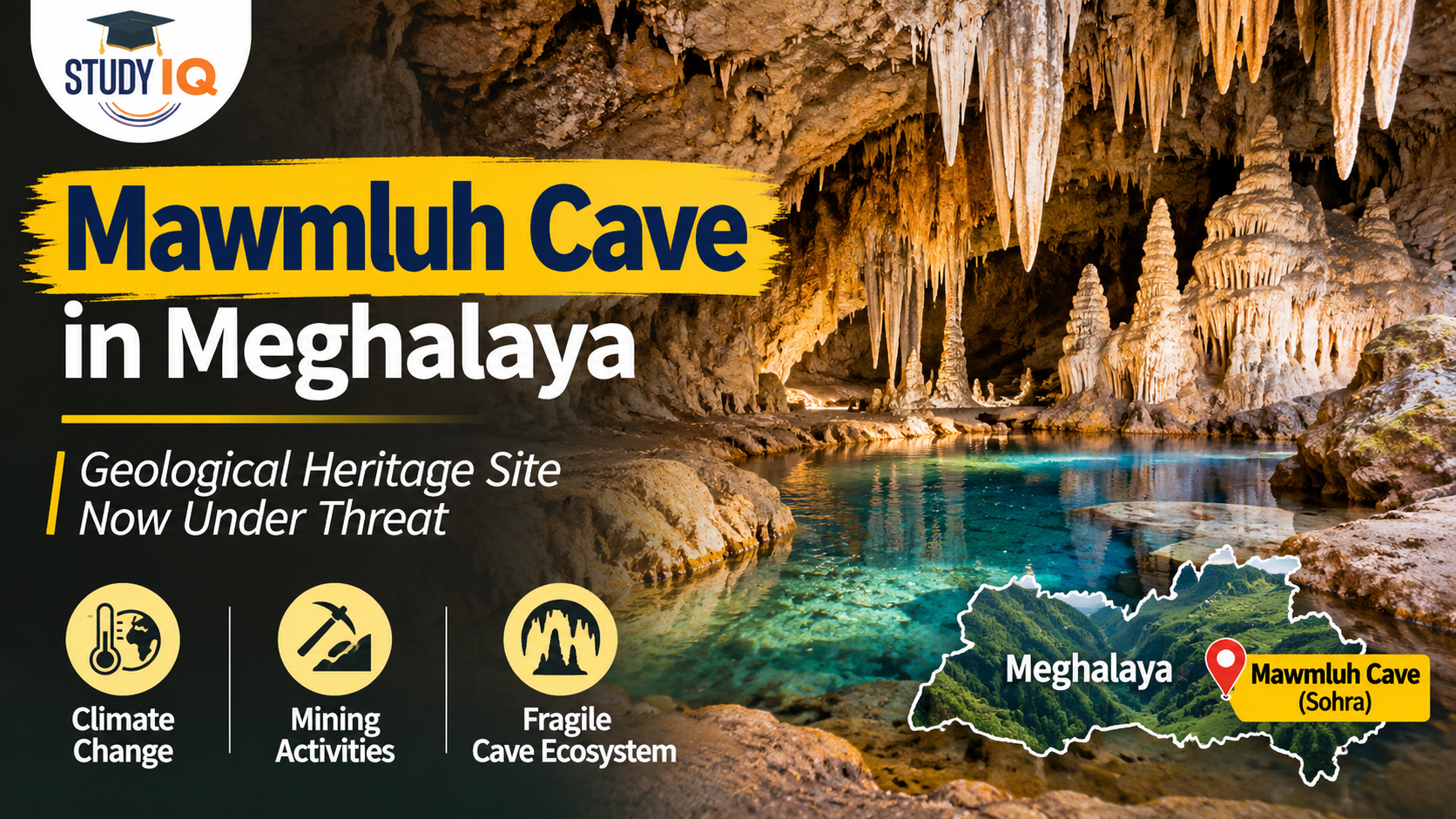
Mawmluh Cave, located in Meghalaya, is facing growing threats from climate change and mining activities. Changes in rainfall patterns and groundwater levels are affecting its fragile geological structures and underground ecosystems.
The threats have raised concerns about the conservation of this important geological heritage site.
About Mawmluh Cave
-
Location: Sohra (Cherrapunji), East Khasi Hills district, Meghalaya.
-
Local Name: Krem Mawmluh.
-
Exploration: It was first explored by British official Lieutenant Yule in 1844.
-
Length: Approximately 7.2 km, making it the fourth-longest cave in the Indian subcontinent.
-
Geological Importance: It preserves evidence of significant events in Earth’s geological history.
-
Recognition: Recognised among the First 100 Geological Heritage Sites by the International Union of Geological Sciences (IUGS) in 2022.
Geological Features of Mawmluh Cave
-
The cave is known for its spectacular limestone formations.
-
It contains several geological structures collectively known as speleothems.
-
Important formations include:
-
Stalactites: Mineral deposits hanging from the cave ceiling.
-
Stalagmites: Mineral deposits rising from the cave floor.
-
Columns: Structures formed when stalactites and stalagmites join.
-
Drapes: Sheet-like mineral formations hanging from cave ceilings.
-
-
It developed at the junction of an early Eocene dolomite and a sandstone formation.
Connection with the Meghalayan Age
Mawmluh Cave has exceptional importance in understanding Earth’s geological history.
-
The cave contains a stalagmite that preserves evidence of a major climatic event around 4,200 years ago.
-
This evidence helped scientists identify the beginning of the Meghalayan Age.
-
The Meghalayan Age is the youngest age of the Holocene Epoch in the International Chronostratigraphic Chart.
-
It began approximately 4,200 years ago and continues to the present.
Threats to Mawmluh Cave
The cave’s fragile ecosystem faces several environmental threats:
-
Climate Change: Changes in rainfall patterns can affect groundwater systems and cave environments.
-
Mining Activities: Limestone and other mining activities can damage geological formations and underground habitats.
-
Groundwater Disturbance: Changes in groundwater flow may affect the natural processes responsible for cave formation.
-
Ecosystem Degradation: Disturbance of underground habitats can threaten specialised cave-dwelling organisms.
Conservation Significance
Protecting Mawmluh Cave is important for preserving India’s geological heritage and understanding past climate changes.
-
Regulating mining activities around sensitive cave systems.
-
Monitoring groundwater and rainfall patterns.
-
Promoting scientific research and geological documentation.
-
Involving local communities in cave conservation.
-
Developing sustainable tourism practices.
Frequently Asked Questions (FAQs)
Q1. Where is Mawmluh Cave located?
Answer: Mawmluh Cave is located at Sohra in the East Khasi Hills district of Meghalaya.
Q2. What is the local name of Mawmluh Cave?
Answer: It is locally known as Krem Mawmluh.
Q3. Why is Mawmluh Cave globally significant?
Answer: It contains a stalagmite record that helped scientists identify the beginning of the Meghalayan Age, approximately 4,200 years ago.
Q4. What are speleothems?
Answer: Speleothems are mineral deposits formed inside caves. Examples include stalactites, stalagmites, columns and drapes.
Q5. Which organisation recognised Mawmluh Cave as a geological heritage site?
Answer: The International Union of Geological Sciences (IUGS) recognised it among the First 100 Geological Heritage Sites in 2022.

 WHO Global TB Report 2026: India’s TB ...
 World Diabetes Day 2026: Theme, History,...
 Children’s Day 2026: Date, History, Si...














 WhatsApp