Table of Contents
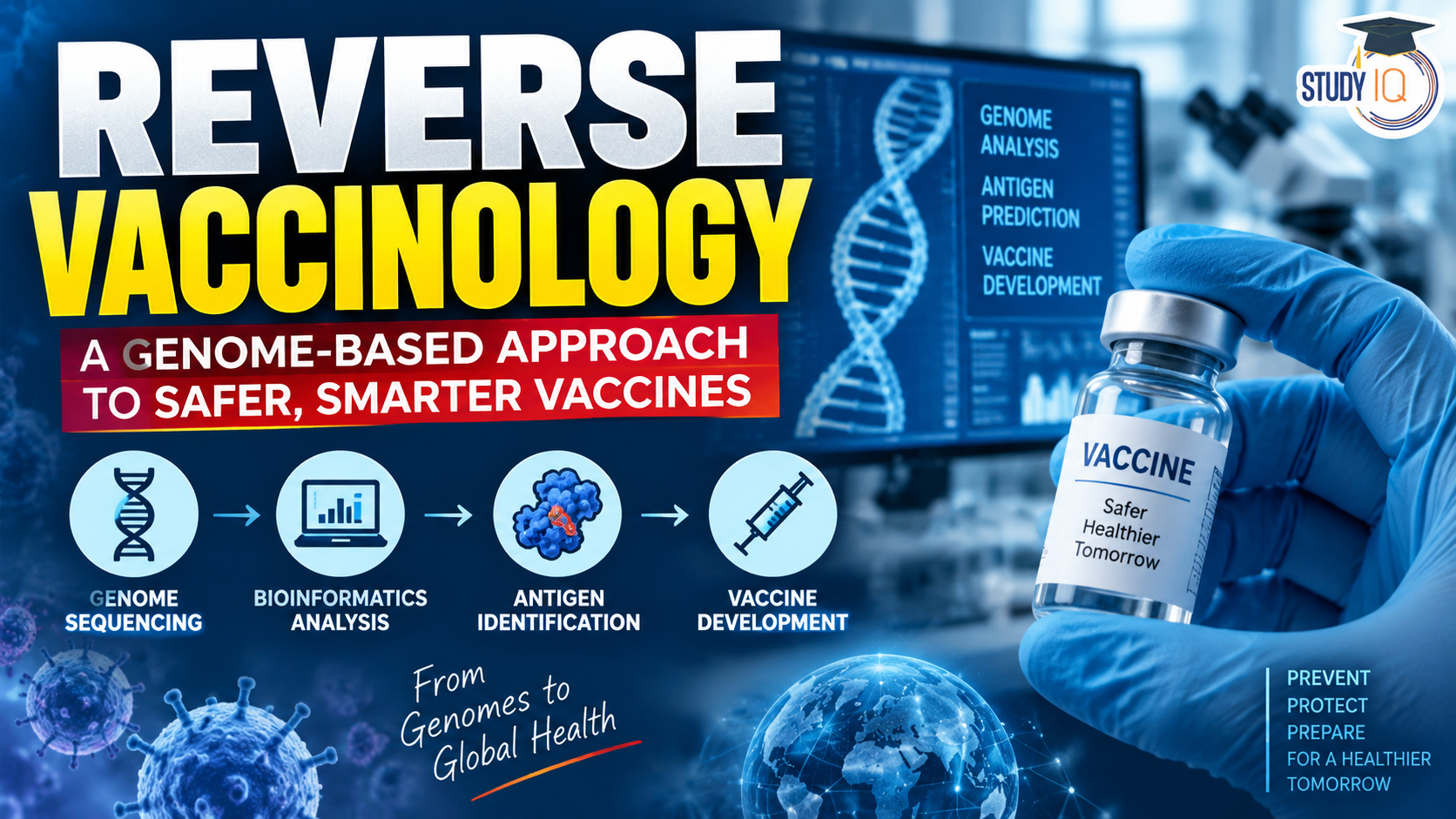
Reverse Vaccinology is an innovative approach to vaccine development that uses genome sequencing, bioinformatics and computational analysis to identify potential vaccine targets. Unlike conventional methods, which generally begin by studying the pathogen and searching for suitable antigens, reverse vaccinology starts with the genetic information of the pathogen.
The approach has transformed modern vaccine research by allowing scientists to screen thousands of genes and predict which proteins could trigger a protective immune response.
Read Also: UPSC Daily Current Affairs 2026
What Is Reverse Vaccinology?
Reverse vaccinology is a genome-based vaccine-development strategy in which scientists analyse the complete genome of a pathogen to identify proteins that could potentially serve as vaccine antigens.
The term “reverse vaccinology” was coined by Rino Rappuoli in 2000. The approach was first successfully applied to the development of a vaccine against serogroup B Neisseria meningitidis (MenB).
How Reverse Vaccinology Works
The process broadly involves the following steps:
- Genome sequencing: The complete genetic sequence of the pathogen is obtained.
- Bioinformatic analysis: Computer-based tools analyse genes and predict proteins that may be located on the pathogen’s surface or secreted outside the cell.
- Antigen identification: Scientists shortlist proteins that are likely to stimulate a useful immune response.
- Laboratory production: Selected proteins are produced and purified for further investigation.
- Immunological screening: Candidate antigens are tested for their ability to generate an immune response.
- Preclinical and clinical testing: Promising candidates undergo animal studies followed by human clinical trials to establish their safety and effectiveness.
Why Is Reverse Vaccinology Important?
Traditional vaccine development can be time-consuming because researchers may need to culture pathogens, isolate their components and experimentally identify suitable antigens.
Reverse vaccinology changes this process by allowing researchers to begin with genomic information.
Its major advantages include:
- Genome-wide screening of potential vaccine targets.
- Identification of previously unknown antigens.
- Reduced dependence on conventional pathogen-culture methods.
- Greater use of computational and genomic technologies.
- Potentially faster identification of promising vaccine candidates.
- Useful for pathogens that are difficult to grow or study using conventional techniques.
Reverse Vaccinology and Pneumonia
Reverse vaccinology has also gained attention in research aimed at developing broader vaccines against pneumonia and meningitis-causing bacteria.
Pneumonia can be caused by several pathogens and different strains, making the development of broadly protective vaccines challenging. Genome-based approaches can help researchers identify conserved proteins or immune targets that may provide protection across multiple strains.
However, identifying a promising antigen computationally does not automatically result in an effective vaccine. Laboratory validation, animal studies and human clinical trials remain essential.
Reverse Vaccinology vs Conventional Vaccinology
| Conventional Vaccinology | Reverse Vaccinology |
|---|---|
| Begins with the pathogen or its components | Begins with the pathogen’s genome |
| Relies heavily on experimental antigen discovery | Uses computational prediction |
| Can require pathogen cultivation | May identify targets directly from genomic data |
| Antigens are identified experimentally | Candidate antigens are predicted and then experimentally validated |
| Can be relatively time-consuming | Can enable systematic and rapid screening |
Applications Beyond Neisseria meningitidis
The reverse vaccinology approach has been investigated for several pathogens, including:
- Streptococcus pneumoniae
- Bacillus anthracis
- Mycobacterium tuberculosis
- Other bacterial pathogens
Its applications are expanding alongside advances in next-generation sequencing, artificial intelligence, structural biology and immunoinformatics.
Challenges of Reverse Vaccinology
Despite its potential, reverse vaccinology has limitations.
- A protein predicted to be antigenic may not generate protective immunity.
- Computational predictions require experimental validation.
- Pathogens can have considerable genetic and antigenic diversity.
- Identifying an antigen is only the first step; vaccine formulation, safety and efficacy must still be established.
- Human immune responses are complex and cannot always be accurately predicted computationally.

 Special Summary Revision (SSR) 2026–27...
 Global Hunger Index 2026: India Ranks 10...
 France Protests 2026: Cost of Living, Sc...













 WhatsApp