
Table of Contents
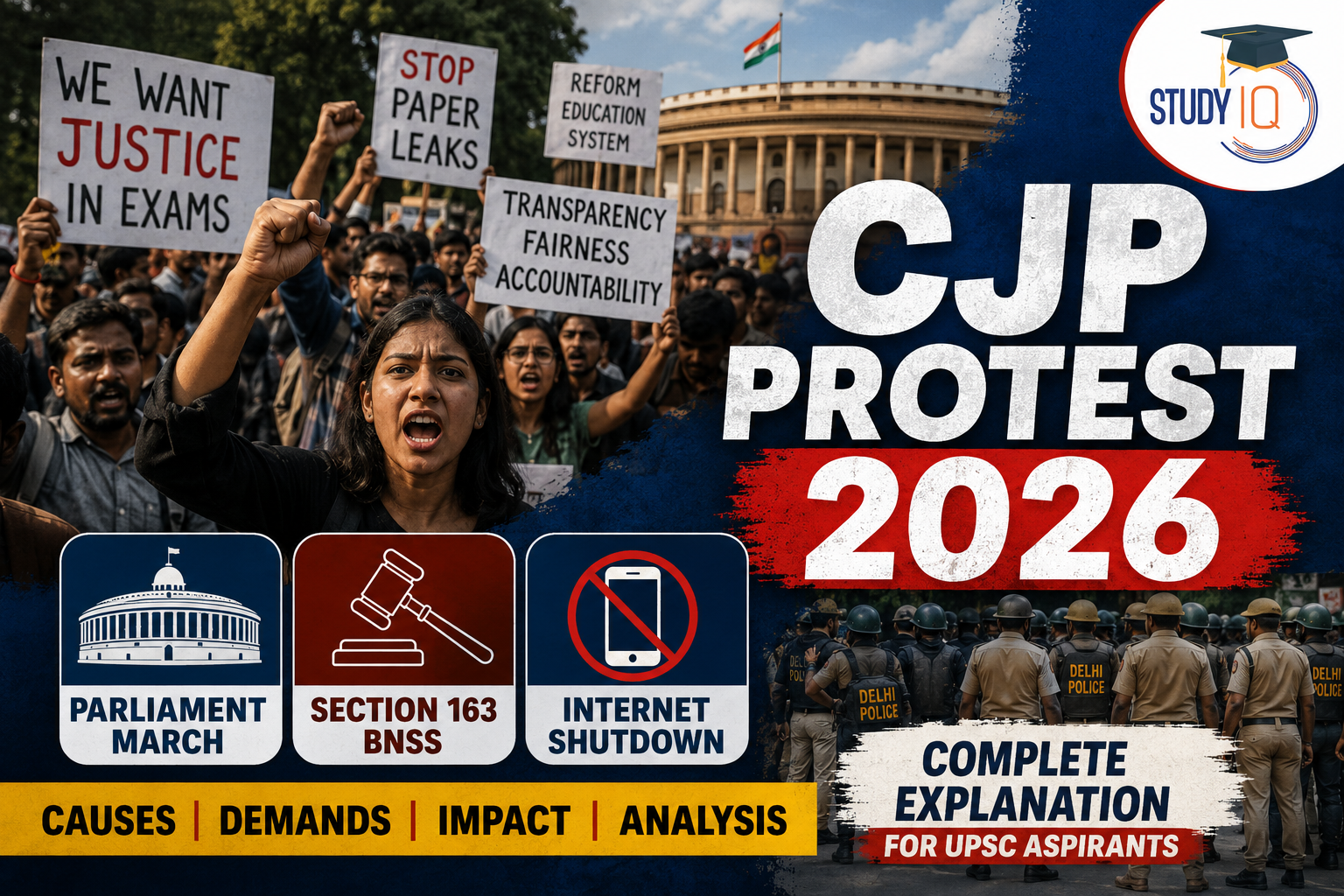
The CJP Protest 2026 has emerged as one of the biggest public demonstrations witnessed in New Delhi in recent years. Thousands of protesters gathered at Jantar Mantar before attempting to march toward Parliament under the “Sansad Chalo” campaign. The movement drew nationwide attention after clashes between protesters and Delhi Police, resulting in injuries, detentions, and widespread political reactions.
The protest has sparked a national debate over education reforms, the right to peaceful protest, law and order, and government accountability.
Read Also: UPSC Daily Current Affairs 2026
What is the CJP Protest 2026?
The Cockroach Janta Party (CJP) organized a large-scale protest in Delhi demanding accountability over alleged irregularities in competitive examinations. The organization called for major reforms in India’s examination system and demanded the resignation of Union Education Minister Dharmendra Pradhan.
The protest witnessed participation from students, youth groups, activists, and supporters from different states across India.
Why Did CJP Organize the Protest?
The major demands included:
- Resignation of the Union Education Minister
- Transparent investigation into examination irregularities
- Education reforms
- Accountability for paper leak cases
- Stronger recruitment examination mechanism
- Protection of students’ interests
What is the CJP Parliament March?
The Cockroach Janta Party (CJP) announced the “Chalo Sansad” campaign to bring the issue of examination reforms directly before lawmakers on the first day of Parliament’s Monsoon Session.
The organization stated that the objective of the march was not merely political but to demand structural reforms in India’s examination system following allegations of paper leaks and recruitment irregularities witnessed over the last few years.
According to the organizers, the movement represents a broader campaign for:
- Transparent recruitment examinations
- Fair evaluation systems
- Accountability in public examinations
- Stronger anti-paper leak legislation
- Better governance in education
Supporters from various states travelled to Delhi to participate in what organizers described as a peaceful democratic movement.
Major Timeline of Events
Early Morning
- Thousands gathered at Jantar Mantar.
- Heavy police deployment across Central Delhi.
- Metro station restrictions imposed.
March Begins
- Protesters attempted to march toward Parliament.
- Multiple barricades were erected.
Police Action
- Tear gas shells were fired.
- Baton charge carried out after barricades were breached.
- Several protesters and police personnel were injured.
Government Outreach
A delegation of CJP leaders met Union Minister J.P. Nadda, who assured them that the government leadership would discuss their demands internally.
Evening Developments
- Police cleared Jantar Mantar.
- Protesters returned later in the evening.
- Sit-in resumed near Kerala House before many returned to Jantar Mantar.
CJP Protest 2026 Highlights
| Event | Details |
|---|---|
| Protest Venue | Jantar Mantar, New Delhi |
| Campaign | Sansad Chalo |
| Main Demand | Education reforms and minister’s resignation |
| Protest Leaders | Abhijeet Dipke, Ashutosh Ranka, Saurav Das |
| Government Representative | JP Nadda |
| Police Action | Tear gas, barricading, detentions |
| Police Claim | 118 personnel injured |
| Protesters Detained | Around 70 |
| Protest Status | Continuing sit-in |
Why Did Delhi Police Stop the March?
Delhi Police stated that no permission had been sought or granted for the Parliament march.
Since the protest coincided with the first day of the Monsoon Session, authorities cited heightened security concerns around Parliament and imposed prohibitory orders in New Delhi district.
According to the police advisory:
- Unauthorized marches were prohibited.
- Assemblies beyond the permitted limit were restricted.
- Only designated protest sites with prior approval could be used.
The administration argued that unrestricted movement of thousands of protesters towards Parliament could disrupt security arrangements.
Section 163 BNSS Explained
One of the most discussed aspects of the protest has been the invocation of Section 163 of the Bharatiya Nagarik Suraksha Sanhita (BNSS), 2023.
This provision replaced the earlier Section 144 of the Code of Criminal Procedure (CrPC) after the implementation of India’s new criminal laws.
What powers does Section 163 provide?
The provision authorizes designated executive authorities to issue temporary preventive orders whenever there is sufficient apprehension regarding:
- Public disorder
- Rioting
- Violence
- Obstruction of public movement
- Threat to human life
- Disturbance of public tranquility
The orders generally prohibit:
- Large public gatherings
- Protest marches
- Carrying weapons
- Certain public activities within specified areas
The objective is preventive rather than punitive.
Violation of such orders may attract legal action under relevant provisions of the Bharatiya Nyaya Sanhita (BNS).
Mobile Internet Shutdown: Why Was It Imposed?
Ahead of the Parliament march, authorities suspended mobile internet services in parts of central Delhi.
Governments generally cite the following reasons for temporary internet restrictions:
- Preventing misinformation
- Preventing rumor circulation
- Preventing coordination of violent activities
- Assisting crowd management
- Maintaining public order during sensitive events
While administrations consider such measures preventive, internet shutdowns also raise important debates regarding:
- Digital rights
- Freedom of expression
- Access to information
- Proportionality of restrictions
India has witnessed judicial scrutiny over internet shutdowns, particularly after the Supreme Court emphasized that such restrictions must satisfy the principles of legality, necessity, and proportionality.
Metro Stations Closed as Security Tightened
The Delhi Metro Rail Corporation temporarily closed several stations located near Parliament and Jantar Mantar, including:
- Janpath
- Patel Chowk
- Rajiv Chowk
- Central Secretariat
- Seva Teerth
Interchange facilities at Rajiv Chowk and Central Secretariat were later restored as the situation evolved.
Traffic diversions were also implemented across central Delhi.
What Happened During the Protest?
As thousands gathered near Jantar Mantar, some groups attempted to move toward Parliament despite restrictions.
According to eyewitness reports:
- Police erected multiple barricades.
- Protesters attempted to cross security cordons.
- Sporadic clashes occurred.
- Police reportedly used batons to disperse advancing groups.
- Protest organizers appealed repeatedly for calm and peaceful conduct.
The situation remained fluid throughout the morning with security forces maintaining a strong presence around Parliament.
Sonam Wangchuk’s Role in the Movement
Activist Sonam Wangchuk, who has been on a prolonged hunger strike, remained hospitalized during the Parliament march.
In a public statement, he said he would end his fast if:
- The government accepted accountability for failures in the education system.
- Members of Parliament assured that examination-related issues would be raised during the Monsoon Session.
- Senior political leaders personally conveyed these assurances if his health prevented him from participating.
His wife, Dr. Gitanjali Angmo, addressed the gathering and urged protesters to remain peaceful and focused on education reforms.
Constitutional Debate: Right to Protest vs Public Order
The protest once again raises important constitutional questions.
Fundamental Rights Involved
Article 19(1)(a)
Freedom of Speech and Expression
Article 19(1)(b)
Right to Assemble Peacefully Without Arms
Article 19(1)(c)
Right to Form Associations
However, these freedoms are not absolute.
The Constitution permits reasonable restrictions in the interests of:
- Sovereignty and integrity
- Security of the State
- Public order
- Morality
- Decency
Therefore, while peaceful protest enjoys constitutional protection, authorities may regulate the time, place and manner of assemblies to maintain public order.
Supreme Court’s Position on Peaceful Protests
Indian courts have repeatedly emphasized two important principles:
Citizens have a constitutional right to protest peacefully.
At the same time,
Public roads, essential services and critical government infrastructure cannot be indefinitely blocked.
The judiciary has consistently attempted to balance civil liberties with administrative necessity by applying the doctrine of proportionality.
Governance Challenges Highlighted
The protest underlines several governance issues:
Examination Governance
- Examination integrity
- Recruitment transparency
- Institutional accountability
Public Administration
- Crisis management
- Crowd control
- Preventive policing
Digital Governance
- Internet shutdown policies
- Communication during emergencies
- Technology and civil liberties
Democratic Accountability
- Student participation
- Public consultation
- Institutional responsiveness
UPSC Relevance
Prelims
- BNSS
- Fundamental Rights
- Parliament
- Internet shutdowns
- Public Order
GS Paper II
- Governance
- Education reforms
- Constitutional rights
- Accountability
- Police powers
GS Paper III
- Internal Security
- Crowd management
- Technology and security
- Cyber governance
Essay
Possible themes include:
- Democracy and dissent
- Education reforms
- Youth participation in governance
- Balancing liberty and security
- Constitutional morality
Key Takeaways
- The CJP organized a Parliament march demanding reforms in India’s examination system and accountability over alleged paper leaks.
- Delhi Police denied permission and enforced restrictions under Section 163 of the BNSS in the New Delhi district.
- Mobile internet services were temporarily suspended in parts of central Delhi, and several Metro stations were closed as precautionary measures.
- Reports of clashes emerged after some protesters attempted to move toward Parliament, while protest organizers continued to appeal for peaceful demonstrations.
- The developments have renewed discussion on the constitutional balance between the right to peaceful protest and the State’s duty to maintain public order, making the issue significant from governance, legal, and public policy perspectives.
 India–Poland Relations 2026: Strategic...
 Supreme Court on Children's Right to Int...
 Daily Current Affairs PDF 2026: Download...










 WhatsApp





