Table of Contents
Commercialisation of space: Context
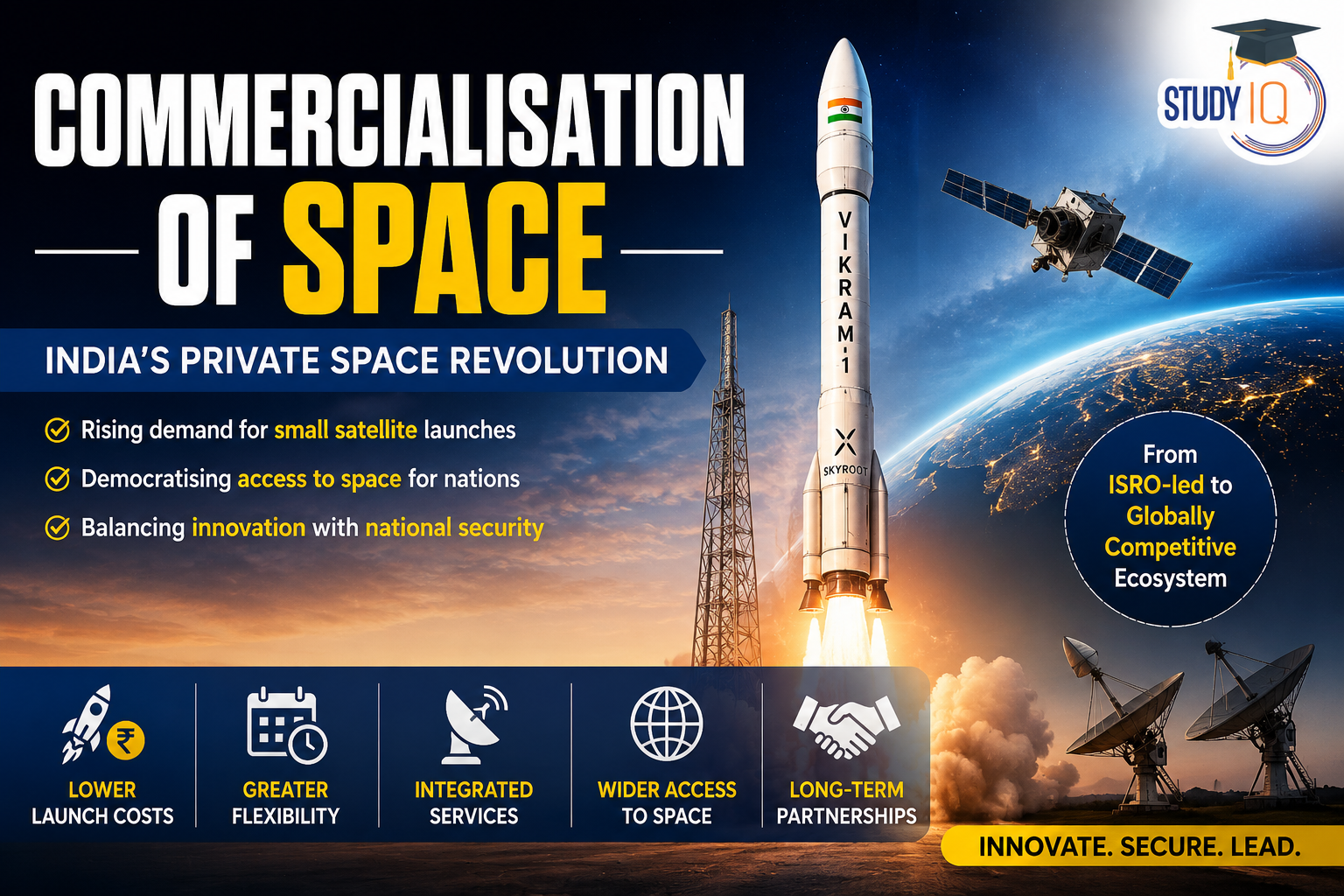
The successful launch of Vikram-1, India’s first privately developed orbital rocket by Skyroot Aerospace, marks a watershed in India’s space sector, showcasing the impact of space-sector reforms, expanding private participation, and the transition from an ISRO-led programme to a globally competitive commercial space ecosystem.
How has the growing demand for small satellite launches reshaped global competition in the launch services market?
- Cost Competition: Competition has shifted from maximizing payload per mission to minimizing launch cost per kilogram, making reusability and economies of scale the primary competitive advantages.
- g., SpaceX’s reusable Falcon 9 significantly lowered launch costs, while Ariane 6 focuses on manufacturing efficiencies to remain cost competitive.
- Launch Flexibility: Dedicated small-launch providers compete by offering rapid deployment and mission-specific orbital insertion, whereas cost-sensitive customers increasingly prefer lower-cost rideshare launches.
- g., Rocket Lab’s Electron serves time-critical and orbit-specific missions despite the lower-cost rideshare alternatives.
- Service Integration: Competition increasingly extends beyond launch capability to end-to-end deployment services, including rideshare integration, orbital transfer, and mission management, creating new value-added business models.
- g., SpaceX’s rideshare programme is complemented by D-Orbit’s orbital transfer vehicles (OTVs) for last-mile orbital delivery.
- Market Access: Lower-cost small-launch systems have enabled private firms and emerging space nations to enter the launch market for small payloads, expanding competition without directly displacing heavy-lift providers.
- g., ISRO’s SSLV complements GSLV/LVM3 by serving the dedicated small-satellite launch segment.
- Contract Competition: Mega-constellations require continuous satellite replenishment rather than one-time launches, making launch cadence, reliability, and long-term contracts key competitive differentiators.
- g., OneWeb secured multi-launch agreements with Arianespace and ISRO to support sustained constellation deployment.
How has the democratisation of access to space reshaped technological capabilities among nations?
- Lower Entry Barriers: Affordable launches have enabled many developing nations to deploy satellites without indigenous launch capability, reducing the divide between spacefaring and non-spacefaring countries.
- g., Several African and Southeast Asian countries launched their first satellites through Falcon 9 and PSLV rideshare missions.
- Human Capital Development: Standardised CubeSat platforms have enabled universities and emerging space agencies to gain systems integration experience and develop a skilled aerospace workforce, even though core technologies are often imported.
- g., Bhutan and Nepal developed their first satellites through university-led CubeSat programmes.
- Functional Access: Commercial Earth observation, communication, and navigation services enable countries to benefit from space applications without building indigenous space infrastructure, improving service access but not technological capability.
- g., Governments use Planet Labs imagery for agriculture, disaster management, and resource monitoring.
- Advanced Technology Divide: Frontier capabilities such as reusable launch systems, heavy-lift rockets, human spaceflight, deep-space exploration, and independent navigation constellations remain concentrated among a few technologically advanced nations.
- g., The US, China, Russia, and India continue to dominate these strategic technologies.
- Strategic Dependence: Reliance on foreign launch providers, satellite platforms, and navigation systems can limit technological autonomy, leaving many nations dependent on external space ecosystems for critical capabilities.
- g., Most countries rely on foreign Global Navigation Satellite Systems (GPS, Galileo, or BeiDou) instead of operating indigenous navigation constellations.
How should India balance ease of innovation with national security in the private space sector?
- Secure Foreign Investment: Encourage global capital and technology partnerships while retaining Indian control over strategically sensitive space assets and launch capabilities.
- g., India’s liberalised space FDI policy permits higher foreign investment under defined thresholds with government approval for sensitive segments.
- Risk-Based Regulation: Fast-track low-risk commercial activities through single-window approvals while applying tiered licensing and enhanced scrutiny only to sensitive technologies such as high-resolution imaging, advanced propulsion, and dual-use systems.
- g., IN-SPACe facilitates private space activities, while India’s Remote Sensing Policy imposes stricter controls on high-resolution satellite imagery.
- Indigenous Capability: Encourage technology transfer, R&D partnerships, and access to testing infrastructure so private firms build indigenous capabilities instead of remaining dependent on imported technologies.
- g., IN-SPACe enables private companies to access ISRO’s facilities and technical expertise for developing space technologies.
- Balanced Data Governance: Protect sensitive geospatial and satellite data through appropriate security standards while enabling responsible commercial use and innovation.
- g., India’s Geospatial Guidelines regulate sensitive geospatial data while liberalising non-sensitive datasets.
- Responsible Technology Exports: Align export controls with national security objectives while streamlining compliance for trusted private firms participating in global space supply chains.
- g., India’s SCOMET framework, aligned with MTCR commitments, regulates exports of dual-use space technologies.
Read Also: UPSC Daily Current Affairs 2026
 Supreme Court on Children's Right to Int...
 Daily Current Affairs PDF 2026: Download...
 Daily Mains Articles 2026 – Updated Da...














 WhatsApp