Table of Contents
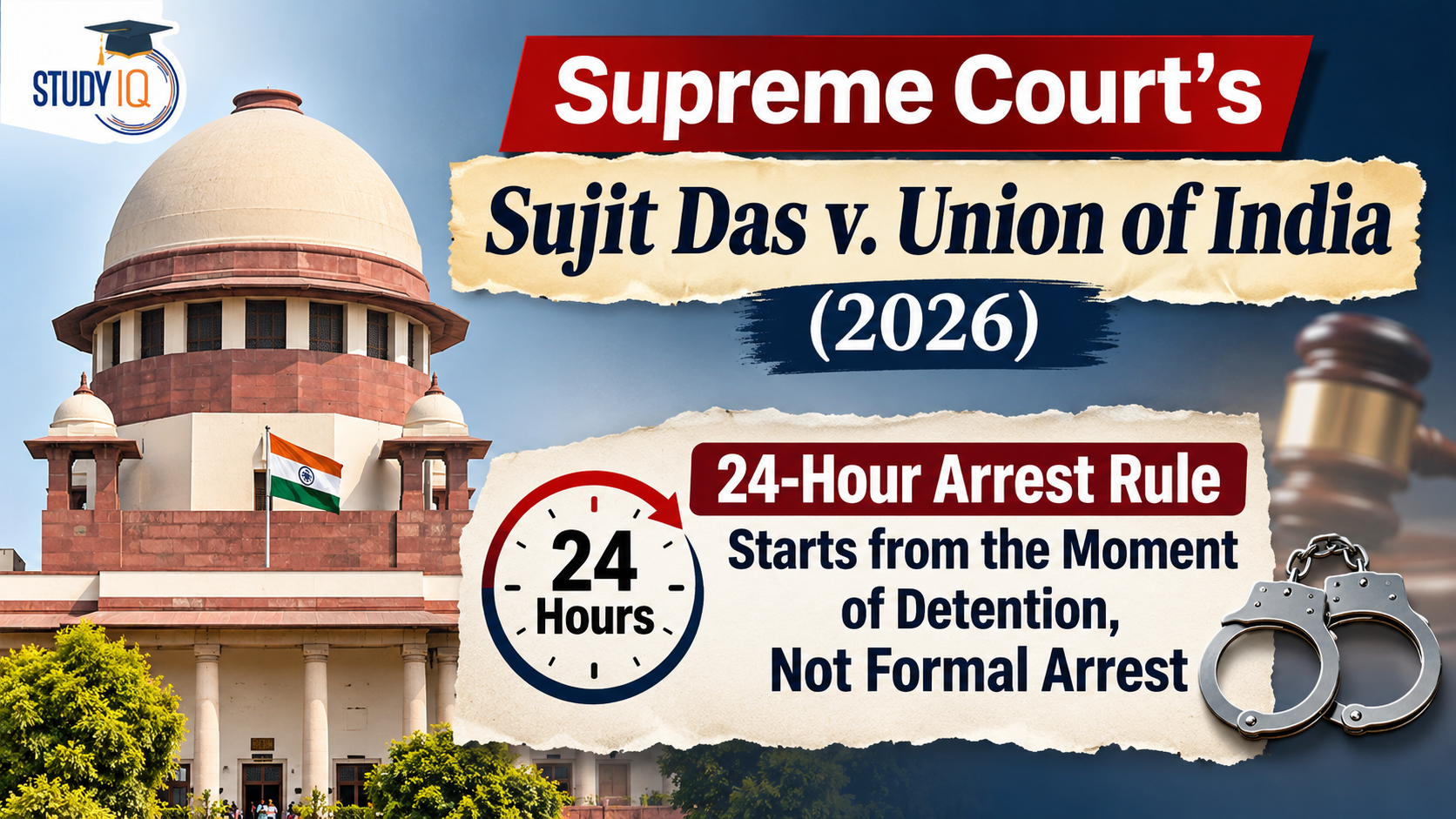
The Supreme Court of India has delivered a significant judgment in Sujit Das & Ors. v. Union of India (2026), strengthening constitutional safeguards against arbitrary detention and custodial abuse. On November 5, 2026, the Court clarified that the 24-hour period for producing an arrested person before a Magistrate under Article 22(2) of the Constitution begins from the moment their personal liberty is physically restricted, not from the time of formal arrest.
The judgment seeks to eliminate the practice of informal custody, where investigating agencies detain individuals for extended periods before officially recording their arrest.
Sujit Das v. Union of India: Key Details
| Particulars | Details |
|---|---|
| Case | Sujit Das & Ors. v. Union of India |
| Citation | 2026 INSC 1195 |
| Judgment Date | November 5, 2026 |
| Court | Supreme Court of India |
| Bench | Justice Ujjal Bhuyan and Justice Atul S. Chandurkar |
| Constitutional Provision | Article 22(2) |
| Statutory Provision | Section 58, BNSS 2023 |
| Key Issue | Calculation of the 24-hour detention period |
Background of the Case
The case originated in Agartala, Tripura, where three individuals—Sujit Das, Suman Das and Rupak Sarkar—were apprehended by Customs authorities on September 29, 2025, in connection with an NDPS investigation.
According to official records, the individuals were intercepted, interrogated and their vehicle searched by 2:30 PM. The search and seizure operations were completed by 5:00 PM.
However, their formal arrest was recorded only at 11:00 AM on September 30, 2025. They were subsequently produced before a Magistrate at 4:45 PM on the same day.
The investigating agency argued that the constitutional requirement had been satisfied because the accused were produced within 24 hours of their formally recorded arrest.
The Tripura High Court accepted this reasoning. The matter subsequently reached the Supreme Court.
Supreme Court’s Seven Key Directions
The Supreme Court rejected the distinction between physical detention and formal arrest for calculating the constitutional 24-hour limit.
Its important conclusions include:
1. Detention Starts the Constitutional Clock
The 24-hour period under Article 22(2) begins when an individual’s personal liberty is actually restricted, irrespective of when the formal arrest memo is prepared.
2. No Unnecessary Exclusions
While calculating the 24-hour period, only the time necessary for travelling from the place of arrest to the Magistrate’s court can be excluded.
3. NDPS Act Cannot Override Constitutional Rights
The Court clarified that stringent provisions of the NDPS Act, 1985, cannot justify bypassing constitutional safeguards. Special statutory procedures do not create an exception to Article 22(2).
4. Reasonable Detention Under Section 58 of BNSS
Authorities must ensure that detention remains reasonable and does not exceed the period necessary under the circumstances, even if it falls within the overall 24-hour limit.
5. Greater Responsibility of Magistrates
Magistrates must independently verify and record the actual date and time when the individual’s liberty was first curtailed instead of relying exclusively on the arrest memo.
6. Consequences of Constitutional Violation
Where detention exceeds the constitutionally permitted period before production before a Magistrate, the individual must be released from custody and detention.
7. Magistrates Can Refuse Remand
Even when an accused is produced within 24 hours, a Magistrate can refuse remand if the preceding detention is found to be unreasonable.
Constitutional and Legal Significance
The judgment reinforces the importance of Article 21 (Right to Life and Personal Liberty) and Article 22(2) (Protection Against Arbitrary Arrest and Detention).
It establishes that constitutional safeguards cannot depend on administrative documentation prepared by investigating agencies.
The ruling also strengthens judicial oversight by placing greater responsibility on Magistrates to examine the circumstances and duration of detention.
Furthermore, it highlights the relationship between individual liberty and criminal investigation, ensuring that investigative convenience does not become a justification for arbitrary restrictions on personal freedom.
Conclusion
The Supreme Court’s decision in Sujit Das v. Union of India represents an important development in India’s constitutional jurisprudence. By recognising physical restraint as the starting point of the 24-hour constitutional clock, the Court has sought to close the loophole of informal detention.
The judgment reinforces the principle that personal liberty is a constitutional guarantee, not a procedural formality. It also strengthens the accountability of investigating agencies and the role of Magistrates in protecting fundamental rights.
Frequently Asked Questions (FAQs)
Q1. What is the main judgment in Sujit Das v. Union of India (2026)?
The Supreme Court held that the 24-hour period under Article 22(2) begins from the actual restriction of personal liberty, not the formal recording of arrest.
Q2. Which constitutional article provides protection against detention beyond 24 hours?
Article 22(2) of the Indian Constitution.
Q3. Which BNSS provision is relevant to this judgment?
Section 58 of the Bharatiya Nagarik Suraksha Sanhita, 2023.
Q4. Can a Magistrate refuse remand even if the accused is produced within 24 hours?
Yes. A Magistrate can refuse remand if the period of detention is found to be unreasonable under the circumstances.
Q5. Does the NDPS Act provide an exception to Article 22(2)?
No. Stringent provisions of the NDPS Act cannot override constitutional safeguards relating to personal liberty.
 Supreme Court on Grandson’s Rights in ...
 Ramkishan Digambar Jadhav Case 2026: Sup...
 Supreme Court on Plaint Amendment After ...







 WhatsApp