
Table of Contents
Context
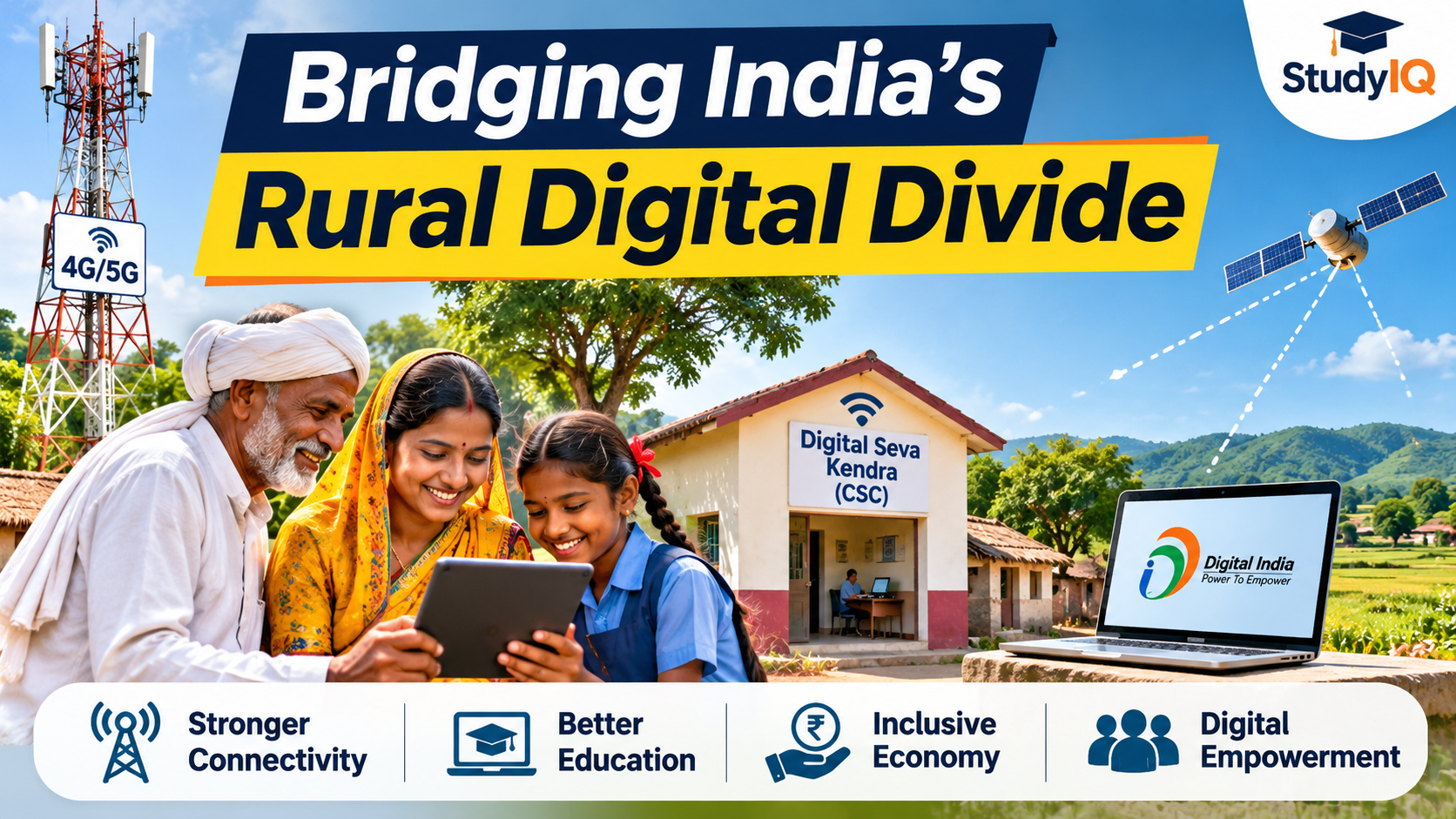
Data released under the Right to Information (RTI) Act, 2005 reveals that the number of Indian villages lacking 4G mobile connectivity has fallen by 75% over the past four years under the BSNL 4G Saturation Project. However, as the Department of Telecommunications (DoT) continues finalising approvals for satellite broadband providers, achieving universal, meaningful digital inclusion remains a critical governance challenge.
What Is the Current Status of India’s Digital Divide?
- Urban–Rural Teledensity Disparity: While rural India accounts for 57% (548 million) of India’s 958 million active internet users, rural internet teledensity stands at just 49.07%, lagging sharply behind urban teledensity at 129.03%.
- Household Connectivity Gap: According to the National Council of Applied Economic Research (NCAER), 27.5% of Indian households remain completely offline—comprising 32.2% of rural households compared to 17.2% of urban households.
- BharatNet Progress: Approximately 2.21 lakh Gram Panchayats (GPs) are service-ready under BharatNet, with the Amended BharatNet Programme (2023) targeting optical fibre connectivity across 2.64 lakh GPs and 3.8 lakh non-GP villages on demand.
- Demographic and Usage Skew:
- Gender & Age Gaps: Only 35.6% of working-age women use the internet versus 57.6% of men (NFHS-5 similarly recorded 33% female vs. 57% male internet usage), while participation among senior citizens (60+) is a mere 9.4%.
- Consumption vs. Empowerment: Rural internet usage is heavily skewed toward entertainment (66%) and social media (53.8%), whereas uptake for education (16.1%) and e-governance (11.4%) remains low, with 20.4% of households needing external assistance to navigate digital services.
Why Does Bridging the Divide Matter for Governance and Growth?
- Last-Mile Welfare Delivery: With Digital Public Infrastructure (DPI)—such as Aadhaar, UPI, and Direct Benefit Transfers (DBT)—forming the backbone of welfare delivery, weak connectivity forces rural citizens to depend on middlemen or distant Common Service Centres (CSCs).
- Human Capital Development: Unreliable bandwidth limits rural students’ access to EdTech platforms and disrupts telemedicine consultations via initiatives like eSanjeevani.
- Rural Economic Integration: Reliable internet connects farmers, artisans, and rural MSMEs to digital marketplaces (such as ONDC and e-NAM), real-time weather advisories, and formal digital credit.
What Are the Key Challenges in Universalising Rural Connectivity?
- Low Return on Investment (ROI): Laying optical fibre in sparsely populated regions entails high capital expenditure (CAPEX) against low Average Revenue Per User (ARPU).
- e.g., TRAI’s Q1 FY27 data showed wireless data consumption rising 8.30%, yet revenue realisation per GB fell 5.07% to ₹7.13, straining telecom operators’ ability to fund commercially unviable rural expansion.
- Topographical and Maintenance Hurdles: Difficult terrain slows fibre deployment, while laid rural cables frequently suffer from “dark fibre” (unlit/unused infrastructure) due to poor last-mile maintenance and over-reliance on congested wireless towers.
- Regulatory and Funding Bottlenecks: Inconsistent state-level Right of Way (RoW) permissions cause project delays, alongside historical underutilisation of the Universal Service Obligation Fund (now restructured as Digital Bharat Nidhi).
- The “Mobile-Only” Device Trap: While 95% of households own a mobile phone, only 8% own a computer, restricting rural users from high-productivity digital tasks such as coding, research, or advanced online learning.
Way Forward
- Leapfrog Terrain Barriers with Space-Tech: Expedite regulatory clearances and spectrum allocation for Low Earth Orbit (LEO) satellite broadband to connect remote Himalayan, island, and Left-Wing Extremism (LWE)-affected villages where fibre deployment is unfeasible.
- Leverage Digital Bharat Nidhi via Targeted PPPs: Deploy Viability Gap Funding (VGF) and enforce uniform national Right of Way rules to incentivise private telecom operators to build and maintain rural 5G and fibre networks.
- Launch “PMGDISHA 2.0” for Functional Digital Literacy: Build upon the Pradhan Mantri Gramin Digital Saksharta Abhiyan (which trained 6.39 crore rural citizens) by focusing on practical e-governance navigation, digital financial safety, and cyber hygiene, particularly targeting rural women and the elderly.
- Expand Vernacular Content and Community Access Hubs: Develop AI-driven local-language interfaces (such as Bhashini) and equip village schools and Panchayat Bhawans with shared computer labs to overcome the mobile-only device barrier.

 Voyager 1 to Reach One Light-Day from Ea...
 AIBE 22 Admit Card 2026 Released: Downlo...
 China's 10-Year Higher Education Reform ...














 WhatsApp






