Table of Contents
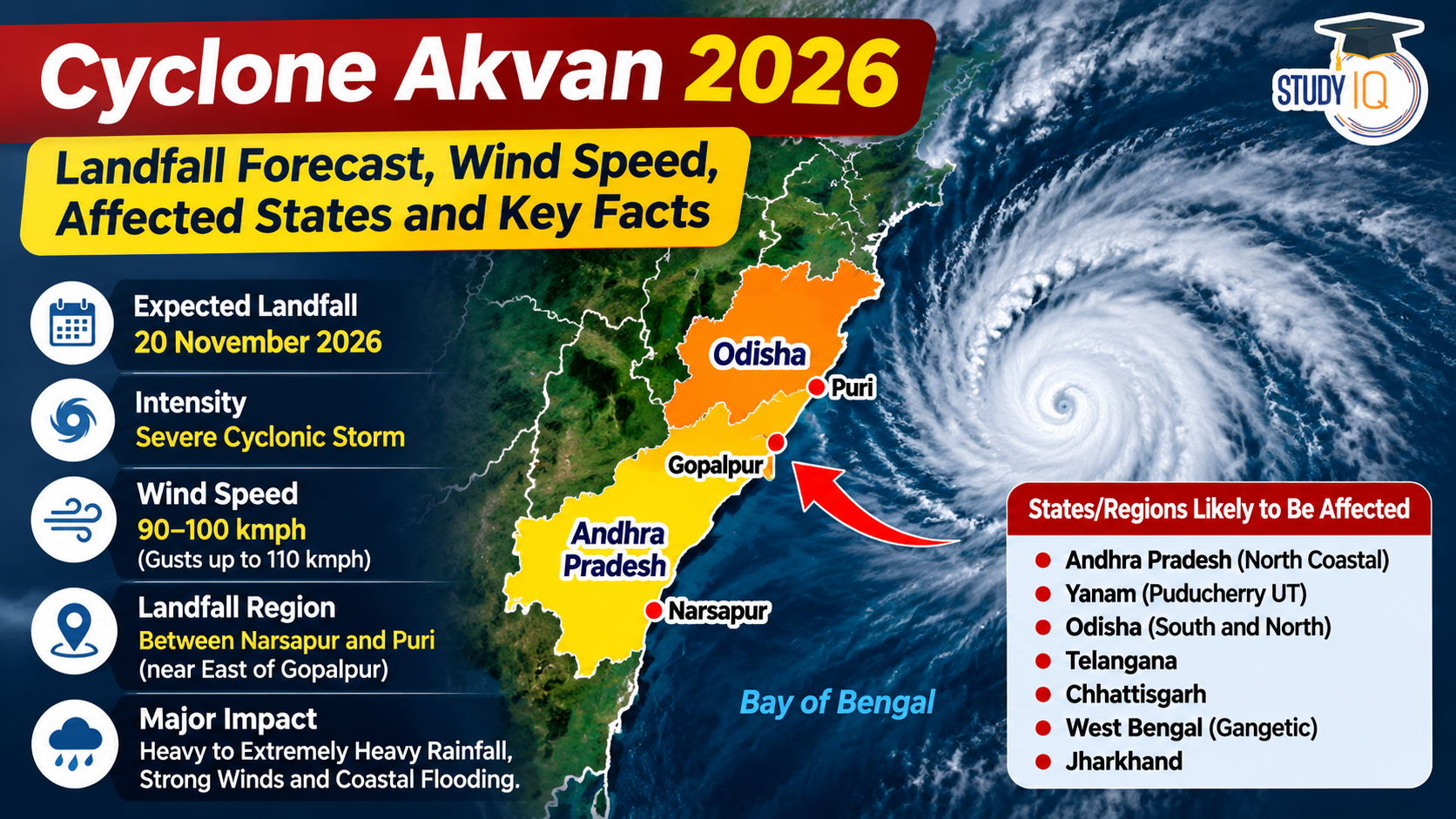
Cyclone Akvan 2026 has intensified into a Severe Cyclonic Storm over the west-central Bay of Bengal. According to the India Meteorological Department (IMD) forecast dated November 19, the cyclone is expected to make landfall around midday on November 20 along the North Andhra Pradesh–Yanam and South Odisha coasts. With wind speeds of 90–100 kmph and gusts reaching 110 kmph, the storm is likely to bring heavy to extremely heavy rainfall and strong winds to several eastern Indian states.
Cyclone Akvan 2026: Latest Updates
The key details of Cyclone Akvan, according to the November 19 forecast, are:
-
Current Category: Severe Cyclonic Storm
-
Location: West-central Bay of Bengal
-
Expected Landfall: November 20, 2026
-
Expected Time: Around midday
-
Landfall Region: Between Narsapur and Puri, near the east of Gopalpur
-
Wind Speed: 90–100 kmph
-
Maximum Gusts: Up to 110 kmph
-
Most Vulnerable Areas: North Coastal Andhra Pradesh, Yanam and South Odisha.
What Is Cyclone Akvan?
Cyclone Akvan is a tropical cyclone that developed over the Bay of Bengal and intensified into a Severe Cyclonic Storm on November 18, 2026.
Tropical cyclones are intense low-pressure weather systems characterised by rotating winds, thunderstorms and heavy rainfall. The Bay of Bengal is particularly vulnerable to cyclones because of its warm ocean temperatures, high moisture content and favourable atmospheric conditions.
Cyclone Akvan Landfall Forecast
According to the IMD bulletin dated November 19, Cyclone Akvan is expected to move north-northwestwards before crossing the Indian coastline.
The predicted landfall zone extends between Narsapur in Andhra Pradesh and Puri in Odisha, close to the east of Gopalpur. The forecast location has shifted northwards compared with earlier projections, which indicated a possible landfall between Machilipatnam and Puri.
The exact landfall location and timing may change with subsequent weather updates.
Cyclone Akvan Wind Speed and Intensity
The cyclone is expected to generate sustained winds of 90–100 kmph, with gusts reaching 110 kmph.
It has been classified as a Severe Cyclonic Storm. Earlier forecasts indicated the possibility of further intensification into a Very Severe Cyclonic Storm, but the latest information does not support that assessment.
Strong winds may damage electricity poles, communication networks, trees, kutcha houses and standing crops.
States Likely to Be Affected by Cyclone Akvan
Several states are expected to experience heavy rainfall and adverse weather conditions.
| State/Region | Expected impact |
|---|---|
| North Coastal Andhra Pradesh | Heavy to extremely heavy rainfall and strong winds |
| Yanam | Heavy rainfall and strong winds |
| South Odisha | Heavy to extremely heavy rainfall |
| North Odisha | Heavy to very heavy rainfall |
| Telangana | Isolated heavy rainfall |
| Chhattisgarh | Isolated heavy rainfall |
| West Bengal | Heavy to very heavy rainfall at isolated places |
| Jharkhand | Isolated heavy rainfall |
Isolated extremely heavy rainfall of 21 cm or more is forecast in parts of North Coastal Andhra Pradesh and South Odisha on November 19 and 20.
Why Is Cyclone Akvan Named Akvan?
The name Akvan has been contributed by Iran under the regional tropical cyclone naming system.
The naming mechanism operates under the World Meteorological Organization (WMO) and United Nations Economic and Social Commission for Asia and the Pacific (UNESCAP) Panel on Tropical Cyclones.
Thirteen countries contribute names to the regional list, including India, Bangladesh, Iran, Pakistan, Oman, Myanmar, Sri Lanka and Thailand.
The IMD’s Regional Specialized Meteorological Centre (RSMC), New Delhi, is responsible for naming tropical cyclones over the North Indian Ocean, covering the Bay of Bengal and Arabian Sea.
Safety Measures and IMD Warnings
Fishermen have been advised not to venture into affected sea areas. People living in vulnerable coastal regions should follow official warnings and evacuation instructions.
Important precautions include:
-
Stay indoors during strong winds.
-
Move to cyclone shelters when instructed by authorities.
-
Avoid beaches, flooded roads and coastal areas.
-
Keep essential medicines, drinking water and dry food ready.
-
Secure important documents and emergency supplies.
-
Follow IMD and state disaster management advisories.

 Quad Summit 2026: Outcomes, India's Role...
 Voyager 1 to Reach One Light-Day from Ea...
 Bridging India’s Rural Digital Divide:...














 WhatsApp