
Table of Contents
Context: While modern tensions often centre on the Strait of Hormuz as a chokepoint for global energy, a historical analysis reveals its long-standing position as a vital geographical lever at the core of imperial competition for hundreds of years.
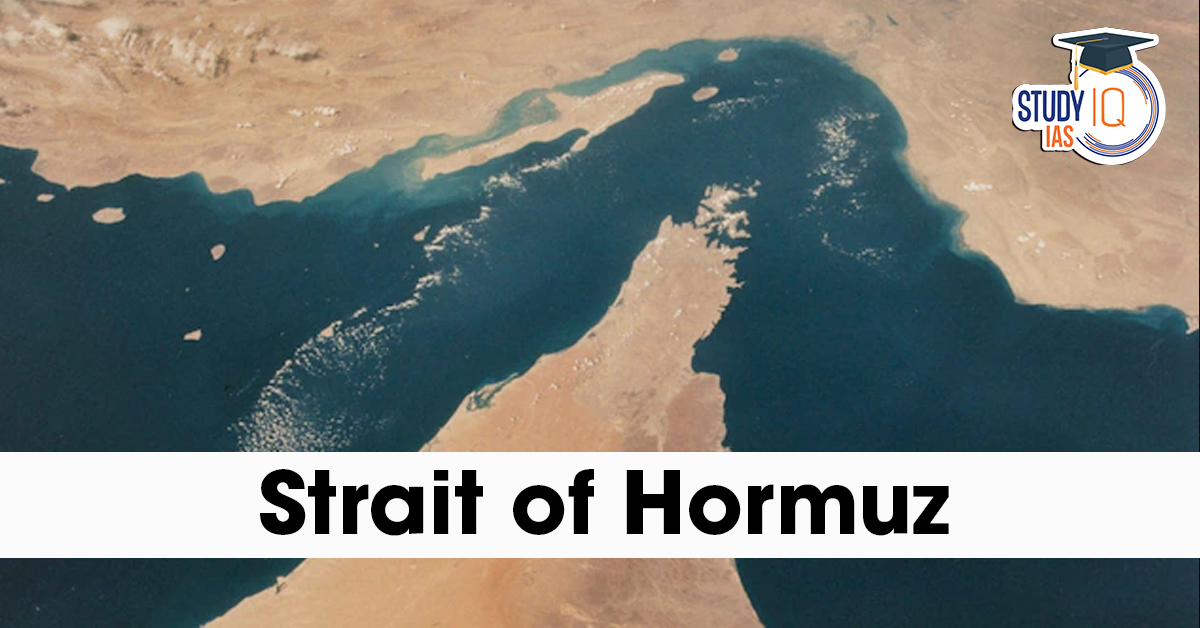
The Strait of Hormuz is one of the world’s most strategically important maritime chokepoints, situated between Iran and Oman. It connects the Persian Gulf to the Gulf of Oman and the Arabian Sea, serving as a vital passage for crude oil exports from the Middle East. With only 33 km width at its narrowest point, and shipping lanes just 3 km wide in each direction, this strait is both geographically narrow and geopolitically sensitive.
What is the Recent Strait of Hormuz Crisis?
The Strait of Hormuz crisis refers to escalating tensions, military activities, and threats to shipping routes in the region. These tensions are often linked to conflicts involving Iran, the United States, and their allies, along with regional powers like Saudi Arabia and the United Arab Emirates.
Key Causes of the Crisis
1. Geopolitical Rivalries
Long-standing tensions between Iran and Western nations, particularly the United States, have contributed to instability in the region.
2. Sanctions and Economic Pressure
Economic sanctions imposed on Iran have heightened tensions, prompting threats to disrupt oil shipments through the Strait.
3. Military Presence
Heavy naval deployment by multiple countries increases the risk of confrontation and accidental conflict.
4. Attacks on Oil Tankers
Incidents involving oil tanker seizures and attacks have heightened global concern over maritime security.
Also Check: Is Another Lockdown Coming Amid Energy Crisis?
Why is the Strait of Hormuz So Important?
The Strait of Hormuz is one of the most critical maritime chokepoints in the world, connecting the Persian Gulf with the Gulf of Oman. Recent tensions in this region have raised serious concerns about global energy security, trade disruption, and geopolitical stability. The Strait handles a significant portion of the world’s oil shipments, making any crisis in the area a matter of global importance.
Global Importance of the Strait of Hormuz
- Around 20% of the world’s oil supply passes through this narrow waterway.
- It is crucial for energy exports from Gulf countries to Asia, Europe, and beyond.
- Any disruption can significantly impact global oil prices and supply chains.
The Strait facilitates the transport of:
-
20 million barrels of oil per day (as per the U.S. Energy Information Administration – EIA).
-
About 20% of global oil and petroleum products consumption.
-
Nearly 20% of the global LNG trade is from Qatar.
Countries such as Saudi Arabia, the UAE, Iraq, Kuwait, and Iran rely on the Strait to export oil. Major importers include China, India, Japan, and South Korea.
Impact of the Strait of Hormuz Crisis
1. Rising Oil Prices
Uncertainty in the region often leads to spikes in global crude oil prices.
2. Threat to Energy Security
Countries heavily dependent on Gulf oil, including India and China, face supply risks.
3. Disruption of Global Trade
Shipping delays and increased insurance costs affect international trade.
4. Regional Instability
The crisis can escalate into broader conflicts affecting the entire Middle East.
What Happens If the Strait of Hormuz Is Closed?
Global Impact:
-
Crude oil prices could surge beyond $100 per barrel.
-
Shipping insurance and transport costs will rise sharply.
-
Global inflation could spike due to rising energy and logistics costs.
-
Stock markets and trade balances would be adversely affected.
India’s Impact:
-
India imports ~40% of its crude oil through the Strait.
-
Disruption could impact supplies from Iraq, Saudi Arabia, and Kuwait.
-
India’s alternate suppliers like Russia, the U.S., and Africa may ease shortfalls, but not pricing volatility.
- It also affects India’s trade and strategic relations with Gulf countries.
Iran’s Own Risk:
-
Iran uses the Strait for its own exports, mostly to China.
-
Blocking the strait may hurt its fragile economy and upset key allies like Beijing.
-
The U.S. Navy’s 5th Fleet in Bahrain could rapidly respond militarily to reopen the channel.
Strait of Hormuz Map and Geopolitical Position
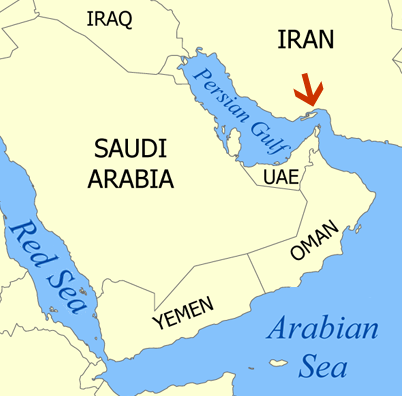
The map shows the Strait nestled between Iran (north) and Oman and the UAE (south). Under UN maritime law, the shipping lanes pass through Iranian and Omani territorial waters, giving Iran a geographic advantage in influencing traffic.
Alternative Routes to the Strait of Hormuz
Oil-exporting nations have tried to diversify routes:
-
Saudi Arabia’s East-West Pipeline: Transports up to 5 million barrels/day to the Red Sea.
-
UAE’s Abu Dhabi–Fujairah Pipeline: Capacity of 1.8 million barrels/day.
-
Iran’s Goreh–Jask Pipeline: Still limited in capacity (~350,000 barrels/day).
These routes can only offset ~15% of the volume currently transiting the Strait.
Possible Solutions
Diplomatic Engagement
Peace talks and negotiations between the involved countries are essential.
Diversification of Energy Sources
Countries should reduce dependence on a single region for oil imports.
Strengthening Maritime Security
International cooperation is needed to ensure safe navigation.
Strategic Reserves
Maintaining oil reserves can help countries manage short-term disruptions.
History of the Strait of Hormuz
- 11th–15th Century: The Kingdom of Hormuz controlled the Strait of Hormuz and emerged as one of the richest trading powers, acting as a key link between India, Persia, Arabia, and East Africa.
- Early 16th Century: The Portuguese Empire conquered Hormuz Island to dominate the spice and silk trade, building costly fortresses and imposing heavy taxes on merchants.
- 1622 (End of Portuguese Control): The English East India Company, in alliance with the Safavid Empire and supported by the Dutch East India Company, defeated the Portuguese and ended their century-long control over the strait.
- 17th Century (European Rivalry): After the Portuguese exit, intense rivalry developed between the English East India Company and the Dutch East India Company, with the Dutch dominating trade from Bandar Abbas before declining in the 18th century due to financial and administrative issues.
- 18th–19th Century (British Hegemony): The British Empire established dominance over the region, securing maritime routes to Bombay through a mix of naval power and diplomatic control rather than expensive fortifications.
- 1809 & 1819 (Trucial System Formation): Through naval campaigns, the British subdued local forces and established treaty-based protectorates known as the Trucial States, which later evolved into the modern United Arab Emirates.
- 1901–1908 (Beginning of Oil Era): William Knox D’Arcy secured oil exploration rights in Persia, leading to the discovery of oil at Masjed Soleyman in 1908 and the formation of the Anglo-Persian Oil Company.
- 1914 (Strategic Shift to Oil): The British government acquired a controlling stake in the Anglo-Persian Oil Company to ensure a steady oil supply for its navy, marking a shift from coal to oil as the primary fuel.
- 20th Century (Energy Chokepoint): The Strait of Hormuz transformed into a critical global energy corridor, facilitating the movement of petroleum and becoming central to global geopolitics.
- 1971 (End of British Control): The British military withdrew from the Gulf, ending the Trucial States system and marking the transition to independent regional states.
Conclusion
The Strait of Hormuz crisis highlights the vulnerability of global energy supply chains and the importance of geopolitical stability. As tensions continue to evolve, international cooperation, diplomatic efforts, and strategic planning are crucial to prevent escalation and ensure uninterrupted global trade and energy flow.

 QS World Future Skills Index 2027: India...
 How Does the UK Parliamentary System Dif...
 International Day of Women in Diplomacy ...














 WhatsApp





