Table of Contents
Context
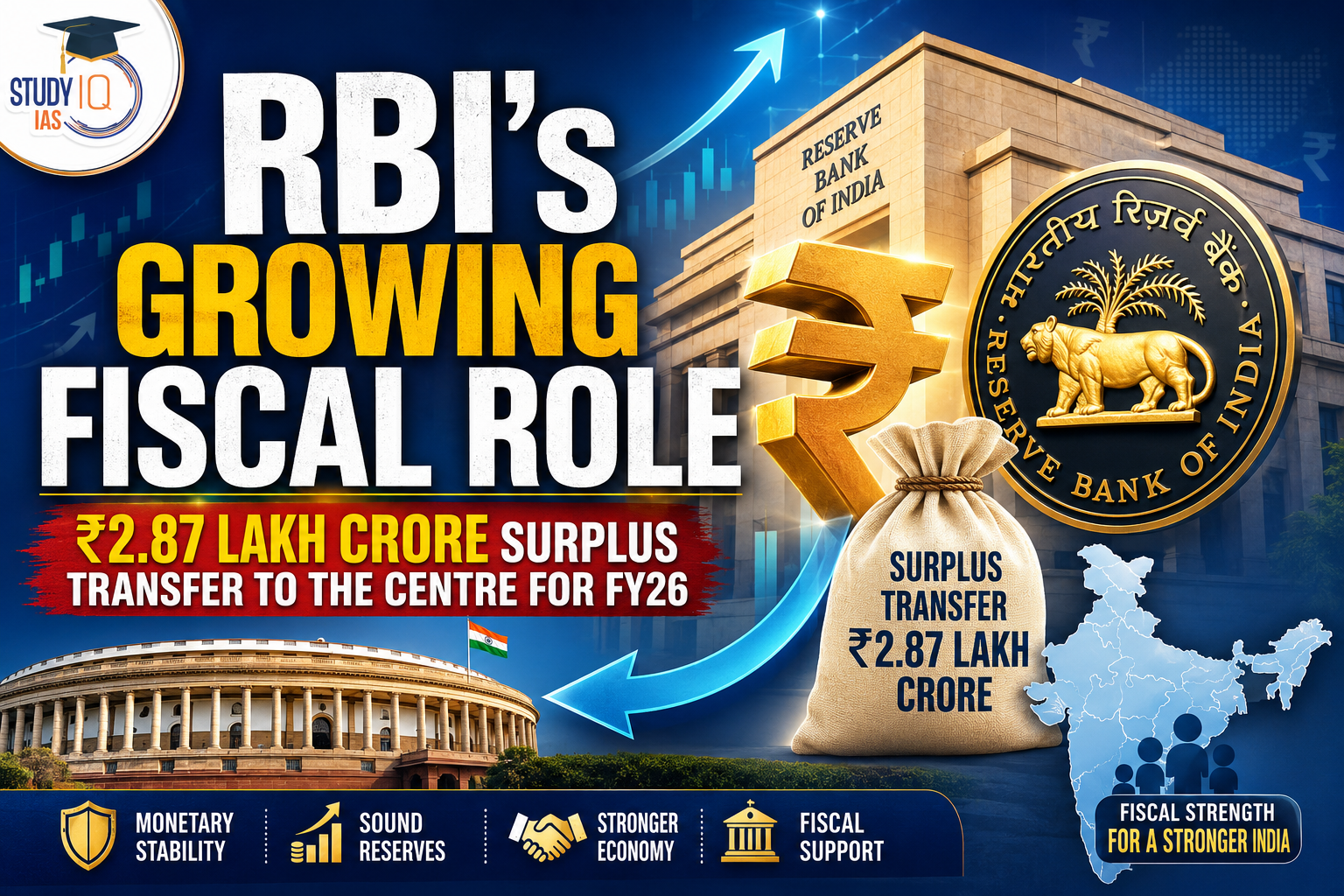
The RBI approved a record surplus transfer of ₹2.87 lakh crore to the Union Government for FY26, reviving debate on the central bank’s growing fiscal role.
How Does the RBI Generate Its Surplus?
- Interest Income: RBI earns interest on the government securities it holds in its portfolio.
- Forex Trading Gains: Buying and selling foreign currencies as part of market operations generates trading income.
- Returns on Foreign Assets: Gold holdings and foreign currency reserves earn returns over time.
- Reserve Rebalancing: Adjusting the mix of reserve assets, such as gold versus foreign currency, also adds to income.
- g., All this income above the RBI’s mandated risk buffer is transferred to the government as non-tax revenue under the Economic Capital Framework (ECF), 2019.
Key Data Showing RBI’s Rising Fiscal Role
- Sharply Rising Surplus Transfers: Surplus payouts have grown each year, from ₹87,416 crore (FY23) to ₹2.11 lakh crore (FY24), ₹2.69 lakh crore (FY25), and ₹2.87 lakh crore (FY26).
- Rapid Balance Sheet Expansion: RBI’s balance sheet grew 20.6% in one year to ₹91.97 lakh crore by March 2026, with gross income up over 26%.
- Fiscal Space Without Tax or Borrowing: Unlike taxes, which need public consent, or loans, which need repayment, RBI transfers give the government funds at no extra cost; the FY26 transfer alone exceeds the annual budgets of several Indian States.
- Forex Earnings, Not Bond Purchases: Unlike Western central banks tied to fiscal policy through bond-buying programmes, most of RBI’s surplus comes from foreign exchange earnings and interest on securities.
- Gold Sold to Defend the Rupee: RBI sold gold worth nearly $12 billion and bought foreign currency assets worth about $7.5 billion to ease rupee pressure.
Why Does This Raise Institutional and Federal Concerns?
- Mixing Up Monetary and Fiscal Roles: A central bank stays credible only if it keeps some distance from the government’s money needs.
- g., Large, repeated transfers make it harder to tell if RBI’s decisions serve stability or the government’s revenue needs.
- Pressure on RBI’s Independence: As the government gets used to large payouts, it may quietly start influencing RBI’s investment and currency choices.
- Riskier Reserve Mix: Selling gold for foreign currency changes the kind of risk the RBI carries on its books.
- g., Gold is a stable long-term asset, foreign securities depend on global yields and currency swings.
- States Get Nothing: The entire ₹2.87 lakh crore transfer is non-tax revenue, so it bypasses the divisible pool governed by Finance Commission formulas and gives States no automatic share.
- Centre Gets Stronger, States Don’t: Big RBI dividends, along with rising cesses and surcharges, are shifting more money towards the Centre.
- g., Cesses and surcharges, like RBI surplus, also bypass the States’ share.
- Accountability Deficit: A public-sector resource transfer of this scale happens without any formal inter-state consultation or federal balance review.
- g., No legislative or Finance Commission mechanism currently examines such transfers from a federal lens.
What Is the Way Forward?
- Keep Safe Risk Buffers: RBI should hold on to a healthy risk buffer before approving big transfers, to protect its own balance sheet first.
- g., The Bimal Jalan Committee’s 2019 framework already sets a buffer range for this purpose.
- Voluntary Non-Tax Revenue Sharing: The Union could institute a mechanism to voluntarily channel a share of windfall non-tax revenues to States constrained by Article 293 borrowing limits.
- More Transparency on Reserves: RBI should clearly disclose large gold sales or forex purchases, to show these are stability moves, not revenue moves.
- g., Regular disclosure formats similar to the RBI’s existing Financial Stability Report could be extended to reserve rebalancing decisions.
- Institutionalised Reviews: Set up regular academic or parliamentary reviews to track the growing link between RBI’s earnings and the government’s budget.
|
Prelims Fact Box |
| ● RBI’s Fiscal RoleEconomic Capital Framework (ECF): Adopted in 2019 on the Bimal Jalan Committee’s recommendation; sets a Contingent Risk Buffer (CRB) range for RBI’s surplus transfer.
● Legal Basis: RBI surplus is transferred to the Union Government under Section 47 of the RBI Act, 1934. ● Divisible Pool: Net tax proceeds shared with States under Article 280 (Finance Commission); excludes non-tax revenue like RBI surplus. ● Article 293: Restricts States from borrowing freely if they owe outstanding loans to the Union. |
Read Also: UPSC Daily Current Affairs 2026
 Anti-Goonda Bill 2026 Explained: Why Pre...
 Cool Leaders Award 2026: Winners, Global...
 Black Carbon and Himalayan Glacier Melt:...














 WhatsApp