Table of Contents
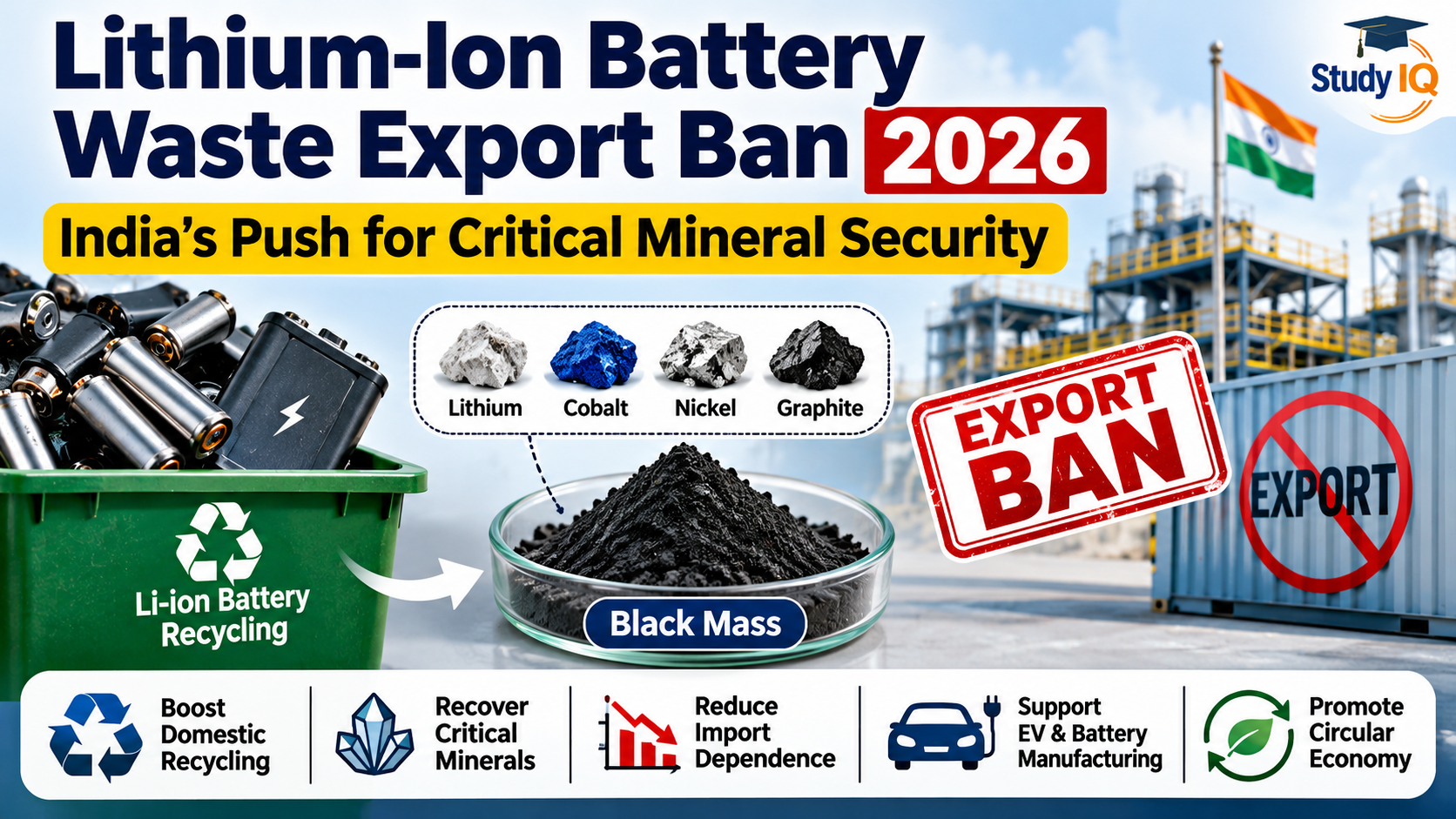
India has prohibited the export of lithium-ion battery black mass and specified related battery waste to strengthen its domestic battery recycling industry and secure critical mineral supplies.
The Directorate General of Foreign Trade (DGFT), under the Ministry of Commerce and Industry, announced the restriction on November 10, 2026, changing the export category from ‘Free’ to ‘Prohibited’ with immediate effect.
The decision aims to retain valuable minerals within India and promote a domestic circular economy for electric vehicle batteries.
What Is Lithium-Ion Battery Black Mass?
-
Black mass is a powder-like material obtained from discarded lithium-ion batteries after dismantling and mechanical processing.
-
It contains valuable materials that can be recovered through specialised recycling and refining processes.
Major materials found in black mass include:
-
Lithium
-
Cobalt
-
Nickel
-
Manganese
-
Graphite
-
Silicon
-
Tin
-
Rhenium
These recovered materials can be reused in battery manufacturing and other industrial applications.
Key Provisions of India’s Battery Waste Export Ban
-
Authority: Directorate General of Foreign Trade (DGFT).
-
Notification Date: November 10, 2026.
-
Ministry: Ministry of Commerce and Industry.
-
Policy Change: Export category changed from ‘Free’ to ‘Prohibited’.
-
Objective: Promote domestic battery recycling and critical mineral processing.
-
Implementation: Immediate effect.
The measure seeks to ensure that valuable battery waste generated in India is processed domestically rather than exported to international markets.
Why Has India Banned Black Mass Exports?
India depends heavily on imports for several critical minerals required for electric vehicles, renewable energy storage and electronics.
The export prohibition aims to:
-
Ensure domestic feedstock availability: Provide Indian recycling industries with a reliable supply of battery waste.
-
Improve mineral recovery: Increase the domestic recovery of lithium, cobalt, nickel and other valuable materials.
-
Reduce import dependence: Lower reliance on imported critical minerals and associated foreign exchange expenditure.
-
Attract investment: Encourage investment in recycling, refining and mineral processing industries.
-
Strengthen supply chains: Support domestic EV manufacturing, battery production and energy storage.
-
Promote circular economy: Convert discarded batteries into valuable secondary resources.
Linkage with the Critical Mineral Processing Scheme
The export ban complements the government’s Critical Mineral Processing Scheme, which aims to develop domestic processing capabilities.
Key features:
-
Financial Outlay: ₹2,814 crore.
-
Focus: Developing domestic lithium and nickel processing capabilities.
-
Target Sectors:
-
Electric mobility
-
Battery Energy Storage Systems (BESS)
-
Electronics
-
Defence
-
Specialty steel
-
Together, these initiatives aim to strengthen India’s critical mineral value chain, from recycling and processing to manufacturing.
India’s Battery Recycling Capacity
According to government data:
| Indicator | Capacity |
|---|---|
| Registered lithium-ion battery recyclers | 57 |
| Combined annual processing capacity | 5.17 lakh metric tonnes |
| Estimated black mass processing capacity | 75,500 metric tonnes per annum |
The difference highlights the need to expand specialised black mass processing and mineral refining infrastructure.
Challenges in Developing India’s Domestic Recycling Ecosystem
Despite the policy push, India faces several challenges:
-
Limited technological expertise: Advanced technologies are required to recover high-purity minerals from black mass.
-
International competition: China has significant battery recycling and refining capabilities, making exports commercially attractive.
-
Import dependence: India remains heavily dependent on imported lithium and other critical minerals.
-
Limited domestic manufacturing: A stronger battery cell manufacturing ecosystem is necessary to create demand for recovered minerals.
-
High investment requirements: Recycling and refining facilities require substantial capital and advanced infrastructure.
-
Global supply chain disruptions: Export controls on battery materials and manufacturing technologies can create additional supply chain vulnerabilities.
Significance for India’s Energy Security
The export prohibition has broader strategic implications:
-
Energy transition: Supports India’s transition towards electric mobility and renewable energy.
-
Strategic autonomy: Reduces vulnerability to international critical mineral supply disruptions.
-
Industrial development: Encourages domestic battery recycling and mineral processing industries.
-
Employment generation: Creates opportunities in recycling, refining and clean technology sectors.
-
Resource efficiency: Promotes recovery and reuse of finite mineral resources.
Conclusion
India’s lithium-ion battery black mass export ban is an important step towards strengthening critical mineral security and developing a domestic battery recycling ecosystem.
However, restricting exports alone cannot establish a competitive recycling industry. India needs investment in advanced recycling technologies, mineral refining, skilled manpower and domestic battery manufacturing.
Converting battery waste into a strategic resource will be essential for India’s long-term energy security and clean energy transition.
Important Facts
| Topic | Key Information |
|---|---|
| Black mass | Powder-like material obtained from processed waste lithium-ion batteries |
| Export restriction | November 10, 2026 |
| Regulatory authority | DGFT |
| Relevant ministry | Ministry of Commerce and Industry |
| Export category | Free to Prohibited |
| Critical Mineral Processing Scheme | ₹2,814 crore |
| Registered recyclers | 57 |
| Annual recycling capacity | 5.17 lakh MT |
| Black mass processing capacity | 75,500 MT per annum |

 India’s Russia-Ukraine Diplomacy 2026:...
 Swachh Survekshan Awards 2025-26: Cleane...
 World Pneumonia Day 2026: Date, Theme, H...














 WhatsApp