Table of Contents
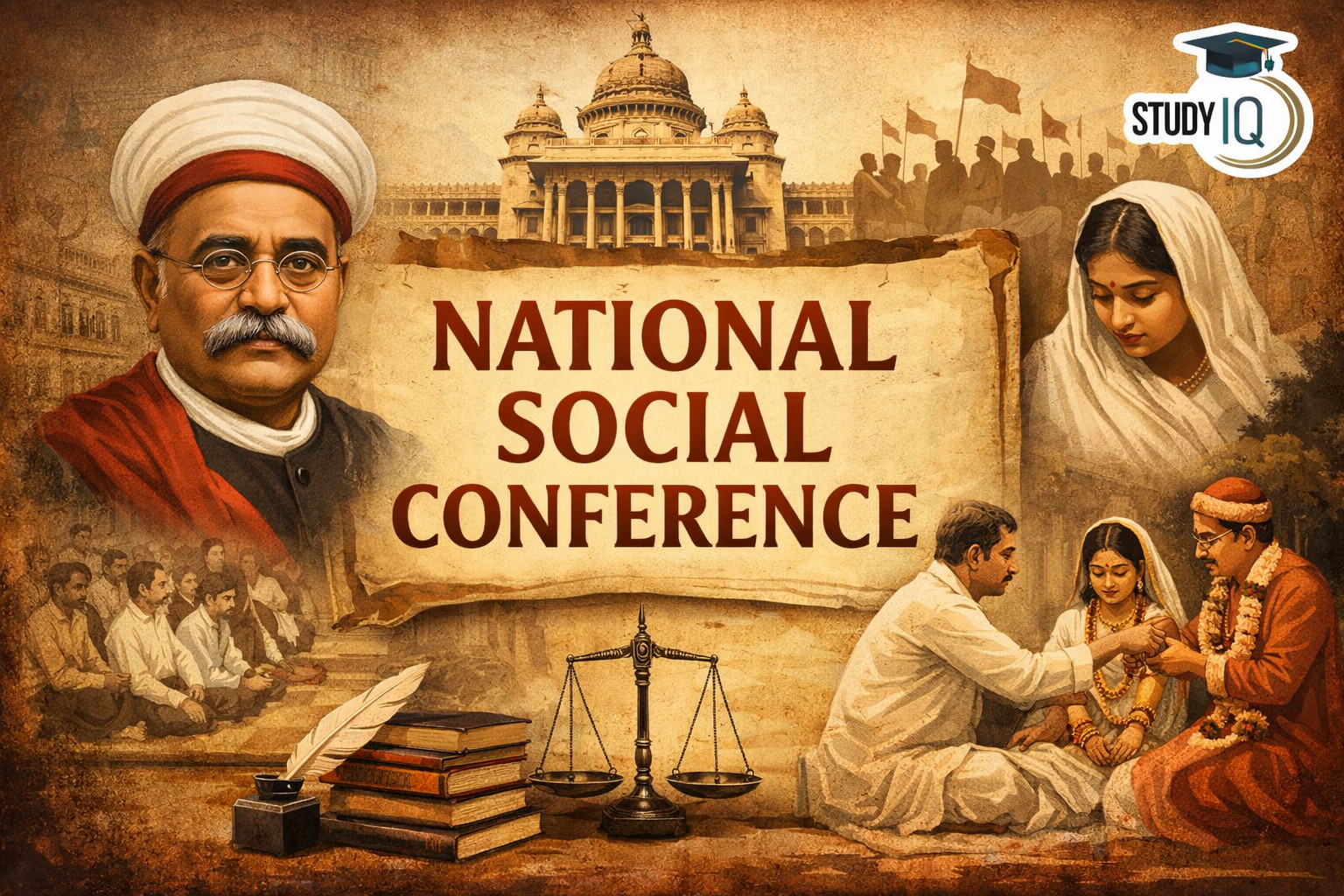
The National Social Conference (NSC) was the pre-eminent platform for social reform in colonial India, serving as the essential social counterpart to the Indian National Congress (INC) from the late 19th century until the early 20th century. While the INC focused on the “external” struggle for political rights, the NSC targeted the “internal” struggle for social modernization.
National Social Conference (NSC): Context and Foundation (1887)
The NSC was founded by Mahadev Govind Ranade (often called the “Socrates of Maharashtra”) and Raghunath Rao during the third session of the Indian National Congress in Madras in 1887.
- The “Political Neutrality” Strategy: Early INC leaders, such as Dadabhai Naoroji, feared that debating sensitive social issues like caste or child marriage would fracture the nascent political movement.
- The Structural Compromise: To ensure social progress was not sidelined, the NSC was established as a technically separate body. To maintain a symbiotic relationship, it met annually at the same venue as the Congress, immediately after the political sessions concluded.
Core Agenda: Reform from Within
The NSC rejected radical iconoclasm, opting instead for Evolutionary Liberalism. Ranade was a proponent of the “Organic Theory” of society, arguing that society is a living organism where change must be systemic rather than forced. He famously used the phrase “Renovate, not Innovate” to advocate for modern values while reassuring traditionalists.
- Pledge Movement: The NSC’s most famous initiative. Members took a formal oath to prevent child marriage and polygamy within their own families, moving reform from public rhetoric to personal accountability.
- Women’s Emancipation: The conference campaigned vigorously for widow remarriage, female education, and the abolition of the Devadasi system.
- Social Equality: It advocated for the removal of caste disabilities and “untouchability.” Its approach was persuasive and educational rather than confrontational.
- Inter-caste Marriage: It was among the first national bodies to pass resolutions supporting inter-caste marriages as a means to unify the fragmented Indian social fabric.
Methodology of Reform
Ranade outlined four distinct pillars that the NSC utilized to drive social change:
- Tradition: Demonstrating that “evil” practices were later corruptions not supported by ancient, pure scriptures.
- Reason: Appealing to the logical and scientific spirit of the modern age.
- Moral Suasion: Utilizing the individual conscience (as exemplified by the Pledge Movement).
- State Legislation: Viewing the law as a last resort, notably supporting the Age of Consent Act (1891).
The “Social Problem” Questionnaire: In a pioneering move for Indian sociology, Ranade sent out an annual questionnaire to reform groups across India. This made the NSC the first organization to use empirical social data to understand and categorize the grievances of Indian society.
Secular Character: Unlike the Brahmo or Arya Samaj, the NSC was strictly Secular-Social. It invited Hindus, Muslims, Parsis, and Christians to deliberate on common social grievances, establishing a precedent for secular activism in the national movement.
“Pandal” Controversy & The Ranade-Tilak Rift
The NSC’s history is defined by its ideological clash with the “Extremist” wing of the Congress led by Bal Gangadhar Tilak.
- The Age of Consent (1891): The NSC’s support for raising the age of consent from 10 to 12 years was the primary casus belli. Tilak viewed this as an “invasion” of the Hindu home by the British, whereas the NSC viewed it as a fundamental “human rights” necessity.
- Ideological Conflict: Tilak argued that political independence (Swaraj) must precede social reform. He believed that internal social issues should be a private matter and not subject to foreign legislation.
- The 1895 Poona Session: The tension peaked in 1895 when Tilak’s supporters threatened to burn down the Congress pandal (tent) if the Social Conference was allowed to meet there.
- The Result: To prevent a split in the Congress, Ranade gracefully moved the NSC to the nearby Fergusson College grounds. He famously remarked: “The Congress is for the people, and the people are not yet ready.”
Historical Significance and Legacy
The National Social Conference marked the first attempt to create a pan-Indian consensus on social reform. While it physically separated from the INC in 1895, its intellectual legacy survived.
The NSC established the principle that political liberty is incomplete without social equality. This “Social Moderate” philosophy was later institutionalized by Gokhale’s Servants of India Society and eventually re-integrated into the national movement through Mahatma Gandhi’s “Constructive Programme,” which finally married the quest for Swaraj with the necessity of social reform.
|
Read More Notes |
|
| Environment Notes | Art and Culture Notes |
| Science and Tech | History Notes |
| Geography Notes | Indian Polity Notes |
| General Knowledge | International Relation |
|
Explore StudyIQ Courses |
|
 16 Mahajanapadas: List, Capitals, Locati...
 Ghaznavid Empire in Punjab: History, Rul...
 Samvatsari Parva 2026: Know the Signific...













 WhatsApp