
Table of Contents
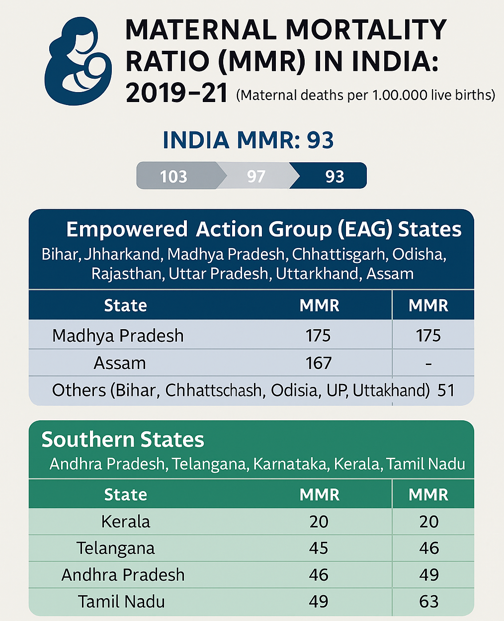
Context: The Maternal Mortality Ratio (MMR) for India is on the decline, but there are States that need to focus on basic and systemic issues.
Maternal Care in India: Challenges
- Three Delays Model: Delay in recognising complications and seeking care (due to low awareness, financial issues, social taboos).
- Delay in reaching a health facility (poor roads, remote areas, lack of ambulances).
- Delay in receiving adequate care at the facility (staff shortages, lack of blood banks, delayed referrals).
- Shortage of Trained Health Professionals: High vacancy rates for specialists (obstetricians, anaesthetists, paediatricians), especially in Community Health Centres and First Referral Units (FRUs).
- Eg., 66% vacancies of specialists in 5,491 community health centres.
- Anaemia and Malnutrition: A large proportion of pregnant women are anaemic or malnourished, increasing the risk of complications and maternal deaths.
- Eg., According to NFHS-5 (2019-21), over 50% of pregnant women in India are anaemic.
- Home Deliveries and Unsafe Abortions: Despite progress, a section of deliveries still happen at home by untrained birth attendants, leading to sepsis, trauma, and increased mortality.
- Socio-cultural and Economic Barriers: Early marriages, low education levels, poverty, and gender inequality hinder timely and safe maternal care.
- Ineffective Maternal Death Audits: Weak implementation of mandatory reporting and audit of maternal deaths in several states limits systemic improvement.
|
Major Government Initiatives Related to Maternal Care |
|||
| Initiative | Launched | Main Focus | Key Features |
| Janani Suraksha Yojana (JSY) | 2005 | Promote institutional delivery | Cash incentives for mothers & ASHAs to deliver at health facilities |
| Janani Shishu Suraksha Karyakram (JSSK) | 2011 | Free maternity and newborn care | Free delivery (incl. C-section), drugs, diagnostics, diet, blood, and transport for mother & newborn |
| PMSMA (Pradhan Mantri Surakshit Matritva Abhiyan) | 2016 | Quality antenatal care | Free specialist ANC on the 9th of every month; focus on early risk detection |
| LaQshya | 2017 | Labour room quality improvement | Upgradation of labour rooms, maternity OTs, staff training, and quality assurance |
| SUMAN (Surakshit Matritva Aashwasan) | 2019 | Dignified, assured maternal-newborn services | Zero expense, respectful, quality care; grievance redressal; covers all public health facilities |
| Anaemia Mukt Bharat (AMB) | 2018 | Reduce anaemia in women and children | 6×6×6 strategy: IFA, deworming, fortified foods, testing, behaviour change, address non-nutritional causes |
Way Forward
- Strengthen the Three Delays Model Response: Increase community awareness of maternal danger signs and the importance of institutional deliveries.
- Expand financial and transport incentives for timely referral and access.
- Ensure rapid response and triage at facilities, with a clear protocol for emergencies.
- Increase Investment in Health Infrastructure: Fill vacancies of obstetricians, anaesthetists, and staff nurses at all FRUs/CHCs.
- Upgrade operation theatres, blood banks, and critical care units at district and sub-district levels.
- Improve Quality of Maternal Death Audits: Mandatory, confidential reviews of every maternal death (e.g., Kerala Model), with accountability and follow-up actions.
| Kerala Model |
| Compulsory to report and review every maternal death, regardless of cause or location (hospital or home). All cases are reported within 24 hours. |
- Focus on Nutrition and Anaemia Control: Strengthen Iron Folic Acid (IFA) supplementation, nutrition counselling, and community-based interventions for adolescent girls and pregnant women.
- Empower Frontline Workers and Women’s Groups: Continue training and incentivising ASHAs, ANMs, and SHGs for community mobilisation and support.

 Right to Education (RTE) Act 2009 and So...
 Women’s Representation on Corporate Bo...
 Why Women’s Reservation Alone Is Not E...














 WhatsApp





