Table of Contents
Supreme Court Upholds Rights of Married Daughters Under Articles 14 and 15
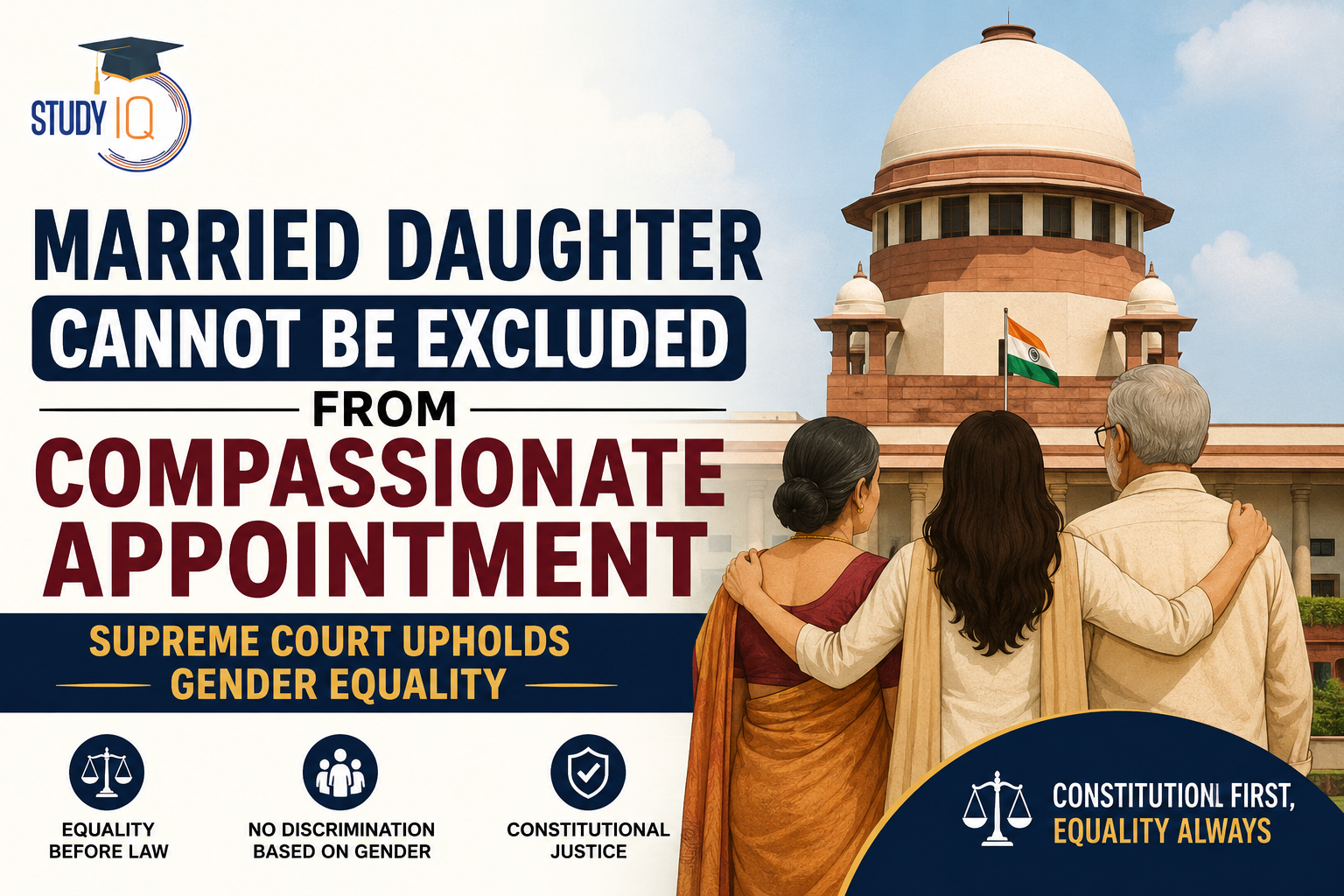
In a landmark judgment strengthening gender equality in India, the Supreme Court has held that a married daughter cannot be denied compassionate appointment or benefits under welfare schemes solely because of her marital status. The ruling came in Kulsum Nisha v. State of Uttar Pradesh (2026 LiveLaw (SC) 588), where the Court declared that excluding married daughters from dependent-family benefits is unconstitutional and based on outdated patriarchal assumptions.
The judgment reinforces the constitutional guarantees of equality and non-discrimination under Articles 14 and 15 of the Constitution and marks a major step toward eliminating gender stereotypes from public welfare policies.
Read Also: Judiciary Current Affairs
What Was the Case About?
The dispute arose from the allocation of a fair-price shop under the Public Distribution System (PDS) in Uttar Pradesh.
After the death of her mother, who operated the fair-price shop, Kulsum Nisha applied for allotment under the dependent quota. However, her application was rejected because a 2019 Government Order issued by the Uttar Pradesh government excluded married daughters from the definition of “family.”
Under the policy, the following relatives were considered eligible:
- Unmarried daughters
- Widowed daughters
- Divorced or legally separated daughters
However, married daughters were specifically excluded.
Despite living in the same village, assisting her mother in running the shop, and supporting her disabled sister, Kulsum Nisha was denied consideration solely because she was married.
Supreme Court’s Key Observation
Justice Alok Aradhe, speaking for the Court, rejected the assumption that a daughter ceases to belong to her parental family after marriage.
The Court observed that:
Marriage does not automatically sever emotional, financial, social, or caregiving relationships between a daughter and her natal family.
The Court emphasized that dependency is a factual issue and cannot be presumed solely based on marital status.
Many married daughters:
- Continue to live with or near their parents.
- Financially support their families.
- Care for elderly parents.
- Remain dependent on their parental household.
Therefore, excluding them from welfare benefits merely because they are married is arbitrary and discriminatory.
Why the Supreme Court Found the Rule Unconstitutional
Violation of Article 14
Article 14 guarantees equality before law and equal protection of laws.
The Court applied the doctrine of reasonable classification and found that:
- The classification between married and unmarried daughters lacked a rational basis.
- Marital status had no connection with the objective of providing financial relief to dependent family members.
A married daughter may be dependent, while an unmarried daughter may be financially independent.
Thus, the exclusion failed the constitutional test of reasonable classification.
Violation of Article 15
Article 15 prohibits discrimination on grounds of sex.
The Court noted that:
- Married sons remained eligible under the scheme.
- Married daughters alone were excluded.
This unequal treatment was based on the patriarchal stereotype that a daughter joins another family after marriage, whereas a son remains part of his parental family.
Such assumptions, the Court held, are incompatible with constitutional equality.
Supreme Court Rejects Patriarchal Stereotypes
One of the most significant aspects of the judgment is its explicit rejection of gender stereotypes.
The Court held that the assumption that a married daughter ceases to be part of her parental family is rooted in historical notions of women’s subordinate status.
According to the Court:
- Constitutional rights cannot depend upon social stereotypes.
- Public policies must reflect contemporary social realities.
- Gender-based assumptions cannot be the basis of government action.
This reasoning aligns with the Supreme Court’s broader gender justice jurisprudence.
Important Supreme Court Judgments Relied Upon
The judgment follows a long line of decisions aimed at dismantling discriminatory gender norms.
1. Anuj Garg v. Hotel Association of India (2008)
The Court struck down restrictions on women’s employment in establishments serving alcohol and rejected paternalistic assumptions about women’s vulnerability.
2. Joseph Shine v. Union of India (2018)
The Supreme Court decriminalized adultery and rejected the notion that women are the property of their husbands.
3. Vineeta Sharma v. Rakesh Sharma (2020)
The Court recognized daughters as equal coparceners in Hindu joint family property and affirmed equal inheritance rights.
The Kulsum Nisha judgment extends these principles into the domain of welfare entitlements and compassionate appointments.
Conflicting High Court Decisions Resolved
Before this ruling, High Courts had delivered conflicting judgments on the issue.
Judgments Supporting Married Daughters
- Vimal Srivastava v. State of Uttar Pradesh
- Ranjana Murlidhar Anerao v. State of Maharashtra
These decisions held that excluding married daughters violates constitutional guarantees of equality.
Judgments Supporting Exclusion
- Kusumlata v. State of Uttar Pradesh
- Saida Begum v. State of Uttar Pradesh
These rulings upheld the exclusion of married daughters under the Uttar Pradesh Government Order.
The Supreme Court has now settled the legal position nationwide by overruling the contrary view.
Impact on Compassionate Appointments and Welfare Schemes
The judgment has far-reaching implications beyond fair-price shop allotments.
It is expected to influence:
- Compassionate appointments in government service
- Welfare benefit schemes
- Dependent quotas
- Pension benefits
- Family assistance programs
- Social security entitlements
Government authorities can no longer automatically disqualify married daughters solely because of their marital status.
Instead, eligibility must be assessed based on:
- Actual dependency
- Financial condition
- Residence
- Caregiving responsibilities
- Scheme-specific requirements
Significance for Gender Justice in India
The Supreme Court’s ruling recognizes the changing realities of Indian families.
Modern family structures increasingly witness daughters:
- Supporting aging parents.
- Managing family businesses.
- Acting as primary caregivers.
- Contributing financially to parental households.
By acknowledging these realities, the Court has reaffirmed that marriage does not extinguish a woman’s relationship with her birth family.
The judgment strengthens substantive equality and ensures that women enjoy equal constitutional protection both before and after marriage.
Supreme Court’s Final Direction
The Supreme Court quashed the orders denying relief to Kulsum Nisha and held that married daughters are entitled to be considered as family members under the dependent quota.
The Court directed the competent authorities to issue an appropriate allotment order in her favour within four weeks.
Conclusion
The Supreme Court’s decision in Kulsum Nisha v. State of Uttar Pradesh is a landmark victory for gender equality and constitutional justice. By rejecting the patriarchal assumption that marriage severs a daughter’s ties with her parental family, the Court has reinforced the principles of dignity, equality, and non-discrimination.
The ruling makes it clear that dependency is a matter of fact, not marital status. Welfare benefits and compassionate appointments must be based on genuine need rather than outdated social stereotypes. In doing so, the Court has taken another significant step toward ensuring that married daughters receive equal recognition, rights, and opportunities under the Constitution of India.
Key Takeaways
- Married daughters cannot be excluded from compassionate appointments solely because of their marriage.
- The Supreme Court struck down the discriminatory interpretation of the Uttar Pradesh Government Order.
- The judgment is based on Articles 14 and 15 of the Constitution.
- Dependency is a factual question and cannot be presumed through marital status.
- The ruling strengthens women’s rights in welfare schemes, family benefits, and compassionate appointments across India.
Sharing is caring!
 Supreme Court Dowry Enforcement Order 20...
 Supreme Court Modifies 3-Year Practice R...
 Doctrine of Per Incuriam Explained: Supr...







 WhatsApp