Table of Contents
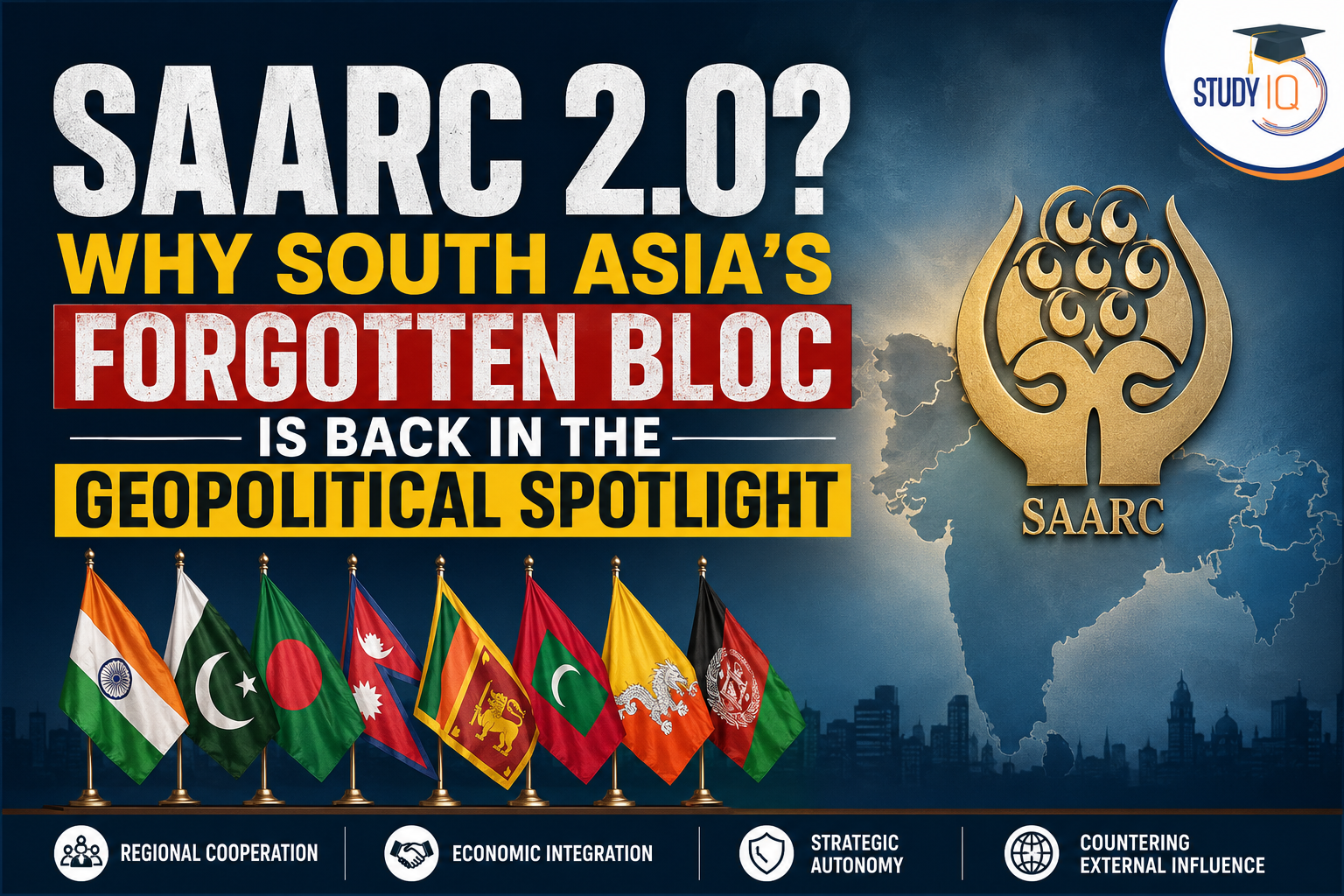
For nearly a decade, the South Asian Association for Regional Cooperation (SAARC) appeared to be fading into irrelevance. Summits were postponed, regional cooperation stagnated, and alternative forums such as BIMSTEC, QUAD, BRICS, and I2U2 increasingly dominated strategic discussions.
Yet in 2026, SAARC has unexpectedly returned to the geopolitical conversation.
Calls from Bangladesh, renewed discussions among regional leaders, and growing concerns over China’s expanding footprint in South Asia have reignited debate about whether SAARC deserves a second chance. While many analysts once viewed the organisation as a relic of an earlier era, changing geopolitical realities suggest that South Asia’s most important regional institution may still have a role to play.
The question is no longer whether SAARC failed in the past. The real question is whether South Asia can afford to leave it dormant in the future.
Read Also: UPSC Daily Current Affairs 2026
What is SAARC?
Established in 1985, SAARC was designed to promote economic, social, and cultural cooperation among South Asian countries. Its members include:
- India
- Pakistan
- Bangladesh
- Nepal
- Bhutan
- Sri Lanka
- Maldives
- Afghanistan
Collectively, these countries account for nearly a quarter of the world’s population, making South Asia one of the most significant geopolitical regions globally.
However, political tensions—particularly between India and Pakistan—have repeatedly prevented the organisation from achieving its full potential. The last SAARC Summit was held in Kathmandu in 2014, and subsequent summits were postponed amid diplomatic disputes.
Why is SAARC Back in the Spotlight?
The renewed interest in SAARC stems from a combination of regional and global developments.
China’s Expanding Presence in South Asia
Over the past decade, China has significantly increased its economic and strategic footprint across the region through investments, infrastructure projects, energy partnerships, and port development.
From the China-Pakistan Economic Corridor (CPEC) to projects in Sri Lanka, Nepal, Bangladesh, and the Maldives, Beijing has emerged as a major external actor in South Asia.
The prolonged inactivity of SAARC has created what many analysts describe as a geopolitical vacuum. In the absence of a functioning regional platform, external powers have found greater opportunities to shape regional outcomes.
A revived SAARC could help India re-establish a cooperative regional framework and reduce the strategic space available to outside actors.
Growing Uncertainty Around Minilateral Forums
India has increasingly relied on minilateral arrangements such as QUAD, I2U2, IMEC, and BRICS to advance its global ambitions.
These forums have undoubtedly enhanced India’s international profile. However, they remain vulnerable to extra-regional variables.
For example:
- QUAD depends heavily on Indo-Pacific strategic calculations.
- IMEC’s progress is affected by instability in West Asia.
- I2U2 is influenced by Middle Eastern political dynamics.
- BRICS faces internal contradictions among member states.
As global conflicts intensify and power balances shift, the limitations of minilateral diplomacy are becoming increasingly evident.
Unlike these arrangements, SAARC is fundamentally rooted in South Asian geography and regional realities.
Why SAARC Matters for India’s Neighborhood Policy
India’s rise as a global power depends not only on its international influence but also on stability in its immediate neighborhood.
This creates a strategic dilemma.
The more India focuses on global leadership roles, the greater the risk of neglecting regional engagement. Conversely, excessive focus on neighborhood issues can constrain India’s broader geopolitical aspirations.
A functioning SAARC offers a mechanism to balance both objectives.
Strengthening Strategic Autonomy
One of SAARC’s greatest advantages is that it does not depend on external sponsorship.
Unlike many contemporary geopolitical initiatives, SAARC remains a South Asian institution designed by South Asian countries for South Asian interests.
This gives India greater strategic autonomy in shaping regional outcomes without relying on extra-regional powers.
Managing Asymmetric Regional Interdependence
India’s size and economic strength create a situation of asymmetric regional interdependence.
Neighboring countries depend heavily on India for trade, connectivity, markets, energy, and employment opportunities. At the same time, India requires stable and cooperative neighbors to secure its borders and regional interests.
SAARC provides an institutional framework for managing these asymmetries through dialogue and cooperation rather than competition.
Preventing Regional Fragmentation
South Asia remains one of the least economically integrated regions in the world.
Intra-regional trade accounts for only a small fraction of the region’s total trade volume, significantly lower than levels seen in ASEAN or the European Union.
A revitalized SAARC could promote:
- Trade facilitation
- Regional connectivity
- Energy cooperation
- Disaster management
- Climate resilience
- Educational and cultural exchanges
Such initiatives would strengthen regional cohesion and reduce incentives for fragmentation.
Challenges to Reviving SAARC
Despite its potential benefits, reviving SAARC will not be easy.
Several structural obstacles remain:
India-Pakistan Rivalry
The biggest challenge continues to be the strained relationship between India and Pakistan. Political tensions and security concerns have repeatedly disrupted regional cooperation.
Institutional Weakness
SAARC lacks strong enforcement mechanisms and has often struggled to translate agreements into tangible outcomes.
Competing Regional Platforms
India has increasingly prioritized BIMSTEC and other forums that exclude Pakistan, reducing incentives to invest political capital in SAARC.
Trust Deficit
Many South Asian countries continue to balance relations between India and China, creating uncertainty about the future direction of regional cooperation.
Can SAARC 2.0 Succeed?
A revived SAARC will not transform South Asian geopolitics overnight.
It will not resolve India-Pakistan disputes. It will not eliminate China’s influence. Nor will it instantly create an integrated regional economy.
However, success should not be measured against unrealistic expectations.
Even a limited revival could:
- Restore regular regional dialogue.
- Enhance economic cooperation.
- Strengthen collective responses to disasters and climate challenges.
- Reduce strategic drift toward external powers.
- Reinforce India’s Neighborhood First policy.
In a world increasingly characterized by geopolitical fragmentation, regional institutions matter more—not less.
 Species in News: Cheetah | Project Cheet...
 Quantum Computing: RRI Scientists Demons...
 Artificial Intelligence in Warfare: How ...










 WhatsApp