Table of Contents
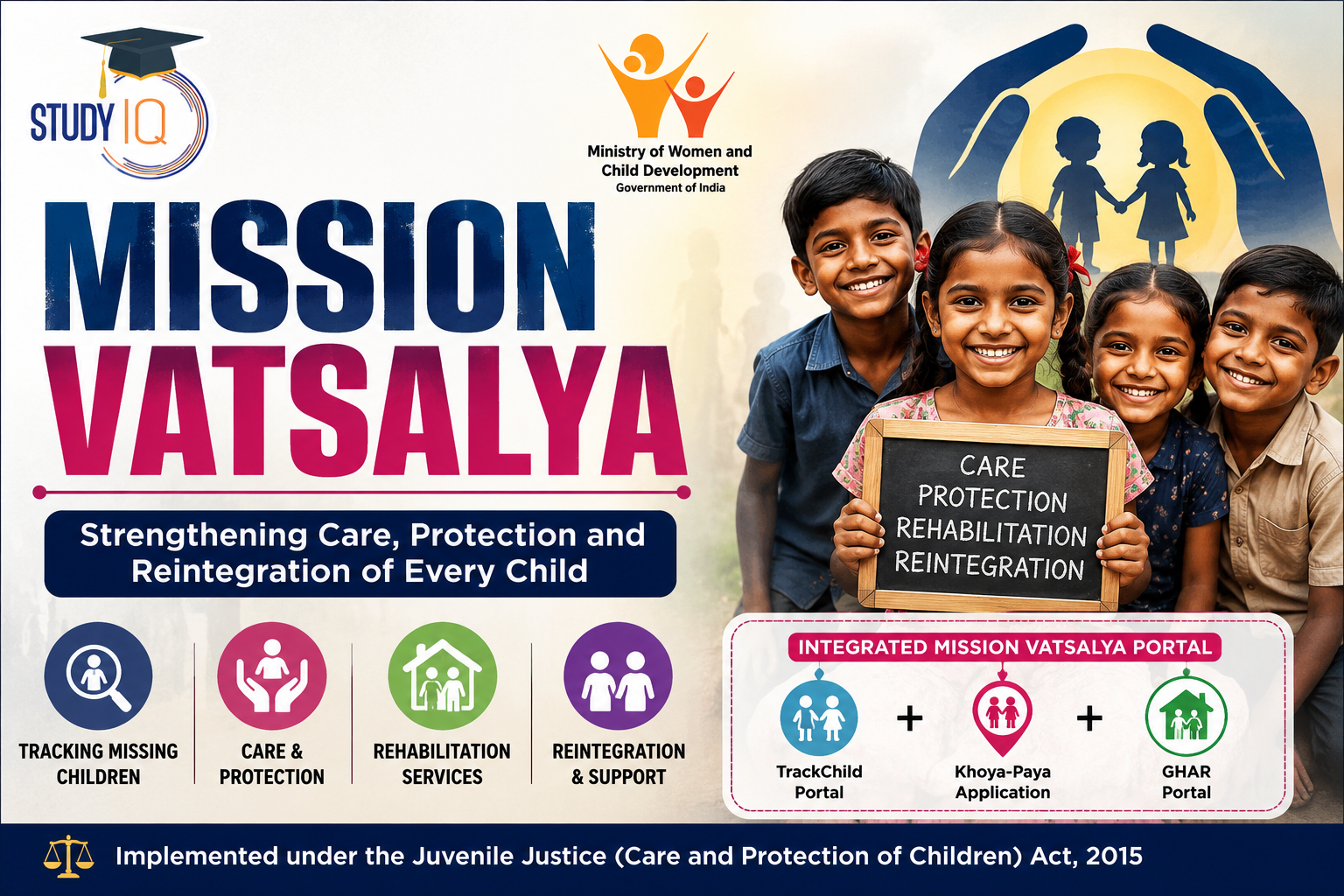
The Ministry of Women and Child Development (MWCD) has launched the integrated Mission Vatsalya Portal by merging the TrackChild Portal, Khoya-Paya Application, and GHAR (Go Home and Re-Unite) Portal. This integration aims to strengthen the identification, tracking, rehabilitation, and reintegration of missing, abandoned, trafficked, and vulnerable children across India.
Mission Vatsalya is a flagship Centrally Sponsored Scheme (CSS) that provides a comprehensive framework for child protection by ensuring care, support, rehabilitation, and social reintegration for children in difficult circumstances. The scheme is implemented by States and Union Territories in accordance with the Juvenile Justice (Care and Protection of Children) Act, 2015.
What is Mission Vatsalya?
Mission Vatsalya is a centrally sponsored child protection scheme of the Government of India designed to safeguard the rights and welfare of children who require care and protection or are in conflict with the law. It focuses on creating a safe and supportive environment through institutional as well as family-based care while strengthening child protection mechanisms at the national, state, and district levels.
The scheme promotes child-centric governance and aims to ensure that every child grows up in a secure, nurturing, and inclusive environment.
Latest Update: Integrated Mission Vatsalya Portal
The Ministry of Women and Child Development has integrated three major child protection platforms into a single Mission Vatsalya Portal to improve coordination among child protection agencies.
Portals Merged
- TrackChild Portal – Tracks missing and found children across India.
- Khoya-Paya Application – Enables citizens to report missing or found children.
- GHAR (Go Home and Re-Unite) Portal – Facilitates digital tracking and restoration of children to their families.
Benefits of the Integrated Portal
- Faster identification and tracing of missing children.
- Better coordination among police, Child Welfare Committees, and child care institutions.
- Digital monitoring of rehabilitation and restoration.
- Improved transparency and accountability.
- Enhanced data sharing among stakeholders.
Mission Vatsalya Highlights
| Particular | Details |
|---|---|
| Scheme Name | Mission Vatsalya |
| Ministry | Ministry of Women and Child Development (MWCD) |
| Scheme Type | Centrally Sponsored Scheme (CSS) |
| Beneficiaries | Children in Need of Care and Protection (CNCP) and Children in Conflict with Law (CCL) |
| Legal Basis | Juvenile Justice (Care and Protection of Children) Act, 2015 |
| Objective | Care, protection, rehabilitation and reintegration of vulnerable children |
| Implementation | States and Union Territories |
Objectives of Mission Vatsalya
Mission Vatsalya seeks to create a robust child protection ecosystem through the following objectives:
- Protect children from abuse, neglect, exploitation, trafficking, and violence.
- Ensure rehabilitation and social reintegration of vulnerable children.
- Strengthen institutional and family-based child care systems.
- Promote family preservation and restoration wherever feasible.
- Improve child protection infrastructure across States and UTs.
- Enhance digital governance for child tracking and rehabilitation.
- Ensure effective implementation of child protection laws.
Target Beneficiaries
Mission Vatsalya primarily benefits:
- Children in Need of Care and Protection (CNCP)
- Children in Conflict with Law (CCL)
- Missing children
- Orphaned and abandoned children
- Trafficked children
- Street children
- Child labour survivors
- Children affected by disasters and emergencies
- Children rescued from exploitation and abuse
Key Features of Mission Vatsalya
1. Institutional Care
The scheme supports:
- Child Care Institutions (CCIs)
- Observation Homes
- Special Homes
- Place of Safety
- Open Shelters
- Specialized Adoption Agencies
These institutions provide education, nutrition, counselling, healthcare, vocational training, and rehabilitation services.
2. Non-Institutional Care
Mission Vatsalya promotes family-based care through:
- Foster care
- Sponsorship
- Adoption
- Aftercare support
- Family restoration
The objective is to reduce unnecessary institutionalisation and ensure children grow up in family environments whenever possible.
3. Child Protection Services
The scheme strengthens:
- Child Welfare Committees (CWCs)
- Juvenile Justice Boards (JJBs)
- District Child Protection Units (DCPUs)
- Special Juvenile Police Units (SJPUs)
- State Child Protection Societies
4. Digital Child Tracking
The integrated Mission Vatsalya Portal enables:
- Online child tracking
- Missing child identification
- Family tracing
- Rehabilitation monitoring
- Data integration among departments
Legal Framework of Mission Vatsalya
Mission Vatsalya operates under the Juvenile Justice (Care and Protection of Children) Act, 2015, which provides the legal framework for child protection in India.
Section 55 of the JJ Act, 2015
Section 55 empowers:
- Central Government
- State Governments
- District Magistrates
to periodically monitor and evaluate the functioning of:
- Juvenile Justice Boards (JJBs)
- Child Welfare Committees (CWCs)
- Special Juvenile Police Units (SJPUs)
- Registered Child Care Institutions
- Fit Facilities
- Fit Persons
This ensures accountability and quality standards in child protection services.
Importance of Mission Vatsalya
Mission Vatsalya plays a significant role in strengthening India’s child protection system by:
- Reducing child trafficking and exploitation.
- Improving rescue and rehabilitation mechanisms.
- Promoting child rights and welfare.
- Strengthening digital governance in child protection.
- Facilitating quicker restoration of missing children.
- Supporting vulnerable children with education, healthcare, and psychosocial services.
- Enhancing coordination among government departments and law enforcement agencies.
Challenges in Implementation
Despite its comprehensive framework, Mission Vatsalya faces several challenges:
- Delays in tracing missing children.
- Shortage of trained child protection personnel.
- Uneven implementation across States.
- Limited awareness among citizens.
- Need for better technological integration.
- Monitoring and evaluation gaps.
- Overburdened Child Care Institutions.
Way Forward
To maximize the impact of Mission Vatsalya, the following measures are essential:
- Strengthen digital infrastructure through the integrated portal.
- Increase capacity building for child protection officials.
- Enhance coordination among police, judiciary, and child welfare agencies.
- Promote community awareness regarding child safety.
- Improve rehabilitation services with psychological counselling and skill development.
- Ensure periodic audits of Child Care Institutions.
- Expand family-based alternative care mechanisms.
Mission Vatsalya UPSC Relevance
Prelims
- Mission Vatsalya
- Juvenile Justice Act, 2015
- Child Welfare Committee (CWC)
- Juvenile Justice Board (JJB)
- TrackChild Portal
- GHAR Portal
- Khoya-Paya Portal
Mains (GS Paper II)
- Government policies for vulnerable sections.
- Child rights and welfare.
- Rehabilitation of trafficked and missing children.
- Role of digital governance in child protection.
Conclusion
Mission Vatsalya represents India’s comprehensive approach to child protection by combining legal safeguards, institutional support, family-based care, and digital governance. The launch of the integrated Mission Vatsalya Portal marks a significant step toward improving the tracking, rescue, rehabilitation, and reintegration of missing and vulnerable children. By strengthening coordination among stakeholders and leveraging technology, the scheme aims to ensure that every child in need receives timely protection, care, and opportunities for a safe and dignified future.
Read Also: UPSC Daily Current Affairs 2026
 Species in News: Cheetah | Project Cheet...
 Quantum Computing: RRI Scientists Demons...
 Artificial Intelligence in Warfare: How ...













 WhatsApp