
Table of Contents
Context
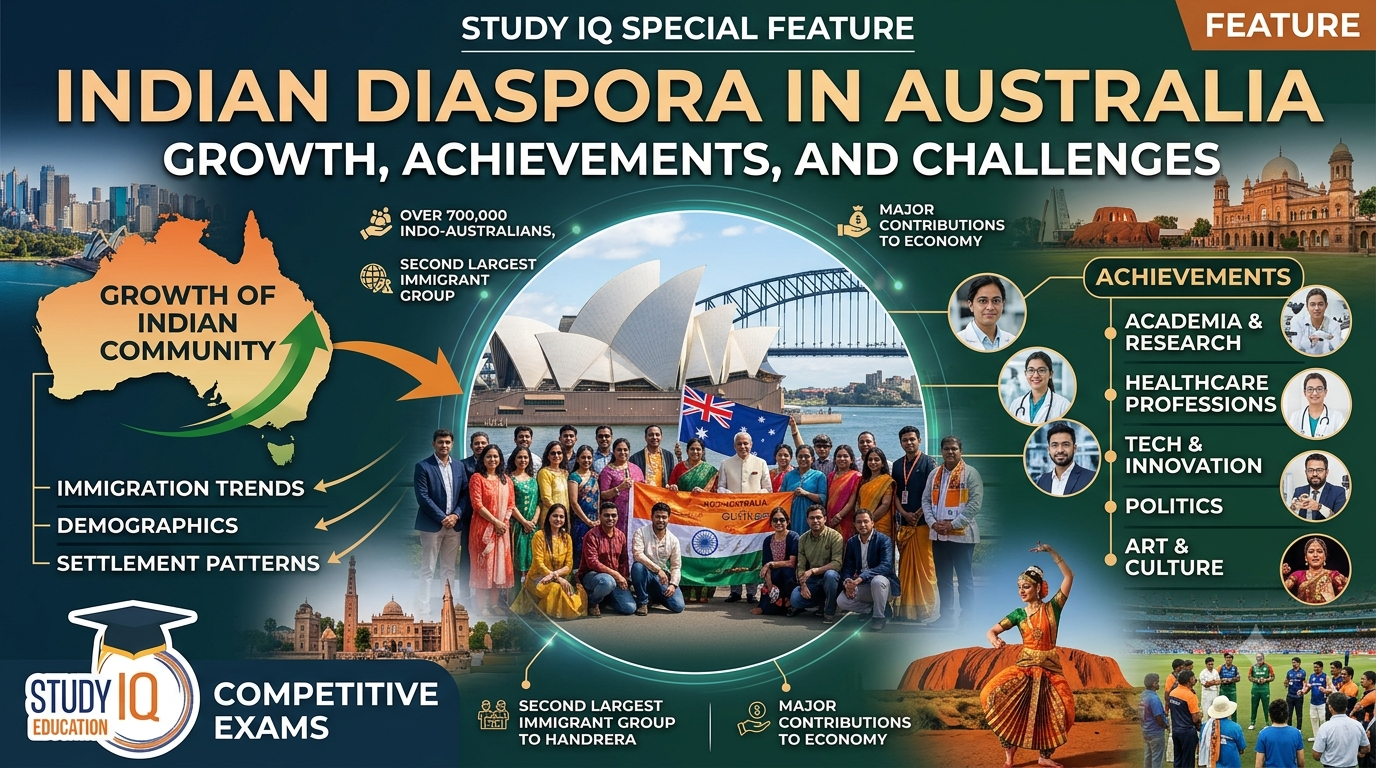
The Indian diaspora has become Australia’s largest overseas-born community, overtaking the England-born population for the first time, reinforcing its role as a key pillar of the India–Australia Comprehensive Strategic Partnership.
Why is the Indian Diaspora Significant for India–Australia Relations?
- Socio-Cultural Capital and Public Diplomacy: The diaspora promotes mutual understanding through shared democratic values, multiculturalism, and cultural exchanges, strengthening India’s soft power.
- g., The relationship has evolved from the “3 Cs” (Cricket, Curry, Commonwealth) to the “4 Ds”—Democracy, Defence, Diaspora, and Dosti, supported by festivals such as Diwali and the International Day of Yoga.
- Economic and Technology Partnership: The Indian diaspora strengthens economic integration by contributing skilled talent, facilitating investment, and supporting innovation-led cooperation.
- g., Indian professionals play a key role in IT, healthcare, research, start-ups, and the India–Australia Critical and Emerging Technology Partnership.
- Political Constituency and Strategic Trust: A growing Indian-origin community has emerged as an influential political constituency, encouraging bipartisan support for stronger India–Australia relations.
- Talent Mobility and Knowledge Partnership: Educational exchanges and skilled migration create long-term institutional linkages, strengthening human capital and innovation ecosystems.
- g., The Australia–India Economic Cooperation and Trade Agreement (ECTA) and the Migration and Mobility Partnership Arrangement (MMPA) facilitate student and professional mobility.
- Strategic Indo-Pacific Partnership: The diaspora reinforces broader strategic cooperation by fostering long-term institutional, business, and societal linkages that support a stable Indo-Pacific.
What Are the Major Challenges Facing the Indian Diaspora and Bilateral Relations?
- Extremism: Political and ideological divisions originating outside Australia can spill over into diaspora communities, creating diplomatic sensitivities and law-and-order challenges.
- g., Incidents involving Khalistani extremism, temple vandalism, and politically motivated protests have periodically affected India–Australia diplomatic engagement.
- Migration Policy Uncertainty: The bilateral relationship remains disproportionately dependent on education-led migration, making people-to-people ties vulnerable to Australia’s evolving immigration and visa policies.
- g., Australia’s efforts to reduce Net Overseas Migration (NOM) through stricter Genuine Student (GS) assessments and higher financial requirements have constrained Indian student mobility.
- Skill Recognition and Underemployment: Despite high educational attainment, many Indian professionals face delays in the recognition of qualifications, leading to underemployment and inefficient utilisation of skilled human capital.
- g., Australia’s “Activate Australia’s Skills” report estimates that over 253,000 skilled migrants are underemployed, including around 50,000 engineers and 16,000 nurses.
- Socio-Political Friction and Social Cohesion: Housing shortages, rising living costs, and infrastructure pressures have fuelled anti-immigration sentiment, occasionally affecting the safety and integration of the Indian community.
- Nationalist campaigns such as “March for Australia” and rising anti-immigration rhetoric have increasingly targeted the Indian community, alongside periodic incidents of racial discrimination and hate crimes.
- Institutional Gaps in Diaspora Governance: A uniform approach to diaspora engagement overlooks the distinct needs and capacities of different migrant groups, reducing the effectiveness of bilateral policies and partnerships.
- The Lowy Institute’s Beyond the Model Minority report highlights that while initiatives like the Maitri Grants primarily benefit established professionals and businesses, temporary Indian students continue to face challenges such as wage theft, housing insecurity, and workplace exploitation, underscoring the need for differentiated diaspora engagement.
How Can India and Australia Strengthen Diaspora-Led Partnership?
- Promote Cultural Cohesion and Community Integration: Strengthen grassroots initiatives that foster multicultural harmony, counter misinformation, and improve the social integration of the Indian diaspora.
- g., Expand community outreach programmes, multicultural festivals, and anti-racism initiatives supported through Maitri Grants and local government partnerships.
- Institutionalise Diaspora Diplomacy: Create structured mechanisms to integrate diaspora expertise into bilateral policymaking, business, academia, and strategic dialogue.
- g., Strengthen Track 1.5 Dialogues, and leverage platforms such as the India Chair at the Lowy Institute for policy engagement.
- Strengthen Talent Mobility and Skill Recognition: Facilitate seamless movement of students and professionals by harmonising qualification recognition and expanding mobility pathways.
- g., Operationalise the Taskforce on Education Qualifications Recognition, expand the MATES (Mobility Arrangement for Talented Early-professionals Scheme), and accelerate mutual recognition of professional credentials to reduce brain waste.
- Leverage the Diaspora for Economic and Technology Partnerships: Mobilise diaspora networks to deepen investment, innovation, and technology collaboration in priority sectors.
- g., Strengthen start-up partnerships in critical minerals, clean energy, AI, fintech, and critical technologies, while accelerating negotiations for the Comprehensive Economic Cooperation Agreement (CECA).
- Deepen Strategic and Indo-Pacific Cooperation: Recognise the diaspora as the human ballast that strengthens political trust and societal support for long-term strategic cooperation.
- g., Leverage strong people-to-people ties to reinforce cooperation under the Quad.
Latest UPSC Updates
| Resource | Link |
|---|---|
| UPSC Prelims Result 2026 | Check Here |
| UPSC Exam Calendar 2027 | View Calendar |
| UPSC Question Paper 2026 | Download PDF |
| UPSC Prelims Answer Key 2026 | Check Answer Key |
| UPSC Cut Off 2026 | View Cut Off |
| UPSC Syllabus 2026 | Read Syllabus |
| Daily Current Affairs 2026 | Read Updates |
| StudyIQ UPSC IAS Foundation 2027 (English) | Join Course |
| StudyIQ UPSC IAS Foundation 2027 (Hindi) | Join Course |
| StudyIQ UPSC IAS Foundation 2027 (Bilingual) | Join Course |
 Circular Economy in India: Benefits, Cha...
 EPFO Wage Ceiling Hike 2026: Social Secu...
 Daily Mains Articles 2026 – Updated Da...













 WhatsApp





