
Table of Contents
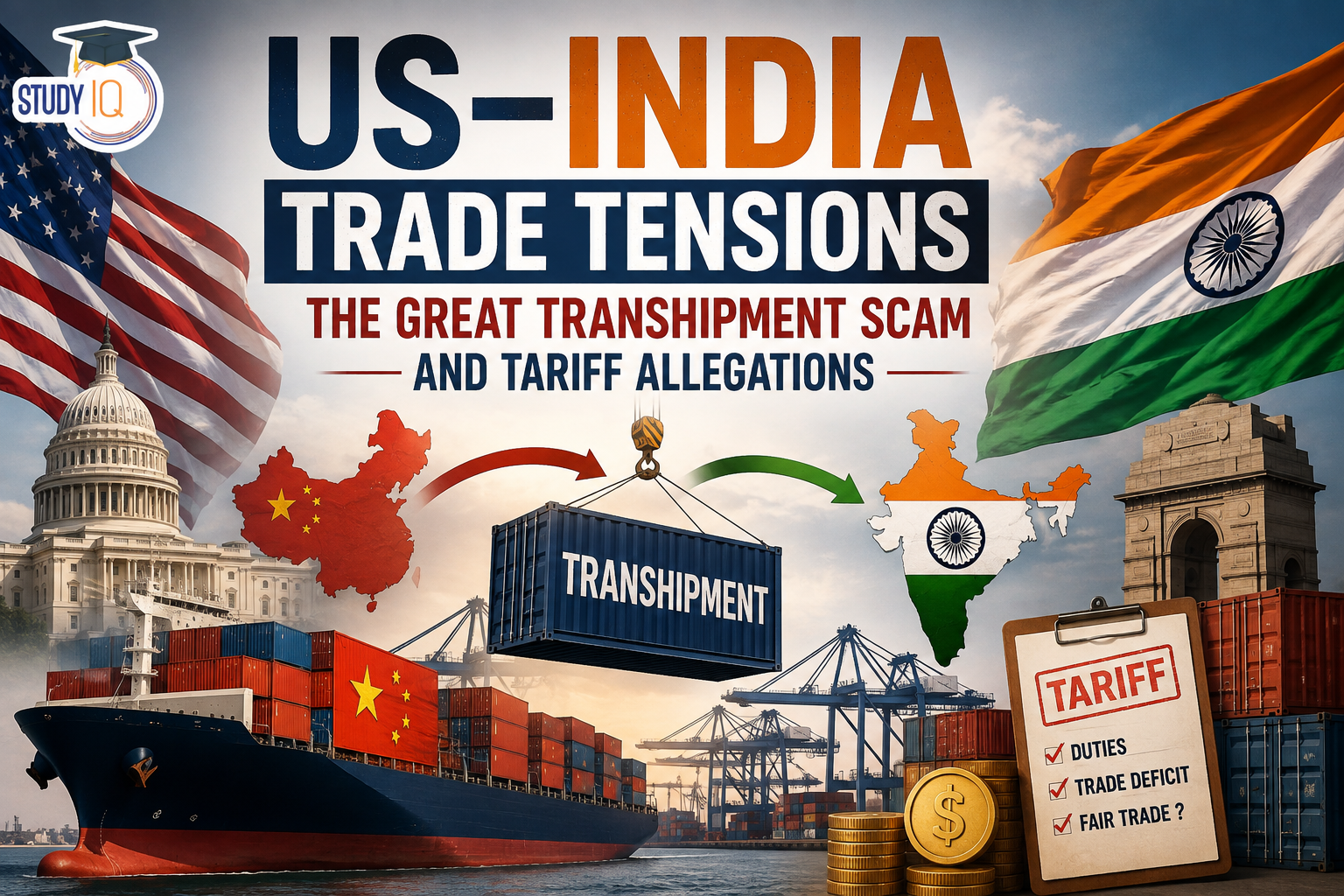
The latest phase of US–India trade tensions has brought the issue of Chinese goods being routed through third countries into sharp focus. In August 2026, the White House released a report titled “The Great Transshipment Scam”, alleging that Chinese exporters have used third-country jurisdictions to circumvent US tariffs imposed on Chinese imports. India is among the more than 40 economies identified in the report as part of what Washington calls China’s “Shadow Transshipment Network.”
The issue is significant for India because the country is simultaneously seeking to deepen its manufacturing base, expand exports and integrate into global value chains.
Read Also: UPSC Daily Current Affairs 2026
What is Transshipment?
Transshipment refers to the movement of goods from one country to another through an intermediate country. Transshipment itself is not illegal. It becomes problematic when the intermediate country is allegedly used to evade tariffs, conceal the actual country of origin or make minimal changes to a product before re-exporting it.
According to the White House report, Chinese exporters increasingly began routing goods through third countries after the US imposed substantial tariffs on Chinese imports from 2018 onwards. The alleged practices include:
- Repackaging and relabelling;
- Minor processing or assembly;
- Re-invoicing;
- Changes in shipping documentation; and
- False declarations regarding the country of origin.
The US argues that such practices allow Chinese-origin goods to enter the American market under a lower tariff regime.
Why Did the Issue Emerge?
The dispute is rooted in the broader US–China trade conflict. Since 2018, successive US administrations have imposed tariffs and other trade restrictions on Chinese products, citing concerns over unfair trade practices, industrial policy, technology transfer and persistent trade deficits.
However, tariffs can also encourage firms to reconfigure supply chains. Instead of exporting a finished product directly from China, companies may undertake some assembly or processing in countries such as Vietnam, Mexico or India before exporting it to the US.
This creates an important distinction between:
- Legitimate supply-chain diversification → genuine manufacturing and value addition in a third country.
- Illegal transshipment → minimal processing intended primarily to disguise Chinese origin and evade applicable tariffs.
The central challenge is therefore determining where legitimate global manufacturing ends and tariff circumvention begins.
Why Has India Been Named?
The White House categorises India among its Tier 1 “diversified scale leaders”, alongside economies such as Mexico, Canada, Japan, South Korea and the European Union. The classification does not by itself establish that all trade routed through India is illegal; rather, the report identifies these economies as large trade hubs where potential transshipment risks may be embedded within legitimate trade flows.
India’s growing integration with Chinese supply chains makes the issue particularly sensitive. Indian manufacturers import a range of intermediate goods, components, machinery and raw materials from China and subsequently use them in domestic production.
Therefore, Chinese inputs in an Indian-made product do not automatically make that product a Chinese-origin product. The relevant question is whether sufficient processing and value addition have occurred under applicable rules of origin.
Did US Tariffs Reduce Dependence on China?
The experience of the last several years presents a mixed picture.
US imports directly from China declined substantially after the tariff measures were introduced. However, overall US imports from the rest of the world continued to grow. This indicates that part of the adjustment may have involved trade diversion rather than complete reshoring of production to the United States.
In other words, tariffs can change where America imports from without necessarily eliminating America’s dependence on foreign supply chains.
This phenomenon is important for understanding the current controversy. A product moving from China → India → United States may represent either tariff evasion or the emergence of a genuinely diversified global manufacturing network. Determining which is occurring requires product-level customs data and assessment of actual value addition.
Implications for India
1. Impact on Make in India
India’s manufacturing strategy increasingly depends on participation in global value chains. Electronics, machinery, chemicals and other sectors often require imported intermediate inputs.
If US authorities impose additional restrictions on Indian exports merely because they contain Chinese inputs, India’s export competitiveness could suffer.
2. Higher Production Costs
A sharp reduction in access to competitively priced Chinese components could increase input costs for Indian manufacturers. This may weaken India’s ability to compete with manufacturing hubs such as Vietnam, Mexico and other Asian economies.
3. Pressure on Rules of Origin
The controversy could encourage India to strengthen its rules-of-origin verification, customs intelligence and supply-chain traceability. Stronger documentation would help distinguish genuine Indian manufacturing from simple tariff-routing arrangements.
4. Opportunity for Supply-Chain Diversification
At the same time, the controversy presents an opportunity. Global companies seeking alternatives to excessive dependence on China may increasingly consider India for manufacturing and final assembly.
India can benefit if it moves beyond assembly towards higher domestic value addition, component manufacturing, technology development and logistics efficiency.
Broader India–US Trade Relations
The transshipment controversy comes against a wider backdrop of trade disagreements between India and the United States, including disputes concerning tariffs, market access, forced-labour enforcement and India’s economic engagement with Russia.
In July 2026, the US also imposed Section 301 tariffs linked to concerns over the effectiveness of forced-labour import prohibitions. India was placed in the 10% tariff category under that action after undertaking measures concerning forced-labour prohibitions. This is distinct from the transshipment report.
Importantly, the “Great Transshipment Scam” report itself does not announce a specific punitive tariff against India. It signals heightened scrutiny and identifies potential risks; future enforcement measures could nevertheless follow.
Way Forward
India should adopt a calibrated approach rather than treating the issue solely as a bilateral dispute.
- First, India should strengthen customs cooperation and digital tracking of supply chains to prevent genuine cases of tariff circumvention.
- Second, exporters should maintain transparent documentation regarding the origin and extent of processing of goods.
- Third, India should deepen domestic manufacturing of critical components so that its export competitiveness is not excessively dependent on imported inputs.
- Fourth, New Delhi should use diplomatic and trade channels with Washington to ensure that legitimate Indian manufacturing is not equated with illegal transshipment.
- Finally, India should diversify its export markets while simultaneously improving logistics, infrastructure, technology and ease of doing business.
Conclusion
The “Great Transshipment Scam” highlights a fundamental tension in the emerging global trading system: the difference between tariff evasion and legitimate global value-chain integration.
For the United States, preventing circumvention is an important customs and revenue objective. For India, however, excessive restrictions on products containing Chinese intermediate inputs could undermine its ambition to become a competitive manufacturing and export hub.
The appropriate response is therefore not isolation from Chinese supply chains, but greater transparency, higher domestic value addition and stronger integration into diversified global value chains. For India, the long-term objective should be to transform the current trade friction into an opportunity to move from being primarily an assembly destination to a globally competitive manufacturing ecosystem.

 Child Marriage in India: Causes, Impacts...
 World Development Report 2026: The Promi...
 US Suspension of PERM Filings by Major I...














 WhatsApp





