Table of Contents
Welcome back to the Study IQ Judiciary blog! On August 21, 2026, the Supreme Court of India pronounced a highly anticipated judgment modifying the mandatory three-year practice rule for the Civil Judge (Junior Division) examination. If you have been worried about how the recent mandates impact your preparation, this blog covers all the essential details from today’s verdict.
The Background of the Practice Requirement
To fully understand this judgment, we must first look at the history of the eligibility criteria:
1993 (Second AIJA Case)
The Supreme Court directed all States to prescribe a minimum of three years’ practice as a lawyer as an essential qualification for judicial officers at the lowest rung.
2002 (Third AIJA Case)
Based on the Shetty Commission’s report, this mandatory three-year requirement was removed. As a result, fresh law graduates became eligible to enter the judicial service without prior experience.
2025 Judgment
The Supreme Court reversed the 2002 position and restored the three-year practice rule. The Court observed that fresh law graduates lacked familiarity with court procedure and the decorum of court proceedings.
The 2026 Verdict: Balancing Experience and Opportunity
Authored by Chief Justice Surya Kant and Justice Augustine George Masih, the majority judgment recognized the sudden hardship imposed on fresh graduates who had planned their legal education under the old rules. The Court emphasized that while practical exposure is necessary, requiring three years of practice delays entry into the judicial service and creates economic barriers, especially for women and marginalized groups.
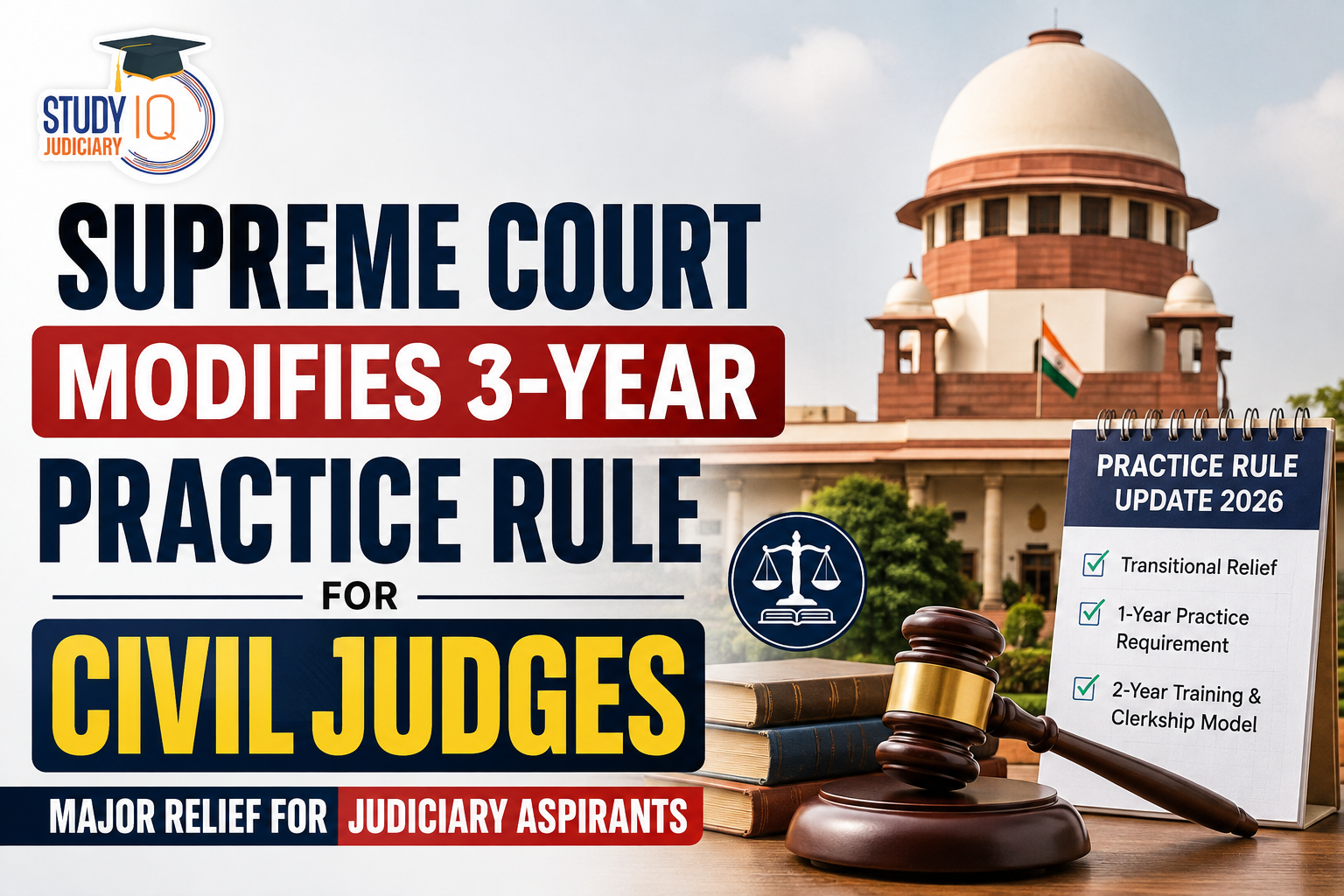
To resolve this issue, the Supreme Court introduced a structured framework divided into two phases: a Transitional Period and a Post-Transitional Period.
1. Transitional Arrangement (Notifications up to March 31, 2027)
If you are applying for recruitment notifications issued after the 2025 judgment and up to March 31, 2027, the following rules apply:
- Eligibility Relaxed: All law graduates are eligible to apply, notwithstanding the three-year practice requirement.
- Deemed Practice: Candidates are deemed to have completed one year of active practice. They are not required to furnish a separate Certificate of Practice.
- Designation: Selected candidates will be designated as “Trainee Judicial Officers”.
2. Post-Transitional Period (Notifications on or after April 1, 2027)
For exams notified on or after April 1, 2027, the criteria will shift:
- Actual Practice Requirement: Every candidate must possess at least one year of actual practice at the Bar to appear for the examination.
- Verification: This one year of practice must be verified through a Certificate of Practice.
The 2-Year Mandatory Training & Clerkship Model
Whether recruited during or after the transitional period, all selected candidates must undergo a mandatory two-year practical training phase before assuming independent judicial functions:
Year 1 – Academy Training
Trainees must undergo a compulsory one-year period of intensive training at the State Judicial Academy. This period is treated as equivalent to one year of practice at the Bar.
Year 2 – Structured Law Clerkship
Following the academy training, trainees will undergo a one-year Law Clerkship. The first six months will be spent under the supervision of a Principal District/District and Sessions Judge or a Member of the Higher Judicial Services. The remaining six months will be spent under the supervision of a sitting High Court Judge. This clerkship year is also treated as equivalent to one year of practice at the Bar.
Stipend & Emoluments
During both years, Trainee Judicial Officers will receive a fixed emolument equivalent to one-half of the remuneration payable to a Judicial Magistrate First Class in the concerned State.
Final Appointment
After completing the clerkship, the supervising High Court Judge will submit a reasoned evaluation report. Upon satisfactory evaluation, the Trainee Judicial Officer will be appointed to a regular post and become entitled to the regular pay scale.
The Dissenting Opinion
The judgment was not unanimous. Justice K. Vinod Chandran delivered a dissenting opinion, concluding that the review petitions should be dismissed.
Stance on Practice
Justice Chandran argued that the three-year practice requirement is essential for fresh graduates to experience the affairs of a litigant before deciding their destinies.
Concerns on Training
He expressed that substituting practice with a structured training program where recruits work for two years on half pay would be prejudicial to the candidates. He further noted that keeping trainees out of active service for two years would leave courts unmanned and multiply vacancies.
Conclusion for Judiciary Aspirants
This landmark scheme will remain in force for a period of five years from the date of the judgment and will be revisited by the Supreme Court based on its working and efficacy. For aspiring judges studying with Study IQ Judiciary, this ruling brings a massive sense of relief and clarity. The transitional period opens the doors immediately for recent graduates, while the subsequent one-year practice requirement provides a structured, manageable roadmap for future aspirants.
Keep studying hard, and stay tuned to Study IQ Judiciary for more crucial legal updates!
Read Also: Judiciary Current Affairs
 Supreme Court Dowry Enforcement Order 20...
 Doctrine of Per Incuriam Explained: Supr...
 AI Hallucinations in Legal Research: Sup...






 WhatsApp