Table of Contents
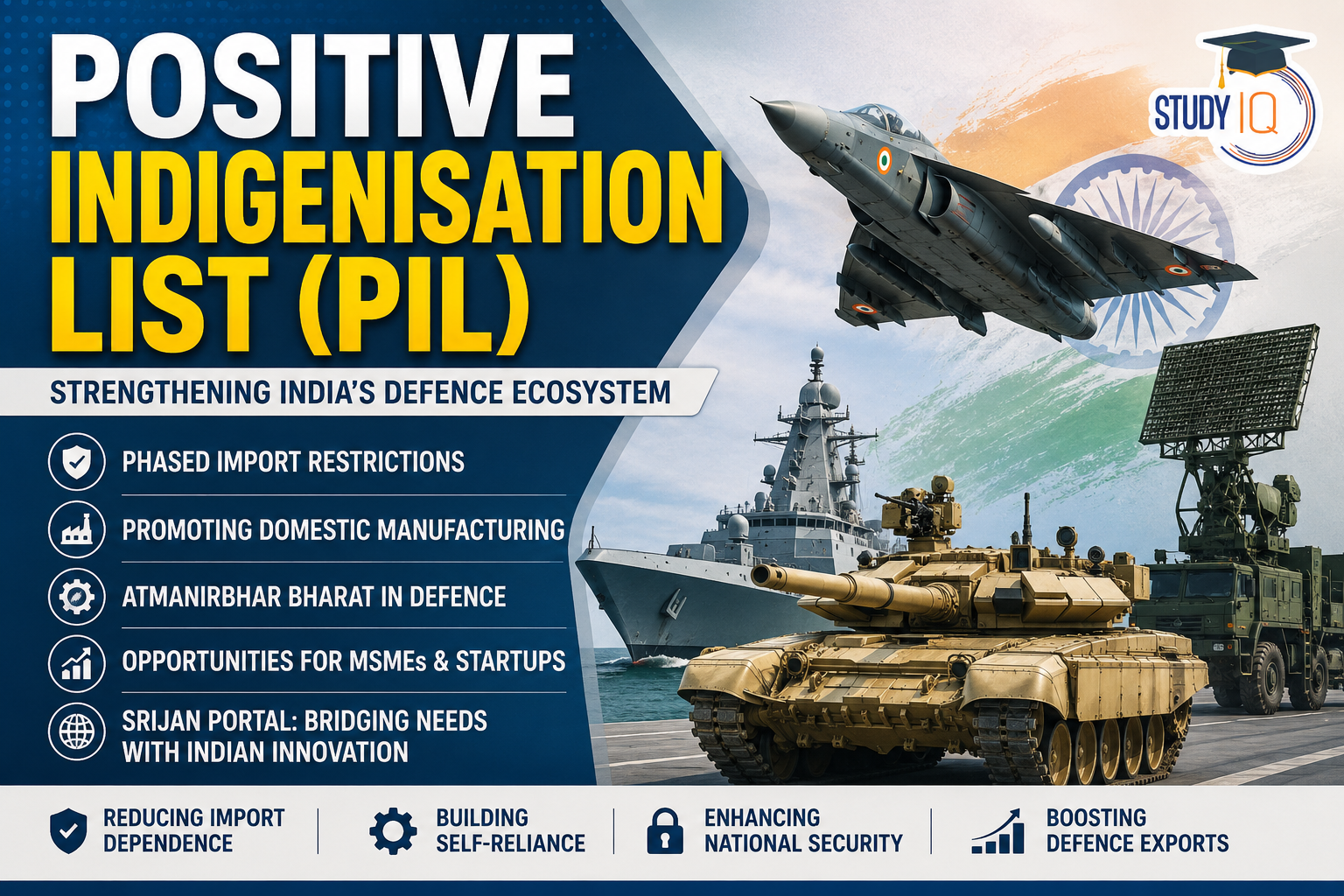
India has been steadily strengthening its domestic defence manufacturing capabilities as part of its broader Atmanirbhar Bharat initiative. A key instrument in this effort is the Positive Indigenisation List (PIL), which identifies defence items that will progressively be procured from Indian sources instead of being imported.
The Department of Defence Production (DDP) has notified the 6th Positive Indigenisation List, covering strategically important defence items. The initiative is aimed at reducing India’s dependence on foreign suppliers, encouraging domestic defence production and creating greater opportunities for Indian defence companies, MSMEs and startups.
What is the Positive Indigenisation List (PIL)?
The Positive Indigenisation List is an official list of defence equipment and items for which the Indian Armed Forces will gradually stop relying on imports.
Under the list, specific items are assigned an indigenisation timeline. After the relevant deadline, their procurement is required to be made from domestic sources, subject to the applicable procurement provisions.
The PIL is therefore an important policy instrument for developing India’s domestic defence industrial ecosystem.
Key Features of the Positive Indigenisation List
- It identifies defence items that are to be progressively indigenised.
- It imposes phased import restrictions after specified deadlines.
- It encourages procurement from Indian manufacturers.
- It provides domestic industry with time to develop, test and qualify alternative products.
- It promotes participation by DPSUs, private companies, MSMEs and startups.
- It seeks to strengthen India’s defence supply chain and technological capabilities.
6th Positive Indigenisation List
The 6th PIL focuses on strategically important defence items that are intended to be brought within the domestic manufacturing ecosystem.
The notification of successive PILs reflects the government’s continuing effort to expand the range of defence equipment that can be manufactured within India.
The phased approach is significant because indigenisation cannot always happen immediately. Complex defence platforms and components may require substantial investment in research and development, testing, certification, manufacturing infrastructure and quality assurance.
By providing an advance timeline, the PIL allows Indian industry to develop and qualify indigenous alternatives before import restrictions take effect.
Objectives of the Positive Indigenisation List
1. Reduce Import Dependence
One of the primary objectives of the PIL is to reduce India’s dependence on foreign suppliers for defence equipment and critical components.
A lower import dependence can improve India’s strategic autonomy and reduce vulnerabilities arising from disruptions in international supply chains.
2. Promote Atmanirbhar Bharat in Defence
The initiative supports India’s broader Atmanirbhar Bharat objective by encouraging the development and manufacture of defence equipment within the country.
3. Strengthen the Domestic Defence Industry
The PIL creates a predictable demand environment for Indian defence manufacturers. This can encourage companies to invest in production facilities, research and development and new technologies.
4. Encourage MSMEs and Startups
Indigenisation can create opportunities for smaller companies to enter the defence supply chain.
Indian MSMEs and startups can contribute to the development of specialised components, subsystems, technologies and innovative solutions.
5. Develop Defence Technology
The long-term objective is not merely to manufacture existing equipment domestically but also to improve India’s indigenous technological capabilities.
Greater domestic R&D and manufacturing can help India move from import dependence towards greater technological self-reliance.
6. Strengthen National Security
A robust domestic defence-industrial base can provide greater security of supply during geopolitical tensions, conflicts or international supply-chain disruptions.
What is Phased Indigenisation?
Phased indigenisation means that defence items are not necessarily shifted from imports to domestic procurement overnight.
Instead, each item may have a specified timeline for developing domestic capability.
This approach provides Indian manufacturers sufficient time to:
- Understand the technical requirements.
- Develop indigenous alternatives.
- Conduct testing and trials.
- Obtain necessary qualifications and certifications.
- Establish production capacity.
- Meet the requirements of the Armed Forces.
This makes the transition towards domestic procurement more practical while maintaining the operational requirements of the military.
Role of the Department of Defence Production
The Department of Defence Production (DDP) plays an important role in India’s defence manufacturing and indigenisation framework.
The DDP is responsible for policy and initiatives aimed at strengthening domestic defence production and increasing the participation of Indian industry in defence manufacturing.
Positive Indigenisation Lists are notified as part of this broader effort.
The Department of Military Affairs (DMA) and the Armed Forces also have an important role in identifying operational requirements and supporting the transition towards indigenous procurement.
SRIJAN Portal and Defence Indigenisation
The SRIJAN Portal is another important component of India’s defence indigenisation strategy.
SRIJAN provides a platform through which imported defence items can be displayed so that Indian industry can explore opportunities to develop them domestically.
The portal can help connect defence requirements with potential Indian manufacturers.
How does the SRIJAN Portal help?
The portal provides opportunities for:
- Indian manufacturers
- MSMEs
- Startups
- Defence companies
- Technology developers
- Other domestic industrial stakeholders
to identify items that are currently imported and explore their indigenous development.
This can help create a stronger connection between the requirements of the Armed Forces and India’s industrial and technological capabilities.
Positive Indigenisation List vs SRIJAN Portal
Although both initiatives support defence indigenisation, they serve somewhat different purposes.
| Positive Indigenisation List | SRIJAN Portal |
|---|---|
| Identifies items subject to phased import restrictions | Displays imported items for indigenous development |
| Focuses on procurement policy | Focuses on industry opportunities |
| Supports progressive replacement of imports | Connects domestic industry with indigenisation requirements |
| Provides timelines for indigenisation | Helps manufacturers identify potential products to develop |
| Supports strategic self-reliance | Encourages participation of MSMEs and startups |
Significance for India’s Defence Sector
The Positive Indigenisation List is important because defence preparedness depends not only on possessing advanced military equipment but also on having reliable access to critical components, spares and technologies.
A stronger domestic defence ecosystem can provide several advantages:
Strategic Autonomy
Greater domestic production can reduce India’s vulnerability to external suppliers.
Supply Chain Resilience
Domestic manufacturing can help reduce risks associated with international disruptions.
Economic Benefits
Defence manufacturing can create investment, employment and opportunities for Indian companies.
Technology Development
Demand from the defence sector can encourage research, innovation and technology development.
Export Potential
Building competitive domestic capabilities can eventually help Indian defence manufacturers expand into international markets.
Challenges in Defence Indigenisation
Despite its advantages, defence indigenisation also involves several challenges.
Technological Complexity
Some defence systems involve highly sophisticated technologies that require substantial R&D capabilities.
Quality and Reliability
Military equipment must meet stringent performance, reliability and safety standards.
Testing and Certification
Domestic alternatives often require extensive testing and evaluation before being inducted into the Armed Forces.
Production Capacity
Developing a prototype is different from establishing the capacity to manufacture equipment consistently at scale.
Cost Competitiveness
Indian manufacturers must also become competitive in terms of cost, quality, delivery timelines and lifecycle support.
Way Forward
For the Positive Indigenisation List to achieve its full potential, India needs continued investment in research and development, defence innovation, testing infrastructure, skilled manpower and private-sector participation.
Closer cooperation between the Armed Forces, DPSUs, private companies, MSMEs, startups, research institutions and academia can further strengthen the defence innovation ecosystem.
The SRIJAN Portal can also play an important role by helping domestic manufacturers identify opportunities arising from imported defence items.
Read Also: UPSC Daily Current Affairs 2026
 Panama Earthquake 2026: Location, Tecton...
 Project Seabird Phase IIA: India’s Nav...
 Daily Current Affairs PDF 2026: Download...














 WhatsApp