
Table of Contents
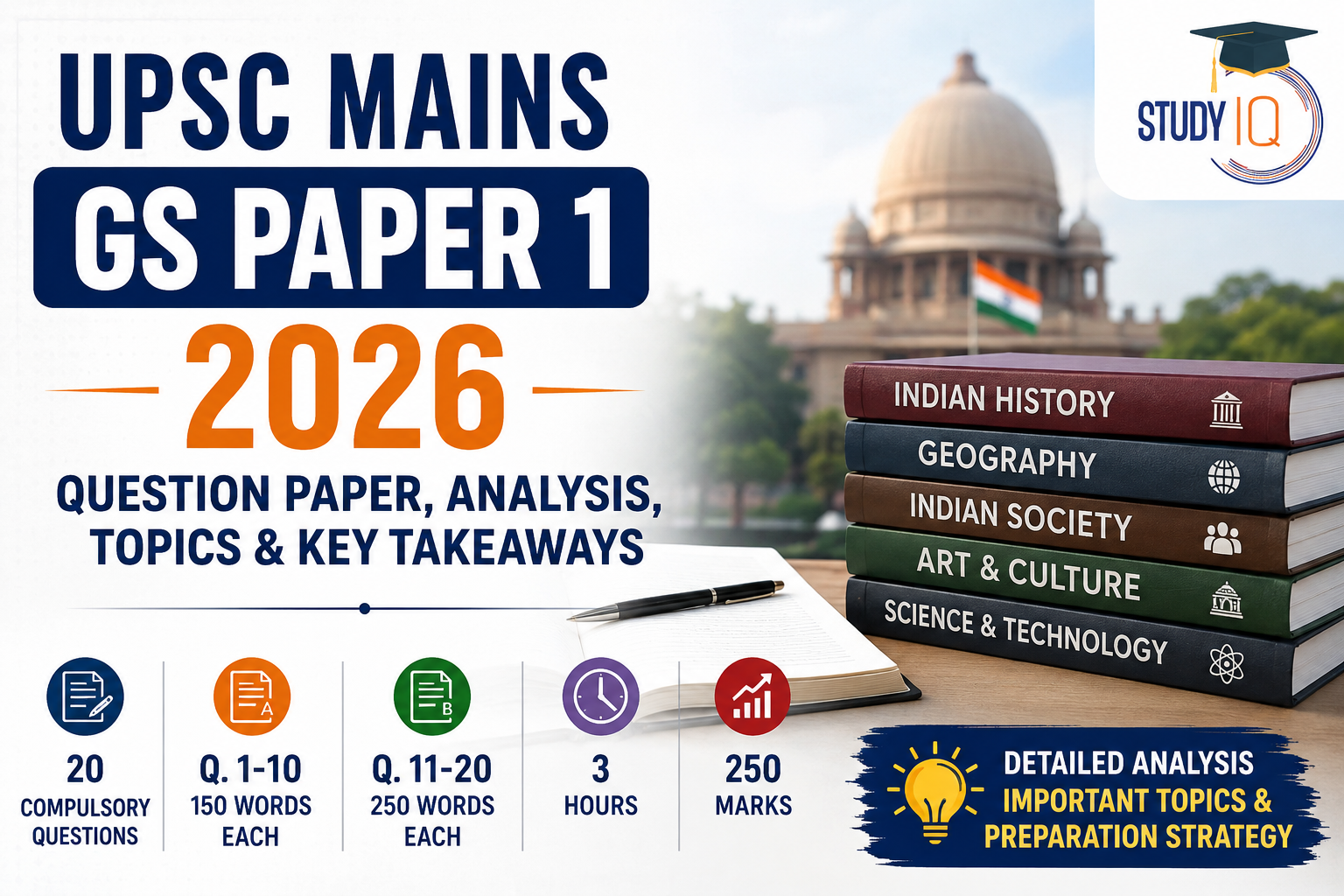
The UPSC Mains GS Paper 1 2026 PDF is now available for aspirants. The paper covers major areas of the General Studies Paper-I syllabus, including Indian History, Art and Culture, Geography, Indian Society, Science and Technology, Economy, Demography and Globalisation.
The paper carries 250 marks and has a total of 20 compulsory questions. Questions 1 to 10 are required to be answered in 150 words, while Questions 11 to 20 require answers in 250 words. The prescribed examination duration is three hours.
This article provides a detailed overview of the UPSC Mains GS Paper 1 2026 questions, important topics, subject-wise coverage and key preparation takeaways.
UPSC Mains GS Paper 1 2026: Highlights
| Particular | Details |
|---|---|
| Exam | UPSC Civil Services Examination |
| Paper | General Studies Paper 1 |
| Total Questions | 20 |
| Maximum Marks | 250 |
| Duration | 3 Hours |
| Questions 1–10 | 150 words each |
| Questions 11–20 | 250 words each |
| Question Type | Analytical/Descriptive |
| Medium | Hindi and English |
The paper instructions state that all 20 questions are compulsory and that candidates must follow the specified word limits.
UPSC Mains GS Paper 1 2026 PDF
The question paper contains 20 questions divided into two sections based on word limits. The first ten questions carry 10 marks each and require 150-word answers, while Questions 11 to 20 carry 15 marks each and require 250-word answers.
Aspirants can use the paper to evaluate their preparation, identify recurring themes and understand the type of analytical questions being asked in GS Paper 1.
UPSC Mains GS Paper 1 2026 Question Paper PDF
UPSC Mains GS Paper 1 2026 Questions
Questions 1 to 10 – 150 Words
The first part of the paper includes questions from History, Geography and Indian Society.
Q1. Analyze the importance of Ashokan inscriptions for reconstructing Mauryan history.
Q2. Discuss the impact of Macaulay’s Minute on colonial administration and education in India.
Q3. Explain the significance of Gandhian movements in terms of the masses they mobilized.
Q4. What is the Fujiwhara effect? Explain its impact on the movement and intensity of tropical cyclones.
Q5. Critically examine the statement: “Tundra regions are ecologically fragile but economically important.”
Q6. Discuss the role of aeolian processes in desertification and land degradation.
Q7. Examine the statement: “Water resources are both an asset and a source of conflict in South Asia.”
Q8. Comment on how unity in diversity remains a defining feature of Indian society despite challenges from communalism and regionalism.
Q9. Explain disability and substantiate the need for an inclusive policy framework in India.
Q10. Explain whether digital technology promotes social empowerment, with suitable examples.
Questions 11 to 20 – 250 Words
The second half of the paper contains 15-mark questions requiring more detailed and multidimensional answers.
Q11. Vijayanagara architecture and its amalgamation of past traditions with contemporary practices.
Q12. Linguistic reorganisation of Indian States and the role of popular pressure from below.
Q13. Planned economy in India and its role in addressing regional imbalances inherited from colonial rule.
Q14. Comparison of Loo, Chinook and Foehn winds with respect to their regions, nature and climatic impacts.
Q15. Role of satellite-based technologies in climate-smart agriculture and food security in India.
Q16. Whether the centre of global trade is shifting from the Atlantic region towards the Indo-Pacific.
Q17. Major drivers of human-induced land-use changes in India and their geographical consequences.
Q18. Whether caste is disappearing in urban India, with examples.
Q19. Challenges of demographic transition in contemporary India.
Q20. Impact of globalisation on Indian youth in social, political, economic and cultural spheres.
UPSC Mains GS Paper 1 2026 Subject-Wise Analysis
History
History continues to occupy an important position in the paper. Questions have been asked on Ashokan inscriptions, Mauryan history, Macaulay’s Minute, Gandhian movements and planned economy.
The questions do not merely demand factual information. They require candidates to establish relationships between historical events, institutions and their wider consequences.
Art and Culture
The Art and Culture component includes a question on Vijayanagara architecture.
The question asks candidates to explain how Vijayanagara architecture represents an amalgamation of earlier traditions and contemporary practices. This requires discussion of architectural features along with suitable examples.
Geography
Geography has substantial representation in the paper.
Important areas include:
- Fujiwhara effect
- Tropical cyclones
- Tundra regions
- Aeolian processes
- Desertification
- Land degradation
- Water resources
- Loo, Chinook and Foehn winds
- Land-use change
- Indo-Pacific trade
- Satellite technology and agriculture
The questions demonstrate the importance of conceptual geography combined with real-world examples.
Indian Society
Indian Society is covered through questions on:
- Unity in diversity
- Communalism
- Regionalism
- Disability and inclusion
- Digital technology
- Caste in urban India
- Demographic transition
- Globalisation and youth
These questions require candidates to understand social issues from multiple perspectives rather than providing purely descriptive answers.
Science and Technology
The question on satellite-based technologies in climate-smart agriculture is particularly important.
It connects Science and Technology with:
Space Technology + Agriculture + Climate Change + Food Security
The question therefore highlights the importance of integrating current technological developments with traditional GS subjects.
Key Themes in UPSC Mains GS Paper 1 2026
Several broad themes emerge from the paper.
1. Interdisciplinary Questions
The paper combines multiple subjects in several questions. For example, satellite technology is connected with agriculture, climate change and food security.
2. Analytical Approach
The paper uses directives such as analyze, discuss, examine, critically examine, comment and evaluate.
Aspirants therefore need to understand the exact demand of the directive before beginning an answer.
3. Static and Applied Knowledge
Many questions are based on static concepts but require candidates to apply them to broader geographical, social or economic contexts.
4. Contemporary Examples
Questions on digital technology, demographic transition, global trade, land-use change and climate-smart agriculture provide significant scope for incorporating contemporary examples.
UPSC Mains GS Paper 1 2026 Difficulty Level
The paper has a strong conceptual and analytical orientation. Instead of simply asking candidates to define concepts, several questions require explanation of causes, consequences, significance and contemporary relevance.
For example, the question on the Fujiwhara effect requires understanding of cyclone interaction, while the question on land-use change requires analysis of both drivers and geographical consequences.
Similarly, the question on caste in urban India requires candidates to examine whether urbanisation has actually weakened caste identities, rather than simply describing the caste system.
 UPSC Mains Directive Words 2010–2026: ...
 UPSC NDA 2 Result 2026 Out: Download Mer...
 UPSC EPFO Previous Year Question Papers ...







 WhatsApp





