Table of Contents
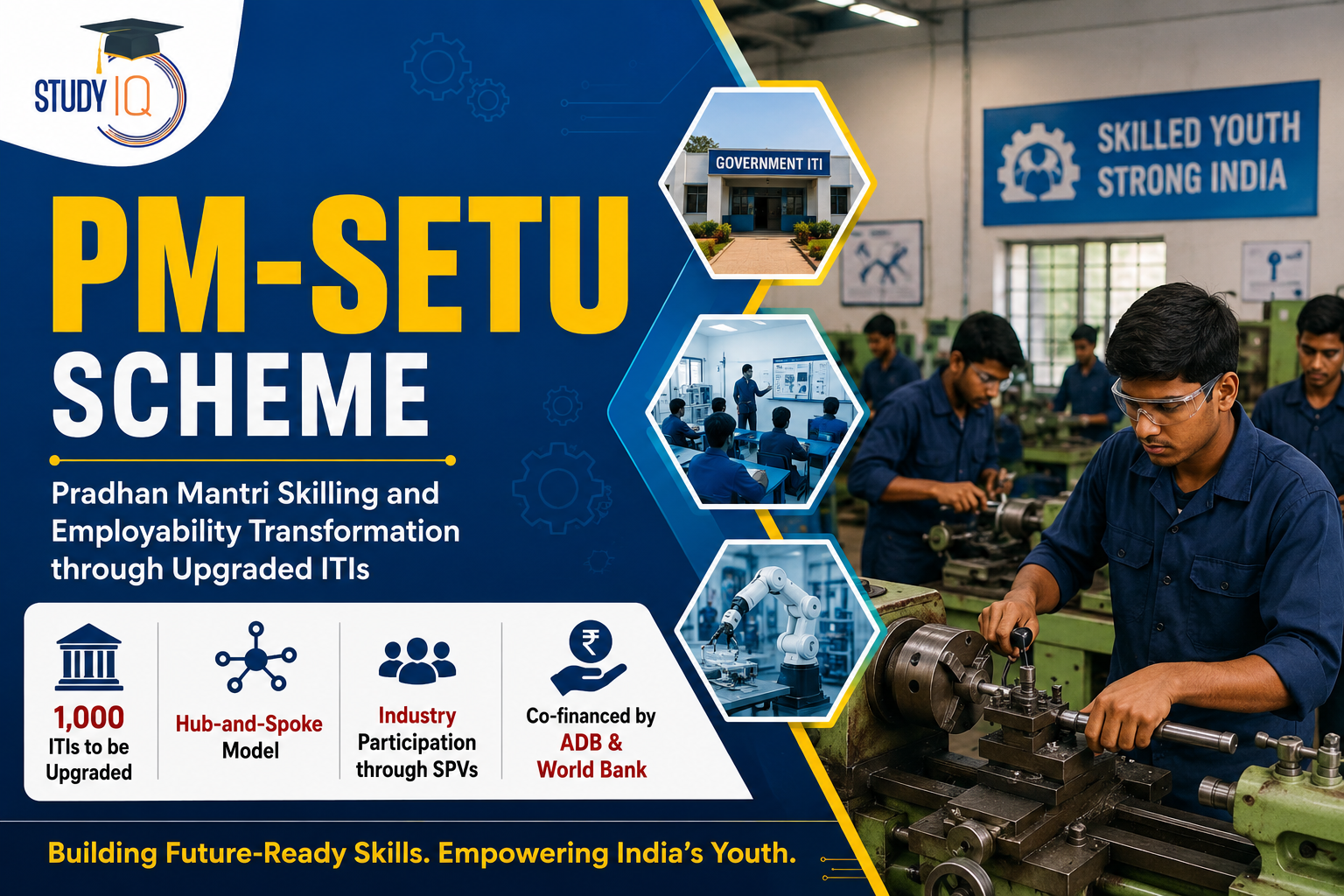
The Union Government has approved the nationwide rollout of the Pradhan Mantri Skilling and Employability Transformation through Upgraded ITIs (PM-SETU) Scheme, a landmark initiative aimed at transforming India’s vocational education ecosystem. The scheme focuses on upgrading 1,000 Government Industrial Training Institutes (ITIs) into modern, industry-aligned skill development centres that can equip youth with skills required for emerging technologies and future job markets.
The initiative aligns with the government’s vision of strengthening India’s skilled workforce under the broader goals of Skill India Mission and Viksit Bharat 2047.
What is the PM-SETU Scheme?
The Pradhan Mantri Skilling and Employability Transformation through Upgraded ITIs (PM-SETU) is a Centrally Sponsored Scheme (CSS) launched by the Ministry of Skill Development and Entrepreneurship (MSDE) in 2025.
The scheme seeks to modernize Government ITIs by improving infrastructure, introducing industry-relevant courses, enhancing faculty capabilities, and strengthening partnerships with industries.
PM-SETU Scheme Overview
| Particulars | Details |
|---|---|
| Scheme Name | Pradhan Mantri Skilling and Employability Transformation through Upgraded ITIs (PM-SETU) |
| Launch Year | 2025 |
| Ministry | Ministry of Skill Development and Entrepreneurship (MSDE) |
| Scheme Type | Centrally Sponsored Scheme |
| Objective | Modernization of Government ITIs for industry-ready skill development |
| Coverage | 1,000 Government ITIs |
| Model | Hub-and-Spoke Model |
| Financial Support | Government of India, Asian Development Bank (ADB), World Bank |
Objectives of PM-SETU Scheme
The major objectives of the PM-SETU Scheme include:
- Upgrade Government ITIs into world-class skill development institutions.
- Improve employability of Indian youth through industry-oriented training.
- Bridge the gap between education and industry requirements.
- Promote emerging technology-based vocational education.
- Strengthen collaboration between industries and training institutions.
- Improve placement opportunities for students.
- Develop a future-ready skilled workforce to support India’s economic growth.
Key Features of PM-SETU Scheme
Modernization of 1,000 Government ITIs
The scheme will upgrade 1,000 Government Industrial Training Institutes with modern infrastructure, advanced laboratories, digital classrooms, smart workshops, and industry-standard equipment.
Hub-and-Spoke Model
PM-SETU adopts a Hub-and-Spoke model, comprising:
- 200 Hub ITIs
- 800 Spoke ITIs
Under this arrangement, Hub ITIs will function as centres of excellence by providing advanced infrastructure, faculty training, curriculum support, and resource sharing to nearby Spoke ITIs.
Industry Participation through SPVs
The scheme provides for the establishment of Special Purpose Vehicles (SPVs) for effective cluster management.
The SPVs will facilitate:
- Industry participation
- Curriculum design
- Apprenticeship promotion
- Placement support
- Local skill planning
Performance-Based Funding
Financial assistance under PM-SETU will be linked to institutional performance indicators such as:
- Student enrolment
- Placement rates
- Industry partnerships
- Infrastructure development
- Training quality
This approach aims to improve accountability and ensure better outcomes.
International Financial Support
The scheme receives co-financing from:
- Asian Development Bank (ADB)
- World Bank
This international support will help strengthen institutional capacity, infrastructure, and quality assurance mechanisms.
Benefits of PM-SETU Scheme
The scheme is expected to generate multiple benefits for India’s vocational education ecosystem:
- Improved quality of technical education.
- Better employment opportunities for ITI graduates.
- Enhanced industry-academia collaboration.
- Modern skill training aligned with Industry 4.0.
- Increased apprenticeship opportunities.
- Stronger regional skill development clusters.
- Higher productivity and competitiveness of the workforce.
Significance of PM-SETU Scheme
India has one of the world’s largest youth populations, making skill development essential for economic growth. However, many Government ITIs require modernization to meet changing industrial demands.
PM-SETU addresses this challenge by:
- Upgrading outdated training infrastructure.
- Promoting technology-driven vocational education.
- Encouraging industry-led curriculum development.
- Creating a skilled workforce capable of supporting sectors such as manufacturing, renewable energy, electronics, AI, robotics, and advanced engineering.
The scheme also supports national initiatives like Make in India, Digital India, Atmanirbhar Bharat, and the Skill India Mission.
Challenges in Implementation
Despite its ambitious vision, effective implementation will require addressing several challenges:
- Ensuring adequate industry participation.
- Training faculty in emerging technologies.
- Maintaining quality standards across all ITIs.
- Effective monitoring of SPVs.
- Timely fund utilization.
- Continuous curriculum updates to match industry needs.
Way Forward
The successful implementation of PM-SETU will depend on strong coordination between the Central Government, State Governments, industries, financial institutions, and training providers.
Continuous monitoring, digital governance, industry-led curriculum reforms, and regular assessment of institutional performance will be critical to achieving the scheme’s objectives. If implemented effectively, PM-SETU can significantly enhance India’s skill ecosystem and contribute to building a globally competitive workforce.
PM-SETU Scheme UPSC Relevance
Prelims
- PM-SETU Scheme
- Ministry of Skill Development and Entrepreneurship
- Centrally Sponsored Scheme
- Hub-and-Spoke Model
- Asian Development Bank (ADB)
- World Bank
- Industrial Training Institutes (ITIs)
 Circular Economy in India: Benefits, Cha...
 EPFO Wage Ceiling Hike 2026: Social Secu...
 Daily Mains Articles 2026 – Updated Da...














 WhatsApp