
Table of Contents
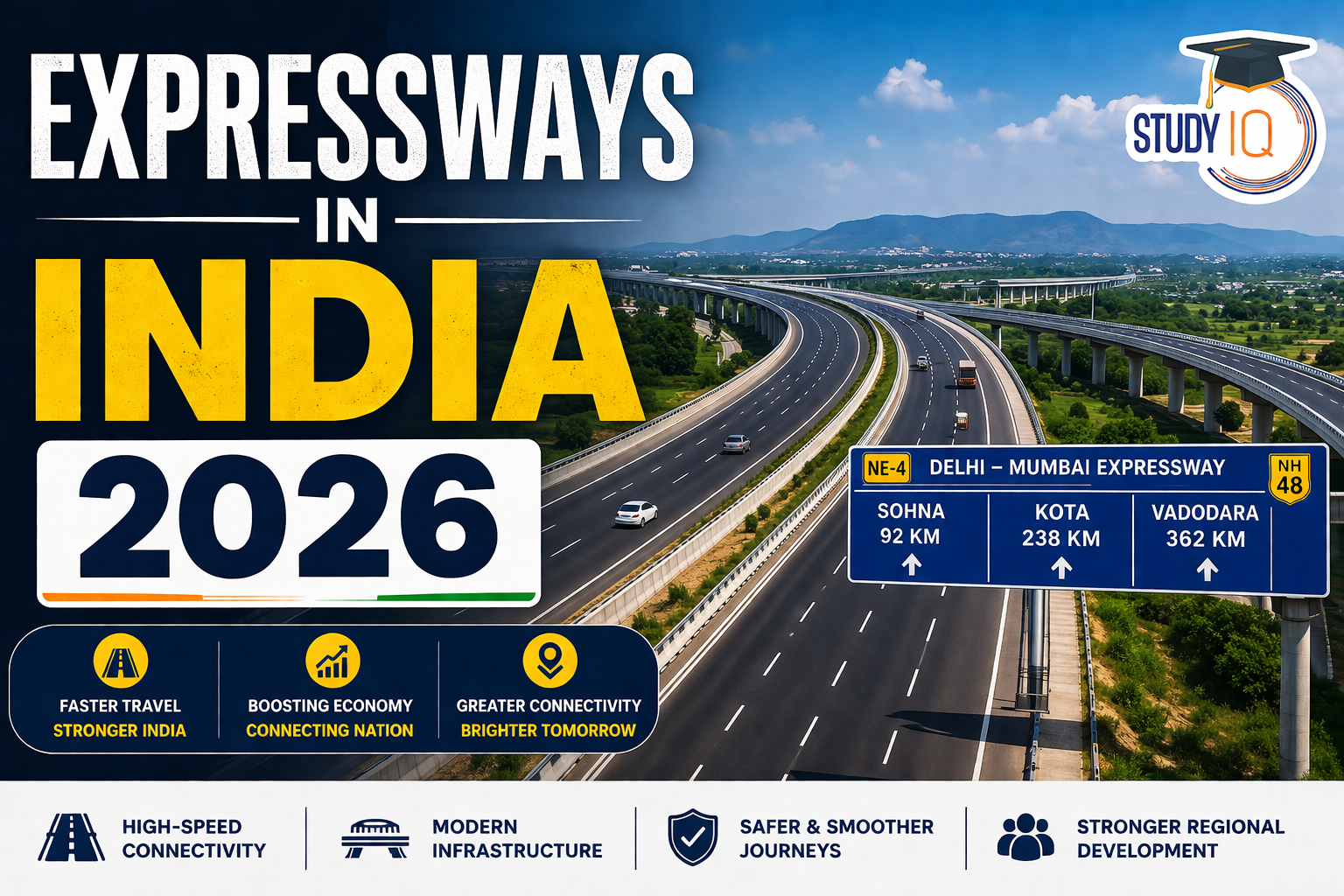
India is on the move — literally. From the sun-baked plains of Rajasthan to the coastal corridors of Maharashtra, a new generation of expressways is transforming how 1.4 billion people travel, commute, and do business. Whether you’re a daily commuter, a real estate investor, a logistics professional, or just a curious citizen, understanding India’s expressway network in 2026 is more relevant than ever.
In this comprehensive guide, we cover:
- Complete list of expressways in India (operational & under construction)
- Longest, widest, and newest expressways in 2026
- India vs China expressway comparison
- Future roadmap under Bharatmala & Vision 2047
UPSC Daily Current Affairs 2026
What Is an Expressway? (Expressway vs Highway Explained)
Before diving into the list, let’s clear up a common confusion: What’s the difference between a highway and an expressway?
| Feature | Expressway | National Highway |
|---|---|---|
| Access Control | Fully controlled | Partial/Open |
| Entry/Exit Points | Grade-separated only | Multiple intersections |
| Speed Limit | Up to 120 km/h | 80–100 km/h |
| Traffic Mix | Motor vehicles only | Mixed (local + commercial) |
| Toll | Yes (mostly) | Varies |
Expressways are India’s highest class of road infrastructure — fully access-controlled, divided carriageway highways built for high-speed, high-volume traffic. They have no traffic signals, no at-grade crossings, and no pedestrians. Think of them as India’s answer to Germany’s Autobahn.
Expressways in India 2026: Key Stats at a Glance
Total Operational Expressway Length: ~6,059 km (as of December 2024) Under Construction: 11,127+ km Longest Expressway: Delhi–Mumbai Expressway (~1,350 km, partially open) Widest Expressway: Dwarka Expressway (16 lanes) First Expressway: Mumbai–Pune Expressway (fully open since 2002) State with Most Expressways: Uttar Pradesh (13+ expressways)
India’s expressway network has grown dramatically under the Bharatmala Pariyojana and NHAI (National Highways Authority of India), with the government’s ambitious Vision 2047 targeting up to 50,000 km of access-controlled highways.
Complete List of Major Operational Expressways in India (2026)
Top 10 Longest Expressways in India
| # | Expressway Name | Length | States Covered | Lanes |
|---|---|---|---|---|
| 1 | Delhi–Mumbai Expressway (NE-4) | 1,350 km | Delhi, Haryana, Rajasthan, MP, Gujarat, Maharashtra | 8 (expandable to 12) |
| 2 | Mumbai–Nagpur Expressway (Samruddhi Mahamarg) | 701 km | Maharashtra | 6 |
| 3 | Purvanchal Expressway | 340.8 km | Uttar Pradesh | 6 (expandable to 8) |
| 4 | Bundelkhand Expressway | 296 km | Uttar Pradesh | 4 (expandable to 6) |
| 5 | Agra–Lucknow Expressway | 302 km | Uttar Pradesh | 6 |
| 6 | Ganga Expressway | 594 km | Uttar Pradesh | 6 (expandable to 8) |
| 7 | Yamuna Expressway | 165 km | Uttar Pradesh | 6 |
| 8 | Delhi–Meerut Expressway | 96 km | Delhi, UP | 6–14 |
| 9 | Mumbai–Pune Expressway | 94.5 km | Maharashtra | 6 |
| 10 | Ahmedabad–Vadodara Expressway (NE-1) | 95 km | Gujarat | 6 |
Other Notable Operational Expressways
- Dwarka Expressway (29 km) – Delhi/Haryana | India’s widest at 16 lanes
- Eastern Peripheral Expressway (135 km) – Uttar Pradesh/Haryana
- Western Peripheral Expressway (135 km) – Haryana
- Jaipur–Kishangarh Expressway (90 km) – Rajasthan
- Hyderabad Outer Ring Road (158 km) – Telangana
- Bangalore–Mysore Expressway (117.5 km) – Karnataka
- Chennai Peripheral Ring Road (127 km) – Tamil Nadu
- Gorakhpur Link Expressway (91 km) – Uttar Pradesh
Under-Construction Expressways in India (2026 Update)
These mega projects are shaping India’s connectivity future:
1. Delhi–Mumbai Expressway (full completion ~2026–27) At 1,350 km and ₹1,00,000 crore, this is India’s most ambitious road project. Partially opened in phases since 2023, it will cut Delhi–Mumbai travel time from ~24 hours to just 12 hours when fully complete.
2. Amritsar–Jamnagar Expressway (1,257 km) Connecting Punjab to Gujarat, this corridor links oil refineries, ports, and industrial zones across Rajasthan and Gujarat. Most civil works were reported complete as of April 2025.
3. Delhi–Amritsar–Katra Expressway A strategically important corridor linking Delhi to the Vaishno Devi shrine, incorporating tunnel sections through challenging Himalayan terrain.
4. Surat–Chennai Expressway (~1,270 km) One of India’s longest planned expressways, running along the western and eastern coasts.
5. Kanpur–Lucknow Expressway (63 km) A bypass corridor in UP that relieves congestion on the traditional NH-25 route — construction reported complete as of late 2025.
Spotlight: Uttar Pradesh — India’s Expressway Capital
Uttar Pradesh leads India with 13+ expressways, more than any other state. Key drivers include UPEIDA (Uttar Pradesh Expressways Industrial Development Authority), which developed:
- Yamuna Expressway (2012)
- Agra–Lucknow Expressway (2016)
- Bundelkhand Expressway (2022) — India’s first solar expressway
- Purvanchal Expressway (2021) — features a 3.2 km airstrip for emergency military landings
India vs China: Expressway Network Comparison 2026
This is the question everyone’s asking: How does India compare to China on expressways?
The Numbers Don’t Lie
| Parameter | India | China |
|---|---|---|
| Total Expressway Length | ~6,059 km (operational) | ~180,000 km |
| Daily Road Construction | ~31 km/day | 10–15 km/machine/day |
| Highway Build Target (2025–26) | 10,000 km | 30,000 km (5-year plan) |
| Rural Road Repair Target | In progress | 105,000 km by 2025 |
| Vision/Target | 50,000 km by 2047 | Already world’s largest network |
Key Differences: Why China Is Ahead
Scale of Investment: China has historically invested about ten times more in its highway network than India. While India focused its early efforts on connecting its four biggest metros (the Golden Quadrilateral — Delhi, Mumbai, Chennai, Kolkata), China’s National Expressway Network (NEN) was designed to connect every city with a population above 500,000, creating a far denser web of connectivity.
Speed of Construction: China’s specialized road-laying machines can pave 10–19 km in a single 24-hour period, while India’s average is around 31 km per day nationally (across all highway types). China’s tunnel boring machines advance 50 meters per day, slashing project timelines by up to 18 months. India, in contrast, still relies more heavily on manual labour and faces civic and land acquisition hurdles.
Travel Time Reality Check: Travelling from Beijing to Shanghai (1,213 km) takes roughly 12.5 hours by road. The equivalent Delhi–Mumbai stretch (1,414 km) takes around 22.5 hours today — nearly double the time for a similar distance. That gap is exactly what India’s current expressway boom aims to close.
Network Density: China’s expressways make up 2–3% of its total road network. India’s expressways are less than 0.1% of its 6.6 million km road network — though that number is changing fast.
India’s Strengths: Catching Up Rapidly
India is not standing still. With Bharatmala Pariyojana, NHAI, and state-level authorities like UPEIDA and MSRDC in overdrive, India’s under-construction expressway pipeline of 11,127+ km is among the largest in the world. Vision 2047 envisions every Indian living within 100–125 km of an expressway — a transformational goal.
India also brings unique innovations: solar expressways (Bundelkhand), emergency military airstrips embedded in highways (Purvanchal), and EV charging infrastructure being added to Wayside Amenity zones across NHAI projects.
Frequently Asked Questions (FAQs)
Q1. How many expressways are there in India in 2026? India has approximately 44+ operational expressways with over 6,059 km of total expressway length as of late 2024, and more opening in phases through 2026.
Q2. What is the longest expressway in India? The Delhi–Mumbai Expressway at 1,350 km is India’s longest expressway, currently partially operational with full completion expected by 2026–27.
Q3. Which state has the most expressways in India? Uttar Pradesh leads with 13+ expressways, including the Yamuna, Purvanchal, Agra–Lucknow, Bundelkhand, Ganga, and Gorakhpur Link Expressways.
Q4. What is India’s first expressway? The Mumbai–Pune Expressway, which became fully operational in April 2002, is India’s first inter-city tolled expressway.
Q5. How does India’s expressway network compare to China’s? China has approximately 180,000 km of expressways — the world’s largest network — compared to India’s ~6,059 km operational. However, India has 11,000+ km under construction and a Vision 2047 target of 50,000 km.
Conclusion
India’s expressway story is one of ambition meeting execution. From a mere handful of operational expressways a decade ago to a rapidly expanding 6,000+ km network, with tens of thousands more under construction, the country is fundamentally rewiring its economic geography.
Yes, China is far ahead in scale. But India’s trajectory is steep, its projects are increasingly world-class, and the political will — backed by Bharatmala, NHAI, and state authorities, has never been stronger. By 2030, India’s expressway network is set to be unrecognizable compared to today.
 Daily Current Affairs PDF 2026: Download...
 Asian Elephant: Population, Project Elep...
 International Day for South-South Cooper...













 WhatsApp





